Visa
About Angarsk State Technical Academy
The academy name and today’s university
Angarsk State Technical Academy is a former name of the institution now officially called Angarsk State Technical University, or AngTU, in Angarsk, Irkutsk Oblast, Russia. The university’s institutional information gives an explicit sequence of reorganizations. In 1991, an Angarsk factory-based higher-education branch of Irkutsk Polytechnic Institute was transformed into Angarsk Technological Institute. It became Angarsk State Technological Institute in 1997 and Angarsk State Technical Academy in October 2000. A Ministry of Education and Science order dated 21 October 2015 renamed the academy Angarsk State Technical University. This directory record therefore preserves an earlier institutional name while describing the continuing university. The official information identifies it as a federal state budgetary higher-education institution and lists its principal address in Angarsk’s quarter 85a. It also lists educational locations elsewhere in the city, including the Maisk district.
Sources: The academy name and today’s university ↗
Teaching buildings and campus organization
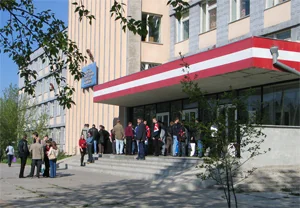
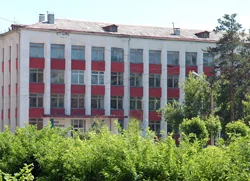
The university’s building directory describes a network of premises within Angarsk. Building One is at quarter 85a, number 5. Its listed units include the rectorate, faculty administration, academic departments, the library, information and computing services, and the editorial and publishing office. Building Two is at quarter 72, number 19, and accommodates the technological faculty and the centre for professional development and retraining. Its department listings include chemical technology and transport-related teaching. A third teaching-and-laboratory building is identified on Partizanskaya Street in Maisk, with environmental-project services among its units. These descriptions show how educational and supporting functions are distributed between buildings. The directory also provides the locations of university services rather than treating the institution as a single classroom block. Photographs published alongside the directory show the entrances and exteriors of the first two buildings.
Sources: Teaching buildings and campus organization ↗
Scientific library and organized collections
The university library dates its establishment to 1960. Its collections developed through the institution’s factory-based and academy stages, and its current description includes scientific, technical, literary and educational materials. Works produced by university staff sit alongside teaching manuals, periodicals and publications by Russian and international authors. Library organization includes a unit responsible for acquiring materials, their scholarly processing and the catalogues. A second unit manages service and storage, including textbook lending, student and teacher reading rooms, electronic-information facilities and fiction lending. Reference, bibliographic, information and methodological work forms a further part of the structure. This arrangement connects the management of collections with the different ways readers use them. The library’s published framework also includes regulations covering collection development, electronic records of course-literature provision and the use of its electronic-information room.
Chemical technology and industrial learning
The Department of Chemical Technology of Fuels traces its formation to 1990, drawing on teachers and specialists from the Angarsk branch of Irkutsk Polytechnic Institute. Its educational description covers chemical technology at undergraduate, master’s and postgraduate levels, including natural energy resources, carbon materials, organic synthesis, and chemical-process equipment. The department connects theoretical study with industrial practice at regional chemical and petrochemical enterprises. During these placements, students study equipment, production processes, economics, safety and the organization of work. Information gathered in practical training can support course projects and final qualifying work. The department also describes teaching and research laboratories, staff publications and opportunities for students to participate in research and conferences. Its account places laboratory instruction and workplace learning within the same educational approach, with industrial specialists contributing to the examination and discussion of final student projects. The regional enterprises named in its account include Angarsk Petrochemical Company, Sayanskkhimplast and the Angarsk Polymer Plant.
Environmental projects and applied expertise
Environmental-project work is another aspect of the university’s applied activity. The environmental-design department states that it has operated at Angarsk since 2003. Its published services concern environmental documentation and the assessment and management of industrial impacts. These include inventories of air-pollution sources, permissible-emission documentation, plans for reducing emissions during adverse weather conditions, waste-related projects and sanitary-protection-zone documentation. The department also identifies environmental monitoring programmes, reporting and population-health risk assessment among its areas of work. Its description refers to projects for enterprises in sectors such as energy, aluminium, mining, pulp production, oil refining, timber processing, construction, agriculture and transport. This is a description of institutional technical services rather than a guarantee of any particular environmental result. It illustrates how the university combines education with practical expertise used by organizations outside the classroom.
Accessibility and support for participation
The university’s accessibility information describes measures intended to support students with disabilities and health-related limitations. It refers to a 2026 programme of cooperation with the resource and methodological centre at Novosibirsk State Technical University. The listed physical provisions include a lifting device, ramps, handrails, accessible entrances and wider doors in adapted teaching and service areas. The page also identifies library, dining, health-support and sports facilities within its accessibility arrangements. Information and teaching equipment includes multimedia resources, office equipment and projection systems. Staff and group tutors are described as receiving preparation for work with students who require additional support. Responsibilities are identified for adapted physical education, psychological and pedagogical assistance, volunteer support and educational guidance. These provisions give an account of the university’s stated support structure without implying that every building or service has identical accessibility features.