Visa

About Andhra Kesari University
A university in Ongole
Andhra Kesari University is a state university in Ongole, in the Prakasam district of Andhra Pradesh, India. It developed from the Acharya Nagarjuna University Post-Graduation Centre established in Ongole in 1993. Its name honours Tanguturi Prakasam Pantulu, the former Chief Minister of Andhra State who was known as Andhra Kesari. The creation of a university in the district continued the work of that earlier postgraduate centre.
The institution's account of its University College identifies teaching in history, economics, social work, education, commerce, business administration, mathematics, statistics and physical education. These subjects formed its original academic base. Physical education included both bachelor's and master's study, while the other listed provision was at postgraduate level. The university's local educational role therefore grew from an established centre with a combination of social science, quantitative, professional and education-related disciplines.
Sources: About Andhra Kesari University ↗
The transition to university status
The Andhra Pradesh Universities Amendment Act of 2021 added Andhra Kesari University to the state's university legislation. The published gazette identifies Ongole as its location and Prakasam as its district. A subsequent government notification appointed 11 January 2022 as the date on which the amendment's provisions came into force.
This distinction between the legislation and its commencement is part of the institution's foundation. The university continued the educational lineage of the Ongole postgraduate centre while taking its place as a named university in the state's legal framework. The official act and commencement notification document that transition separately from later appointments and academic expansion.
Sources: Andhra Pradesh Universities Amendment Act 2021 and commencement notification ↗
Educational purpose and local identity
The university's vision connects higher education with the development of knowledge, skills, conduct and character. Teacher education has a prominent place in its stated educational aims. Its mission also emphasises continued learning, research, extension activity and engagement with communities at local, national and international levels. These are the aspirations through which the university presents its contribution to education and public life.
Its emblem expresses both regional identity and wider educational ideas. The university name appears in English and Telugu. An open book represents knowledge, while a gear wheel is associated with scientific and technical education. The sun, globe and nib add further references to learning and intellectual development. Ongole bulls connect the design with a cattle breed associated with the district and are presented as a symbol of perseverance. Blue and white are associated with education, empowerment, peace and purity.
Sources: Vision, mission and emblem ↗
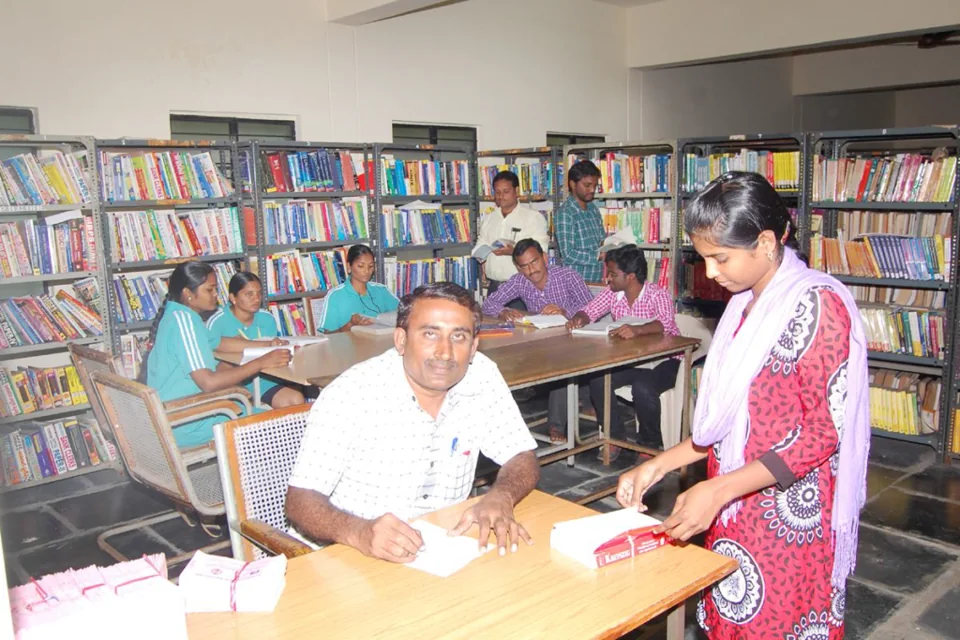
A library inherited from the postgraduate centre
The university library traces its establishment to 11 January 2022, when the earlier postgraduate centre became Andhra Kesari University. Its founding collection came from the Acharya Nagarjuna University P.G. Centre library. The library's account records 8,613 documents at that point, providing continuity between the older centre and the new university.
Membership is available to students, teachers and other university staff. Its published rules describe borrowing through individual reader tickets and the care and return of books and periodicals. Readers use a property counter for bags and other belongings, and the reading areas are intended to remain quiet. The library also provides a photocopy service for students and teachers using its materials. These services place the collection alongside regular study, reference and borrowing activities, supporting the academic community established around the university.
Sources: University library ↗
A broad syllabus catalogue
The university publishes a syllabus catalogue organised into science, arts and professional groups, with separate academic-year entries. Its 2025–26 science listings include mathematics, chemistry, botany, zoology, aquaculture, computer science and physics. The arts group includes Telugu, history, economics, social work, commerce, physical education and education.
The professional section includes business administration, computer applications, physical education, law, teacher education and pharmacy-related curricula. The catalogue preserves entries for 2023–24 and 2024–25 alongside 2025–26 documents, allowing the academic-year framework of a syllabus to be identified. It also includes additional subject documents such as organic chemistry, analytical chemistry, environmental science and technology, English, and different commerce programmes. This published curriculum resource covers a wider range of subjects than the university's account of its original University College provision. It provides an organised route to subject syllabuses and their relevant year rather than a single undifferentiated course list.
Study across disciplines
The multidisciplinary framework sets out a first-semester choice across six subjects. These are Indian history, introductory social work, biological sciences, chemical sciences, physical sciences and psychology. Students select one course from the semester's listed options. The framework also specifies that the choice should not repeat a subject already studied at higher-secondary level or duplicate the student's major discipline.
This arrangement creates a defined opportunity to encounter another field within the curriculum. The published page links the individual subject documents and states that no multidisciplinary course is offered in the second semester. Its structure combines a limited set of introductory choices with a rule intended to keep the selection distinct from prior study and the student's main academic specialism.
Sources: Multidisciplinary course framework ↗
Research preparation in commerce and management
The Department of Commerce and Management's PhD Part I curriculum, effective from 2024–25, combines research methodology, data analysis, a chosen specialisation and a seminar. Research-methodology topics include defining a research problem, reviewing literature, developing hypotheses, designing investigations, sampling, collecting data and writing reports.
The data-analysis paper introduces statistical ideas alongside practical tools. Its listed topics include probability, estimation, hypothesis testing, regression and visualisation, with work involving Excel, Tableau and R. The specialisation choices span marketing, international business, human resources, management processes, finance, the Indian business environment, cooperation, electronic commerce, organisational behaviour and banking. A researcher therefore encounters both common methodological preparation and a more focused area of commerce or management. The seminar adds a further academic component to the formal coursework structure, alongside the written papers.
Sources: Commerce and Management PhD Part I curriculum, effective 2024–25 ↗