Visa

About Ananda Chandra College
Origins in Jalpaiguri
Ananda Chandra College is a higher education institution in Jalpaiguri, West Bengal, whose history begins in 1942. Debendra Kumar Chandra and Tarani Mohan Chakraborty were central to its establishment, with financial support from Nalini Kanta Rahut. The University of Calcutta granted affiliation in May 1942 for intermediate study in arts subjects and mathematics. Classes began on 1 October that year with 62 students in a small building on land donated by the Rahut family in the Race Course area.
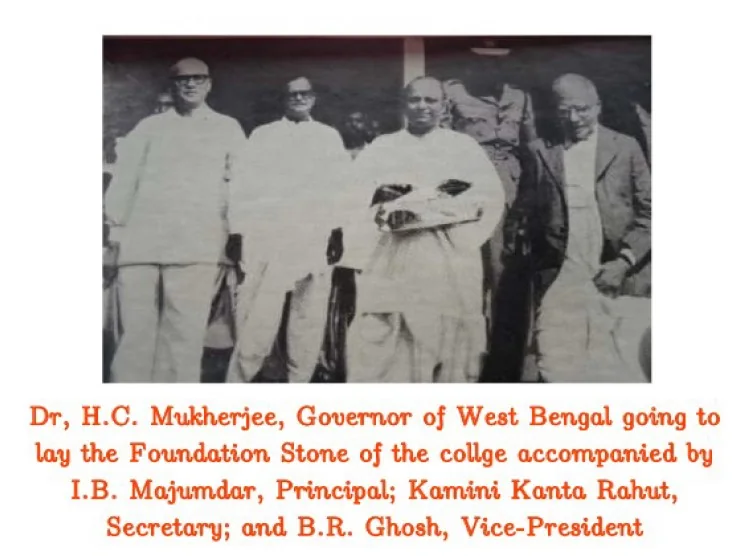
Undergraduate teaching followed in the 1945–46 session. The foundation stone for a new college building was laid on 7 June 1956 by West Bengal Governor H. C. Mukherjee, and the college moved to its present premises in July 1959. Its affiliation transferred from Calcutta to the newly established University of North Bengal in 1962.
Sources: Origins in Jalpaiguri ↗
Academic identity and development
The college describes itself as a government-sponsored institution affiliated with the University of North Bengal. Its academic identity combines the sciences with humanities and social sciences, reflecting a broader range of study than a single specialist college. The official institutional account also describes a governing body operating within the framework of West Bengal's public instruction administration.
Alongside its general academic provision, the college's account records the introduction of self-financed physical education and microbiology courses in 2003. It also identifies postgraduate Bengali as part of its academic development. These additions show how the institution expanded beyond its earliest intermediate and undergraduate teaching. Located in the sub-Himalayan region of West Bengal, the college places its development within the wider history of higher education in North Bengal and the educational needs of the surrounding population.
Sources: Academic identity and development ↗
Regional purpose and educational aims
The college's published vision relates its educational purpose to the cultural and geographical setting of North Bengal. It describes a region of tea gardens, forests, biodiversity and varied ethnic communities. Its founders' aim was to make higher education accessible within the locality while connecting students with wider academic knowledge and information. The vision gives attention both to local cultural traditions and to intellectual exchange beyond the region.
Its mission emphasises crossing social, economic, ethnic and language barriers in education. It also describes a learning environment supportive of women and encourages participation in cultural activity, sport, quizzes, debates and elocution alongside academic study. Social welfare and sustainable development appear among its stated concerns. The Internal Quality Assurance Cell is identified as the body overseeing educational quality enhancement within this institutional framework.
Laboratories, library and shared facilities
The college's facilities policy describes committee meetings and budget allocation as the means for organising maintenance and improvements. Laboratory, classroom and library resources receive specific attention. Laboratory purchases follow a tender process, practical work is organised in batches and supporting faculty monitor the use of resources. Technicians undertake repairs, calibration and maintenance of more specialised instruments.
For the library, the policy provides for the purchase of new editions and additional books in response to requests. A committee including the principal, librarian and senior faculty reviews the collection and considers its development. Departments submit classroom and infrastructure requirements to the principal, while staff maintain stock registers through physical verification of equipment. The policy also assigns hostel upkeep to superintendents working with hostel committees. Sports take place on a field beside the gymnasium, which is included in the college's maintenance arrangements.
National Service Scheme
Ananda Chandra College identifies two functioning National Service Scheme units connected with the University of North Bengal's programme coordination. The college presents NSS as a voluntary route into community service. Its stated objectives include understanding local communities, identifying their needs, sharing responsibilities, developing civic awareness and encouraging community participation. Leadership, democratic attitudes, social harmony and preparedness for emergencies are also included in the programme's objectives.
Students approach the college's programme officer to enrol. The published structure places a faculty programme officer in charge of organising a unit and implementing its work under the principal's supervision. The page also provides annual reports for the college's units, including reports covering 2023–24 and 2024–25. This gives community service an identifiable organisational setting within college life, with unit leadership, student participation and documented activities.
Sources: National Service Scheme ↗
Mentoring and student guidance
The mentor-mentee programme provides a setting for interaction between students and faculty. Its stated purpose is to support personal, academic and professional development through meaningful connections. Students can raise concerns, seek guidance and discuss goals, while mentors contribute experience, encouragement and direction.
The college explains that these sessions are intended to help students navigate college life, develop confidence and consider their future decisions. Communication, trust and collaboration between teachers and students are central to the programme's objectives. Its published page groups mentoring-session records by academic year, from 2021–22 through 2024–25, and includes a photograph gallery. Mentoring therefore appears as a continuing student-support activity with both an articulated purpose and a record of sessions across several academic years.
Sources: Mentoring and student guidance ↗
Sport within college life
Sport is presented as part of the college's approach to all-round development. The college connects participation with discipline, resilience, leadership and teamwork, and describes support through facilities, coaching and encouragement. Its account of the 2024–25 academic session identifies football, badminton, volleyball, cricket and women's athletics among the areas in which college teams participated in inter-college competition.
The sports page also discusses men's and women's athletics at events involving Jalpaiguri and Alipurduar districts. Together with the college's broader encouragement of extracurricular activity, these disciplines provide opportunities for students to participate in organised physical activity and represent their institution beyond the classroom.
Sources: Sport within college life ↗