Visa
About Anadolu University
A public university in Eskişehir
Anadolu University is a state university in Eskişehir, Türkiye. Its institutional history begins with the Eskişehir Academy of Economic and Commercial Sciences, established in 1958. The academy became Anadolu University in 1982. The university combines education on campus with an extensive open and distance education system, making learning in different settings a central part of its identity.
The university’s institutional overview describes a campus environment that brings study, cultural activity and recreation together. Its main library provides printed and electronic resources and different places for individual work. Theatre, concert and exhibition spaces contribute to the cultural life of the Yunus Emre campus. These facilities complement the university’s academic organization and its role as a centre of learning in the city.
A connected environment for distance study
ANADOLUM e-Campus brings together several parts of the university’s open and distance learning provision. Its official description identifies a learning management system, learner analytics, a live online seminar platform and a mobile application. Rather than treating each tool as an isolated service, the project is designed around connections between modules. The structure also allows modules to be added or removed as requirements change.
Course resources include unit summaries, question-based learning activities, summary videos and exercises. Digital books are offered in several formats alongside other support materials. Students reach their course content through the platform’s My Courses area using institutional authentication. The university presents this environment as a way to strengthen communication, interaction and learner motivation in distance education.
Sources: ANADOLUM e-Campus ↗
Textbooks designed for independent learning
Course books have been part of Anadolu’s distance education system since 1982. Their preparation involves academics, editors, educational technologists, art advisers, language specialists and assessment experts. The university describes this collaboration as a planned approach to helping students study independently, with teaching and presentation considered together.
A change introduced for the 2018–2019 academic year made the books available digitally through e-Campus and ended the routine distribution of free printed copies. The university’s textbook guidance distinguishes the current PDF edition used for assessment from supplementary resources that support learning. It also explains that printed copies can be ordered separately, subject to availability. This arrangement gives course books a continuing role within a wider collection of online learning materials.
Sources: Distance education textbooks ↗
Educational and research priorities
The university’s 2024 policy document sets out commitments covering education, research, public contribution, administration, sustainability, openness, quality and international engagement. Its education policy emphasizes student participation, critical thinking, creativity and responsibility for learning. Digital resources and accessible learning environments are also among its stated priorities.
The research policy supports work across disciplines and links scholarly activity with social and regional needs. Public contribution includes collaboration with public bodies, civil society and businesses. The openness policy describes flexible opportunities for learning throughout life, while the internationalization policy concerns exchange, shared programmes and intercultural experience. These statements express the university’s intended direction; they provide a framework for understanding its activities alongside the specific facilities and learning services described on its website.
Sources: University policies ↗
Contemporary art and a restored building
The Museum of Contemporary Arts connects the university’s collections with the architectural history of its setting. Its building represents the First National Architecture Period and formerly served as barracks and a military training building. Heritage registration was recorded in December 1988. Restoration began in 1998 and took thirty months, including returning the exterior to its yellow and white colours.
The collection developed through Palet Art Gallery, which operated under the Faculty of Fine Arts. Works by Turkish and international artists who exhibited there helped form the university collection. Selections from those holdings subsequently became the museum’s collection. The museum therefore brings together a restored historic structure and artwork accumulated through the university’s own exhibition activity.
Sources: Museum of Contemporary Arts ↗
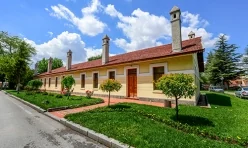
Cartoon art as a subject of study
The Museum of Cartoon Art occupies a former house built in the early twentieth century in Eskişehir’s Odunpazarı district. Its domestic architecture gives the specialist collection a setting associated with the older settlement area of the city. The museum was established by the university’s Research Center for Cartoon Art.
Its facilities include permanent and temporary exhibition galleries, rooms devoted to portraits and cartoonists, a library and areas where artists can work. The museum displays material from its archive alongside works by Turkish and international cartoon artists. Its library also serves research, extending its purpose beyond viewing exhibitions. The published account describes donations of original cartoons and related printed material as a way of developing this specialist resource.
Sources: Museum of Cartoon Art ↗
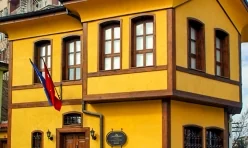
Music, theatre and student participation
The university’s ensemble directory shows several ways in which performance contributes to campus life. The Anadolu Symphony Orchestra developed after the establishment of youth symphony and chamber orchestras. A youth choir brings students together for concerts, while the folk dance ensemble, founded in 1980, introduces students to dance traditions associated with Anatolian culture.
Other groups include Theatre Anadolu and ensembles devoted to Turkish folk and classical music. The theatre company performs at the Atatürk Culture and Arts Center and also undertakes tours. The Turkish folk and classical music ensembles draw participants from different university departments, placing creative activity alongside their main studies. Together, these groups provide a range of settings for rehearsing, presenting performances and engaging with audiences within and beyond the university.
Sources: University performing ensembles ↗
Sport and recreation on campus
Anadolu’s campus facilities include spaces for both organized university sport and recreation. The Çarşı A complex brings together facilities for football, basketball, volleyball and tennis with a gym. A separate football field is used for university team matches and internal tournaments. The sports directory also describes an indoor swimming complex with two pools.
Tennis courts and the Yunus Emre Campus Sports Hall add further options. The hall accommodates basketball, volleyball, table tennis and exercise activities, as well as some concerts and meetings. Access arrangements differ between facilities: the tennis courts, for example, are described as serving university students and staff through reservations. These spaces form another part of the campus environment alongside libraries, museums and performance venues.
Sources: Sports facilities ↗