Visa


About Amur State University
A university in Blagoveshchensk
Amur State University is based in Blagoveshchensk in Russia’s Amur Region. Its current institutional account presents it as a multidisciplinary university with an educational role linked to the region’s economy and social life. The university combines teaching and research with project-based learning, student scientific activity and cultural and sporting opportunities.
The campus account identifies teaching buildings, a swimming pool, an ice arena, a social and cultural centre and a multifunctional sports complex. It also describes student associations and support for young student and staff families. School-level education also forms part of the university’s structure. Its project-oriented model is supported by units concerned with educational practices, innovation, online learning and career development, providing different ways for students to connect academic subjects with practical activity.
Sources: Amur State University: current institutional overview ↗
From a technological institute to a university
The university’s institutional history reaches back to a general technical evening faculty established in Blagoveshchensk in 1961. A separate Blagoveshchensk Technological Institute was formed in March 1975. In December 1992, it was renamed Blagoveshchensk Polytechnic Institute, before receiving the status and name of Amur State University on 19 October 1994.
The published timeline traces the expansion of academic subjects and campus facilities over subsequent decades. It records the development of economics and power engineering, followed by mathematics and informatics, social sciences, philology, international relations and engineering physics. A student social and cultural centre opened in 2006, while a further teaching building entered use in 2011. The timeline also records the opening of a general-education lyceum and swimming-pool complex in 2013, and the formation of an Institute of Computer and Engineering Sciences in 2023.
Sources: Official university history ↗
Research across technical and social fields
The university’s research account places fundamental inquiry, applied research and the use of scientific developments in teaching within its educational strategy. Its listed research priorities range from mathematical modelling and information technologies to functional materials, energy efficiency and environmental management. Other areas address the peoples and religions of the Far East, relations with Asia-Pacific countries, financial and social systems, continuing education and linguistics in the Amur region.
Research is supported by laboratories, research centres, a museum complex and a technology and innovation support centre. Student design bureaus and a student business incubator also appear in the institutional account. The university identifies a Scientific and Technical Council and a Council of Young Scientists among its collegial bodies. This combination of subjects and organisational structures connects the university’s technical traditions with research on society, language, education and the regional environment.
Sources: Research at Amur State University ↗
International academic cooperation
The International Affairs Office traces the development of the university’s international administration to 1993. Its stated activities include developing joint academic and scientific projects, organising international events, supporting academic exchanges and maintaining relationships with overseas universities. It also works with courses for international students and collaboration involving educational, scientific and business organisations.
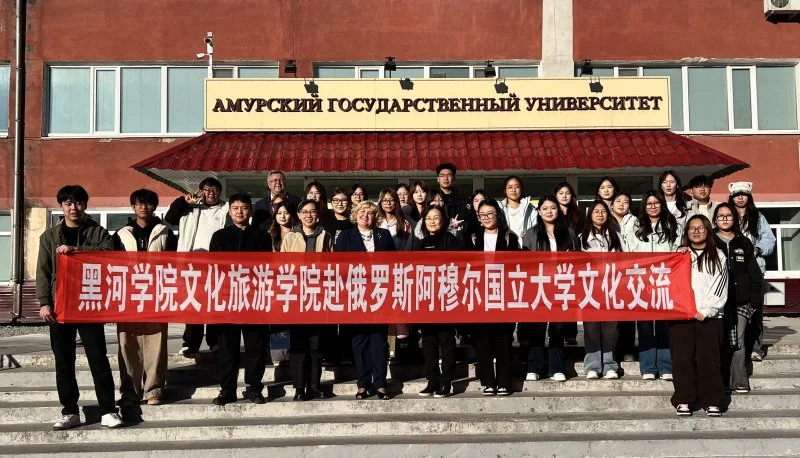
The office’s account identifies China as a particular focus because of Blagoveshchensk’s geographical position. Its partner examples include universities in Beijing, Harbin and Heihe, covering technical education, economics and other areas. The institution also records participation in associations linking Russian and Chinese universities. These relationships form a setting for both formal academic cooperation and direct contact between students and teachers, as illustrated by the university’s reports on educational visits and joint activities.
Sources: International Affairs Office ↗
Digital and distance-learning provision
Amur State University’s distance-learning page describes the use of electronic education at several levels, including general education, vocational programmes, higher education and continuing professional education. It provides a route to Moodle and to the university’s online courses. The stated approach involves developing educational programmes and the local organisational and methodological arrangements needed to support them.
The university describes cooperation with other Russian universities as a way to share teaching, research and management practices in online education. Its objectives include widening the range of courses available to students, supporting flexible study planning and enabling online-course results to be considered within main study programmes. The account also connects digital learning with updating course content and offering more individual educational pathways. These are presented as educational development objectives rather than a single separate online qualification.
Sources: Distance and online learning ↗
Tourism students learning across cultures
An October 2026 university report describes a Student Bridge Russia–China project involving its Department of International Business and Tourism and students and faculty from Heihe University. The programme combined discussion of educational cooperation with cultural visits and direct interaction between students studying tourism.
Visitors explored the House of Russian-Chinese Friendship, local museums and city attractions. Interactive activities included culinary masterclasses and traditional games, while the university visit also introduced examples of local crafts. The report presents the exchange as a way to compare approaches to tourism education and develop intercultural communication through shared activities.
Sources: Student Bridge Russia–China: tourism education exchange ↗
Economics teaching beyond the lecture room
A separate 2026 report describes cooperation between the Department of Finance and a Russian bank in teaching a Banking course to third-year economics students. The format combines university lectures with practical sessions at the bank, linking classroom study to the working environment of a financial organisation.
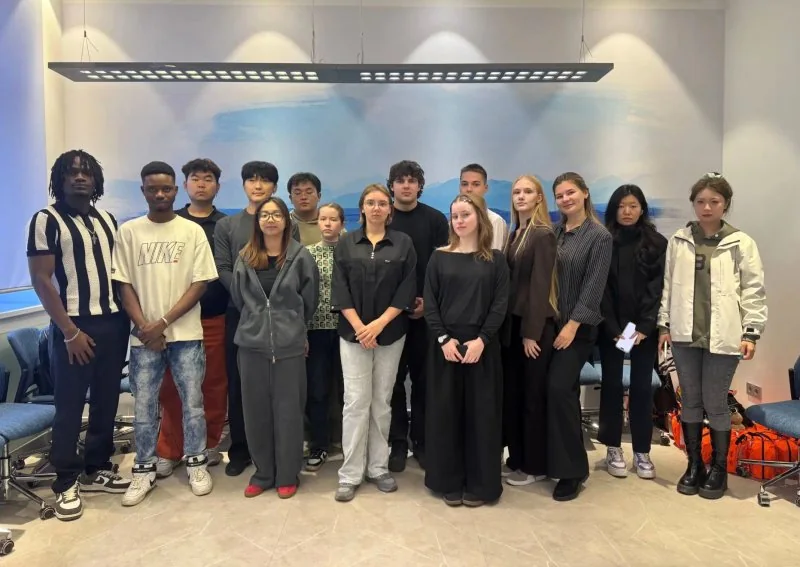
The first introductory practical session took place on 21 September 2026. Bank staff introduced students to the setting and outlined a semester plan aligned with the academic course. The report describes a group including students from Russia, China, Angola and Mali, bringing different national perspectives into the same learning activity.
Sources: Economics teaching with a bank: 2026 report ↗