Visa
About Amravati University
Amravati University and its present name
Amravati University is the historical name of Sant Gadge Baba Amravati University in Amravati, Maharashtra. The university was established on 1 May 1983, Maharashtra Day, with a particular focus on the educational needs of the rural population of western Vidarbha. Its institutional overview identifies a regional remit covering Amravati, Akola, Yavatmal, Buldana and Washim districts.
An official notification dated 26 May 2005 records the substitution of the name Sant Gadge Baba Amravati University for Amravati University under Maharashtra Act XXI of 2005. It also explains that references to the former name in existing documents and enactments are to be understood as references to the renamed university. Today’s institution combines teaching departments with a wider regional educational role, while its overview places student welfare, cultural activities, sports and the development of learning resources alongside academic work.
Sources: About the university ↗ · Notification 111/2005: change of university name ↗
Fabrication and material-based learning
The university’s Fabrication Laboratory, or FABLAB, is organised around experimentation with materials, prototyping and testing. Its published description presents an open environment for material-based learning and research, working with materials ranging from wood and foam to metals, plastics, composites and smart materials. Administration is assigned to an Academic Services Unit, whose establishment arrangements were considered by the Management Council in 2015.
The equipment inventory includes computer-controlled mills and a lathe, circuit-board prototyping systems, benchtop milling equipment, a three-dimensional printer, a vinyl cutter and laser engraving and cutting systems. These represent several different ways to develop and test a design, including removing material, creating circuit boards, producing models and cutting or marking surfaces. The laboratory’s account connects access to these tools with exploration of fabrication processes rather than limiting design work to drawings or computer models.
Sources: Fabrication Laboratory ↗
Library and information science education
The Department of Library and Information Science was established in 1987. Its history records the introduction of bachelor’s-level library and information science study that year and master’s-level study in 1993. Located in the Knowledge Resource Centre, the department describes classrooms, an internet-connected computer laboratory, a seminar hall and a departmental library as part of its academic setting.
Its mission focuses on educating people who collect, organise, preserve, manage and disseminate information in different formats. Teaching objectives include information-technology applications in libraries, information-processing techniques and services for users of modern information centres. The department also places research and professional responsibilities within its educational aims. Its own library contains selected and rare books, conference material, journals, theses and research projects, providing subject-specific resources alongside the wider university’s learning collections.
Computing and technical study
The Department of Computer Science dates its establishment to 1986, when it began with a postgraduate diploma in computer science. Its historical account records the subsequent development of master’s and doctoral study. The department’s mission combines computer-science and engineering education with research, scholarly publication and continued learning. It also identifies service to professional communities and wider society as part of its purpose.
The department lists laboratories for web and mobile computing, distributed computing, advanced computing, network security and research. Server, printing and graphics facilities appear in the same account, with local networking and internet connections supporting laboratory work. These descriptions show how computing study is distributed across several technical areas, from applications and communications to security and research infrastructure. The department’s stated educational approach links technical knowledge with the attitudes and values needed for ongoing learning and leadership.
Sources: Computer Science department ↗
Biotechnology laboratories and research tools
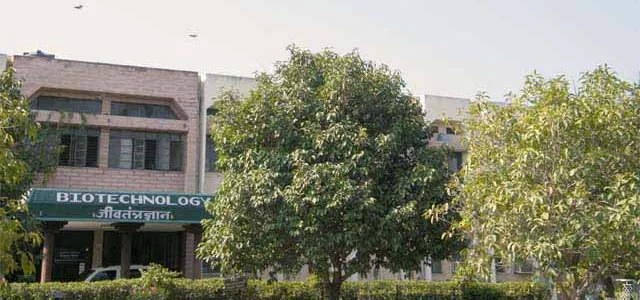
Biotechnology has been part of the university’s departmental structure since 1994. Its mission emphasises a foundation in a rapidly developing field, technical and critical-thinking skills, ethical behaviour and outreach. Its facilities account describes both experimental laboratories and computing resources, bringing practical biological work together with the analysis and handling of scientific information.
Listed research and teaching equipment includes microscopes, chromatography and spectrophotometry systems, fermenters, incubators, electrophoresis equipment and thermal cyclers. The inventory also includes water-purification equipment, cold storage, a biosafety cabinet, centrifugation equipment and instruments used in studying small particles. Laboratories cover tissue culture, microbial biotechnology, genetic engineering, metagenomics, bioprocessing and nanobiotechnology. A bioinformatics facility and computer laboratory complement these experimental spaces. The published inventory illustrates the range of tools associated with departmental teaching and research, spanning sample preparation, measurement, culture work and computational analysis.
Sources: Biotechnology teaching and research facilities ↗ · Biotechnology department ↗
Continuing education and community learning
The Department of Lifelong Learning and Extension extends the university’s educational role beyond conventional undergraduate and postgraduate study. Its account addresses the needs of young people, adults and older citizens, with an emphasis on flexible continuing education and skills development. It describes working with colleges and social organisations to develop and deliver learning opportunities relevant to different groups in the region.
The department’s stated mission includes educational engagement with problems encountered in community life and programmes intended to help learners respond to changing circumstances. Its account includes study in lifelong learning and extension, English communication and counselling, alongside shorter skills-based certificate courses. Community engagement is presented as an educational process that connects the university with people whose learning needs continue beyond an initial qualification. This gives a further dimension to the institution’s original regional purpose, linking academic resources with continuing personal and social development.