Visa
About Amity University Mumbai
A Maharashtra university with its main campus in Panvel
Amity University Mumbai has its main campus at Bhatan, near Somathne in Panvel, Maharashtra, alongside the Mumbai–Pune Expressway. The university’s institutional overview dates its establishment to 2014. It combines academic facilities with residential accommodation and outdoor spaces, including provision for sports such as football, cricket, tennis and badminton. An on-campus innovation incubator is also identified in its account of the university environment.
The university distinguishes this main campus from its city office in Art Guild House at Kurla West in Mumbai. The city location provides information for prospective students and parents and serves as a setting for industry interaction, guest lectures and related academic activities. The main campus is the broader residential and teaching setting described by the university. This distinction helps explain the relationship between the institution’s Mumbai name and the Panvel address used for its main academic site.
Sources: About Amity University Mumbai and its campus ↗ · Main campus and Mumbai city office addresses ↗
A semester-based approach to teaching
The university describes a semester-based academic system in which course content is reviewed in response to developments in disciplines and professional practice. Its account sets out a sequence of review by subject experts, Boards of Studies and the Academic Council. The intention is to connect established subject knowledge with changes in technology and the needs of different fields.
Assessment combines work completed during the semester with end-of-term examinations. Examples of internal assessment include tests, oral examinations, quizzes, case discussions, presentations, assignments, projects, seminars and term papers. The academic page also describes semester and cumulative grade-point averages as ways of recording progress across courses and semesters. Quality assurance involves monitoring how curricula are implemented and updated. These arrangements give a framework for the individual teaching and practical activities described by the university’s schools, from studio projects and laboratory work to discussion-based learning in professional subjects.
Architecture studios, models and environmental measurements
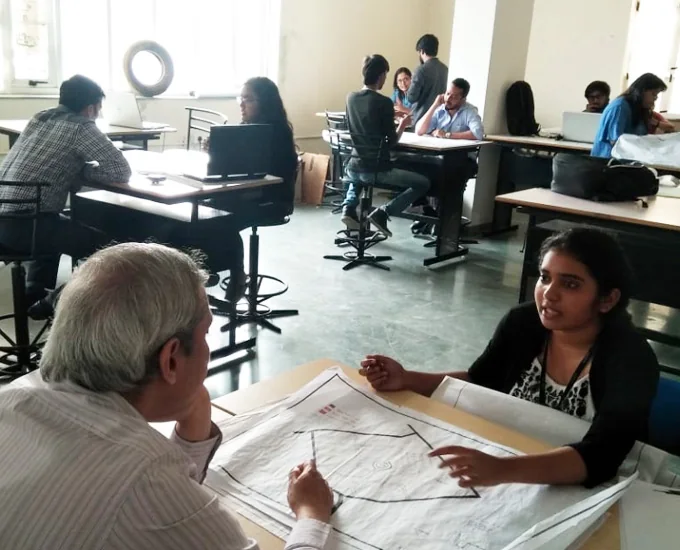
The architecture and planning facilities include computer laboratories for design, modelling and presentation, supported by tutorials and laboratory assistance. Design studios provide drafting boards, lockers and exhibition space, with an emphasis on natural light and room for working. A model-making workshop includes cutting platforms, display boards and storage, while software and hardware support three-dimensional printing.
The surveying laboratory contains equipment ranging from basic surveying tools and levels to a GPS-integrated total station. An environmental laboratory supports work with light, sound, carbon dioxide and temperature measurements. The school also describes a subject library with reference material on architecture, design, planning and philosophy, together with journals and magazines in print and digital formats. These facilities connect visual and spatial design with model construction, measurement and access to academic sources, providing several different settings for practical work within architecture education.
Sources: Architecture and planning facilities ↗
Legal study and practical learning spaces
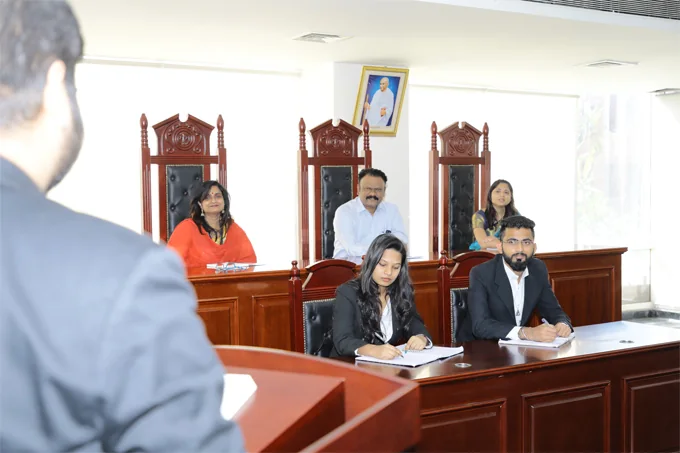
Amity Law School describes a combination of teaching, research and practical exposure. Its facilities include classrooms, tutorial rooms, lecture theatres, a conference hall, a small auditorium and a legal aid centre. A research centre and library collections support academic work, with electronic access to legal resources including SCC Online and Manupatra. A moot-court space provides a setting associated with practical legal education.
The school’s listed research areas include criminology, victimology, corporate law, constitutional law, international human rights, international trade, banking, intellectual property and environmental law. Books, journals, magazines and research publications accompany the electronic resources. The official account places these facilities within a teaching environment intended to connect legal study with different professional and community settings. The variety of research areas also indicates the breadth of subject interests represented within the law school.
Sources: Amity Law School: infrastructure and research ↗
Library resources and connected study
The Mumbai campus’s central library serves students, research scholars, faculty and staff. The travel and tourism institute’s facilities page describes printed books, journals and magazines alongside electronic books, journals and databases. An integrated library management system supports services including renewing and reserving books, maintaining virtual reading shelves and suggesting purchases. Digital resources form another route to learning material beyond physical collections.
The same account describes classrooms and discussion rooms equipped for audiovisual teaching and computer laboratories connected to the campus network. Wireless connectivity supports student devices. Amizone is presented as a student-parent portal for information such as attendance, courses covered, classes held and feedback. Alongside these academic resources, the campus includes shared spaces such as cafeterias and a student-parent lounge. These services connect access to teaching material and university information with the practical setting in which students spend their days.
Sources: Travel and tourism institute: campus and library facilities ↗
Mentoring and development beyond classes
The university’s Beyond Academics page places communication, problem solving, logical thinking and leadership alongside formal subject learning. It describes special sessions on communication and personal development, foreign-language learning and behavioural science. The stated emphasis on values includes truthfulness, honesty, discipline and respect. Community service is identified as part of the wider educational approach.
A mentor–mentee system connects faculty members with small groups of students over the course of their studies. The university describes these relationships as a way for students to discuss academic concerns and personal difficulties, while mentors follow their progress. Counsellors are another stated source of support, and faculty can help students identify when additional assistance may be useful. This account of mentoring and student support complements the curriculum, assessment arrangements and specialist facilities described elsewhere on the university’s Mumbai website.
Sources: Beyond Academics: personal development and mentoring ↗