Visa
About Amity University Bengaluru
A university campus in Karnataka
Amity University Bengaluru is based in Devanahalli Taluk, Karnataka, on the Devanahalli–Doddaballapur Road. Its dedicated campus website identifies a location opposite the Deputy Commissioner Office and distinguishes Bengaluru from Amity’s other Indian and international locations.
The university describes a seventy-acre campus and a community drawn from different regions of India and other countries. Its campus introduction emphasizes learning alongside activities that allow students to work with new ideas, technology and other people. That description connects formal study with participation in a wider university community. The Bengaluru site has its own academic information, campus services and reports of local events, while also providing links to the wider Amity education network.
Sources: About Amity Bengaluru ↗ · Bengaluru campus contact and links ↗
Mission and academic values
The university’s stated vision brings together creativity, innovation, education and research relevant to industry and society. Its mission describes student-centred learning and an environment that supports talent and creative work. Interdisciplinary activity and cooperation across departments are also part of that stated direction.
The mission places university teaching in contact with industry and international collaboration. It combines those outward relationships with attention to moral values, cognitive development and social responsibility. Its published core values include integrity, transparency, continuous learning, scientific ethics and academic freedom, as well as environmental sustainability. These are institutional commitments that frame the educational environment. They explain the university’s intended approach to learning and research.
Sources: Vision and Mission ↗
Teaching, assessment and curriculum review
The Bengaluru academic overview describes teaching that combines theoretical study with practical and industry-related work. Examples include case studies, projects, presentations, research assignments, role play, discussion forums and contributions from visiting speakers. The stated emphasis extends to analytical ability, communication, problem solving and teamwork.
The same overview explains a choice-based credit approach, including opportunities to select courses beyond a single programme and earn credit through appropriate projects or workshops. It describes curriculum review as a process involving an expert committee, a Board of Studies and the Academic Council. The published account therefore treats the curriculum as something subject to review and formal approval.
Assessment includes work completed during the semester as well as end-of-term examinations. The overview lists tests, oral assessment, quizzes, case discussions, assignments, seminars and projects among the possible components. Academic performance is expressed through letter grades and grade-point measures, connecting regular coursework with the progression of a student’s degree studies.
Sources: The Academia ↗
Personal development and activities beyond class
The university’s account of education beyond the classroom includes a personality development programme concerned with self-awareness and preparation for professional situations. Its described training covers communication, English usage, business correspondence, presentations, teamwork, time management and interpersonal relationships. Public speaking, group discussions and simulated interviews are among the practical exercises identified.
The same page describes extracurricular participation through cultural, sporting, technical and community activities. Examples include talent events, student clubs, social-awareness programmes, an entrepreneurship cell and Sangathan, an inter-Amity sports meeting. Such activities sit alongside the formal academic curriculum.
Values education is another strand of the published approach. The university describes using character-related themes in teaching, group activities, lectures and discussions. It also presents mentoring as an ongoing relationship between faculty members and groups of students, with guidance on academic and personal concerns. These provisions outline the kinds of support and participation the institution seeks to offer.
Sources: Beyond Academics ↗
Residential life and shared campus spaces
The Bengaluru accommodation page describes university residences within the campus, with separate facilities for male and female students. Its published description includes apartment-style suites containing single rooms, an attached bathroom and a sitting lounge. Wardens are identified as part of the residential arrangements.
The account also lists internet access, laundry services and furnished common rooms. These facilities are intended to connect residential life with coursework, communication with people outside campus and informal time with other students. Accommodation is presented as part of the campus experience rather than simply an off-site housing referral. The description gives a picture of the residential setting advertised by the university, including the balance between private rooms and shared spaces used by residents.
Sources: Campus Accommodation ↗
Electronics prototyping and practical demonstrations
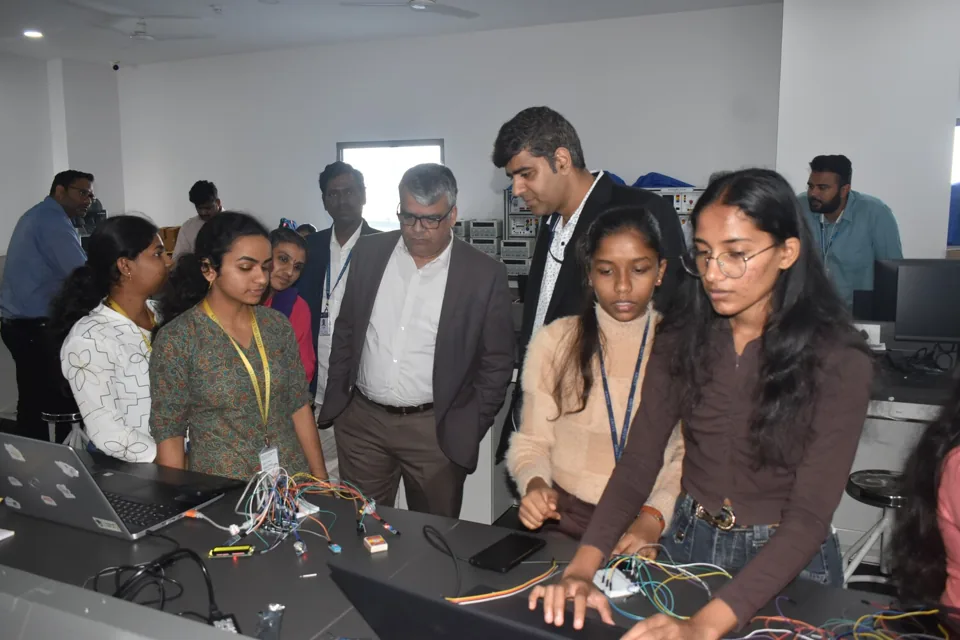
A Bengaluru event report dated February to May 2026 describes a workshop on electronics prototyping and Internet of Things laboratory skills. Sessions led by IoBiT Solutions covered Arduino, ESP32 and Raspberry Pi, together with sensor interfacing, cloud-connected platforms and three-dimensional printing.
The report records practical training followed by project demonstrations and a valedictory ceremony. This provides a specific example of the hands-on learning described in the university’s broader academic account. Its accompanying photograph shows participants gathered around electronic components and computers in a laboratory setting.
Sources: Electronics Prototyping and IoT Lab Skills ↗
A campus gathering around cloud technology
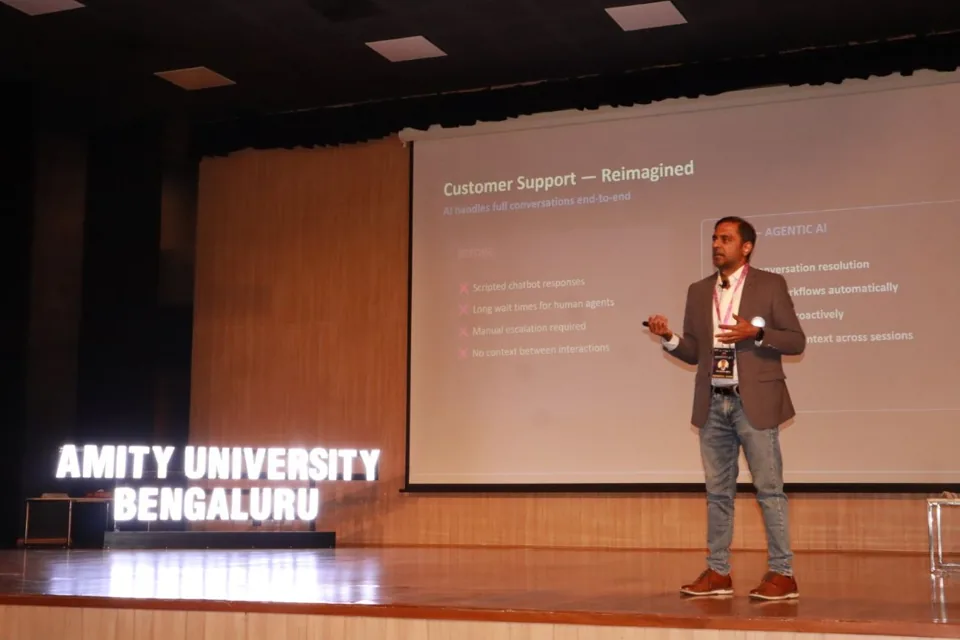
The university’s report of AWS Student Community Day records an event at Bengaluru on 24 April 2026. It brought students together with industry experts and people interested in cloud technology for knowledge sharing and networking. Expert talks, mentoring and technical discussions formed part of the programme.
The event photograph shows a speaker on the university’s auditorium stage during a presentation. Together, the report and photograph document a particular campus activity involving technology and professional interaction. The programme connected student participation with discussions led by people working in the technology sector.
Sources: AWS Student Community Day ↗