Visa

About American University of Science and Technology
A Lebanese university with an evolving identity
American University of Science and Technology, commonly abbreviated AUST, is a Lebanese higher-education institution. Its institutional history traces its beginning to 1989, when it operated as American Universal College. In August 2000 it adopted the name American University College of Science and Technology, preceding its present university name.
The same historical account identifies locations in Beirut, Zahlé, Sidon and Bhamdoun. It describes academic provision across arts and sciences, business and economics, engineering and computing, and health sciences, with undergraduate and graduate study. The founders’ stated concern was to make private American-style education available to students facing financial constraints. That concern remains part of the university’s account of its development and educational purpose.
Sources: Institutional history ↗
Learning, applied training and cultural exchange
AUST’s mission statement places student learning, critical thinking, applied training and research-based coursework at the centre of its educational approach. It combines American-style degree study with a liberal arts curriculum and an emphasis on communication, problem-solving, design and entrepreneurship. Tolerance of different opinions, human rights and intercultural dialogue also appear among its educational aims.
The statement connects formal teaching with cultural and educational activities open to the wider community. It envisages collaboration with other universities for exchanges and joint research, and links with employers through academic advisory arrangements. Internships are identified as a way to connect academic study with workplace experience. Flexible scheduling is another stated priority, intended to allow working students to participate in university education. The published mission was reviewed in August 2024, providing a dated account of these institutional priorities.
Laboratories across scientific and creative fields
AUST’s laboratory overview describes practical facilities serving both technical subjects and creative disciplines. In arts and sciences, these include ceramics and printmaking, drawing, painting and sculpture, fashion design, computer design and carpentry. Television and radio studios, an editing suite, computing facilities and an innovation centre also form part of the listed provision.
Health-science facilities cover biology, biotechnology, chemistry and pharmaceutics, molecular biology and molecular genetics, alongside radiology, optics and optometry, toxicology and phlebotomy laboratories. The engineering list includes biomedical instrumentation, communication systems, control and industrial automation, digital systems and microprocessors, circuit analysis, mechatronics and workshop facilities. A senior capstone project laboratory supports project-based work. Taken together, this range illustrates the university’s stated emphasis on laboratory experience as a complement to theoretical education, extending practical learning across media production, artistic processes, computing and scientific experimentation.
Sources: Academic laboratories overview ↗
Research as part of university teaching
The university’s research policy describes teaching as a priority while also making research part of academic development. Its stated purpose is to support the educational process and encourage contributions from faculty, staff and students through rigorous scholarly methods. The policy covers research undertaken at AUST and work at cooperating universities under institutional agreements.
It identifies integrity in obtaining, recording, analysing and publishing data as a central responsibility. Its provisions address plagiarism, fabricated results, inappropriate use of funding and failures to acknowledge contributors. Applied research is encouraged, while the policy also supports theoretical investigation. Four forms of institutional assistance are described: seed funding, released time, publication costs and conference travel. Applications are considered by the University Research Council, with recommendations submitted to the Executive Council. This structure places research activity within an organised process of ethical expectations, academic review and institutional decision-making.
Sources: Research policy ↗
Records, technology and preparation for work
Several university offices support the practical organisation of student study. The Registrar’s Office manages registration, examination scheduling, academic calendars and academic records. Its work includes enrollment certificates, transcripts and graduation clearance, linking departmental assessment with the formal records of a student’s university education.
The Information Technology Department supports networks, computers, software and communication services. AUST also describes a Job Placement Office that works with employers and instructors to connect students with career-related experience. Its activities include guidance on preparing a CV or résumé, interview techniques and considering work that relates to a student’s subject and interests. The International Students Affairs Office provides orientation and information for students arriving from abroad. The administrative-services account additionally identifies an AUST Press Office, founded in 2005, which publishes scholarly work and books in the humanities, sciences and social sciences.
Coordinating learning support
AUST’s Learning Support Services Program is presented as part of an inclusive educational environment that recognises differences in students’ abilities and learning approaches. Its account refers to individualised teaching, active learning and cooperative learning as ways to support students with differing educational needs.
The published process describes the submission of information and supporting documentation when a student requests academic accommodations. The Learning Support Office considers the file and recommends arrangements, with communication between the relevant administrative offices and academic departments. Follow-up is part of the process rather than ending with an initial recommendation. The programme’s listed actions include checking that agreed accommodations are being offered, meeting with students and parents in preparation for semesters, coordinating efforts across the institution and raising awareness within the university community. These activities describe how learning support is organised alongside teaching and academic administration.
Sources: Learning Support Services Program ↗
A road-safety education partnership
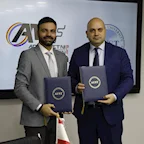
A report published by AUST on March 11, 2024 records an agreement with the Adel Metni Foundation, a nonprofit organisation concerned with road safety and sustainable mobility education. The partnership proposed practical road-safety education for university students and a programme called Defensive Driving Basics.
The report also described planned activities and training in collaboration with IMPEX–Chevrolet Lebanon. It identified representatives of the foundation and AUST’s engineering and computing faculty as signatories. This dated initiative provides an example of the university’s engagement with an external organisation around practical education extending beyond individual degree courses.
Sources: Adel Metni Foundation agreement report, March 11, 2024 ↗