Visa
About Amala Institute of Medical Sciences
A medical education institution in Thrissur
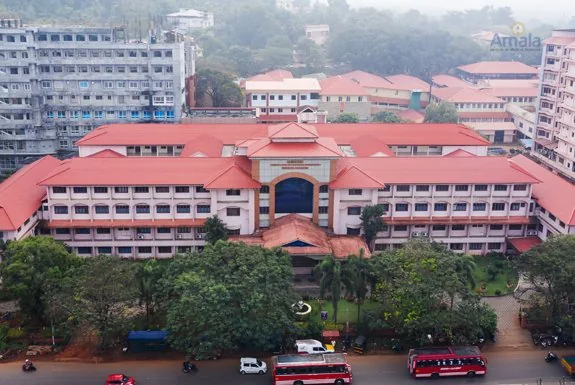
Amala Institute of Medical Sciences is based at Amala Nagar in Thrissur, Kerala. Its institutional history begins with Amala Cancer Hospital, which opened in 1978. The wider Amala network subsequently brought together medical education, hospital services, research and outreach. Management rests with the Devamatha Province of the Carmelites of Mary Immaculate congregation, whose founder was St. Kuriakose Elias Chavara. The institution takes its name from the Blessed Virgin Mary. The medical college belongs to this broader setting alongside separately identified nursing education institutions and research centres. This combination of educational and research organisations forms an important part of Amala’s institutional identity.
Sources: Institutional history ↗
The undergraduate medical programme
The medical college offers the Bachelor of Medicine and Bachelor of Surgery, or MBBS, affiliated to the Kerala University of Health Sciences. Its undergraduate course page gives a duration of five and a half years and provides links to three volumes of the undergraduate curriculum. The programme is presented within the institute’s medical-college portal, which also provides academic schedules and separate postgraduate course information.
Sources: Undergraduate medical course ↗
Anatomy and foundational teaching
Amala’s Anatomy Department was established in 2003. Its teaching encompasses clinical and surgical anatomy, neuroanatomy, embryology and histology, connecting the study of bodily structure with subsequent medical subjects. Facilities described by the department include a subject library, histology laboratory, museum and research laboratory. Audiovisual equipment supports teaching in laboratories and demonstration rooms. The museum brings together anatomical and embryological teaching material, including models used to explain development and structure. Teaching extends to undergraduate medical and paramedical students, while postgraduate surgical training includes workshops. Research facilities support work in histology, embryology and gross anatomy. The department describes using both established and newer teaching methods across undergraduate and postgraduate instruction.
Sources: Anatomy department ↗
Biochemistry and laboratory education
The Biochemistry Department identifies MBBS, MD and doctoral education among its academic activities, alongside clinical biochemistry projects. Its facilities include a clinical biochemistry laboratory and a molecular biology laboratory with real-time PCR equipment. The department lists automated chemistry and immunoassay analysers, capillary electrophoresis equipment, chromatography for HbA1c analysis and electrolyte analysers. These facilities give the department a laboratory-based academic setting encompassing biochemical measurement and molecular methods. Its published research bibliography spans many years and includes work on oxidative stress, mitochondrial biology and biochemical mechanisms. The departmental page brings this research record together with faculty information and an account of laboratory facilities, showing how teaching and investigation sit within the same academic unit.
Sources: Biochemistry department ↗
Physiology teaching and academic exchange
Physiology teaching serves undergraduate and postgraduate medical students as well as students on paramedical courses. The department identifies haematology and clinical teaching laboratories, together with a Computer Assisted Learning laboratory used for instruction concerning amphibian and mammalian experiments. Its research equipment supports electrophysiological testing, autonomic function assessment, pulmonary function testing and exercise physiology. A museum and yoga laboratory are also listed among departmental facilities. Continuing medical education has included a 2023 programme on neurophysiology and an earlier 2017 programme concerning sleep and related disorders. The department’s bibliography includes studies of medical education and student experiences, including stressors, foundation-course feedback and knowledge about elderly care. These records document academic interests beyond the mechanics of laboratory instruction.
Sources: Physiology department ↗
Library services and research support
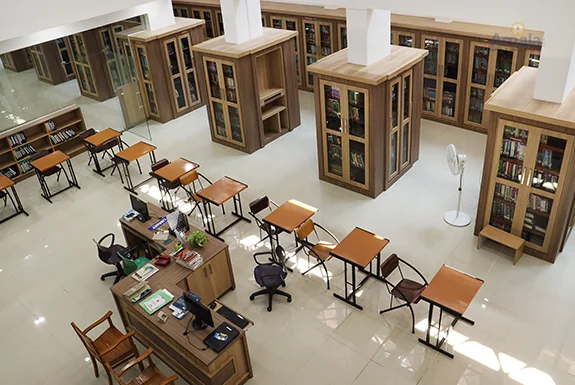
The central library combines lending and reference services with support for academic research. Students and staff can use an online public-access catalogue supported by the Koha library management system, while barcodes assist circulation. A Digital Education Centre and computer facilities support database searches and access to electronic material. Research assistance includes advice about similarity checking, plagiarism and academic publication. The library also provides current-awareness services, journal-content alerts, new-arrival notices and article requests. Its wider educational activities include book exhibitions, National Reading Week programmes, seminars, a readers’ club and book-donation campaigns. A library advisory committee includes institutional leadership, library staff, faculty and student representation. That committee considers purchases, equipment and infrastructure. Library outreach additionally includes consultation and library-development activities for schools and other organisations.
Sources: Central library services ↗
Faculty development and curriculum work
The Medical Education Unit provides an organised forum for teaching development. Its first meeting took place on 9 July 2003, and its published record traces subsequent meetings and faculty-development activities. A curriculum committee brings together coordinators for pre-clinical, para-clinical, medical and surgical phases. The unit’s stated educational aims include strengthening teaching, supporting innovation and encouraging medical-education research. Documented activities include curriculum implementation workshops and basic courses in medical education. A basic course ran from 31 July to 2 August 2025, while another curriculum implementation support workshop took place in December 2025. Faculty participation in advanced medical-education courses is also recorded. These activities provide a continuing institutional structure for discussing how medical students are taught and how curricula are put into practice.
Sources: Medical Education Unit ↗
An institutional research publication
The Journal of Advanced Health Research and Clinical Medicine is the institute’s official journal, published in association with its Amala Cancer Hospital Society setting. Amala describes it as a peer-reviewed, open-access publication with print-on-demand availability and two issues each year. Its editorial scope crosses medical, surgical, dental, nursing and allied-health disciplines. The journal accepts original research articles, reviews, meta-analyses, clinical cases and case series. Its stated purpose is to provide a platform for researchers, clinicians and academics, with an editorial board drawn from different specialties. Alongside departmental publication records and library research support, the journal gives Amala a dedicated channel for scholarly communication across several health-related fields.
Sources: Official journal ↗