Visa
About Altai State Agricultural University
From a wartime institute to a university
Altai State Agricultural University is an agricultural higher education institution in Barnaul, in Russia’s Altai region. Its history begins on 3 December 1943, when the Altai Agricultural Institute was established from the Pushkin Agricultural Institute evacuated to Altai from Leningrad. The new institute initially operated in Pavlovsk with agronomy and animal husbandry faculties, before moving to Barnaul in 1944. Its first graduates completed their studies in 1946. The historical timeline records the introduction of correspondence education in 1947, agricultural mechanisation and postgraduate research training in 1950, and veterinary training in 1962. In 1991 the institute became Altai State Agricultural University. Later milestones included the university’s own scientific journal in 2001, doctoral training in 2003 and the introduction of master’s programmes in 2007.
Sources: From a wartime institute to a university ↗
Agronomy, soils and cultivated landscapes
Agronomy has been part of the institution since its foundation. The faculty’s history describes the contribution of teachers from the evacuated Pushkin institute and the gradual formation of its own teaching community after the war. Its educational portfolio expanded beyond general agronomy over time: agrochemistry and agricultural soil science were introduced in 1997, fruit and vegetable growing with viticulture in 1999, and forestry in 2003. The faculty began moving to bachelor’s and master’s preparation in 2009. Its departmental structure connects soil science and agrochemistry with general farming, crop production, plant protection, botany, horticulture and forestry. An electronic mapping centre and a soil physics laboratory add specialist resources to that subject mix. The faculty thus links the study of cultivated plants with the properties and management of the land supporting them.
Animal science and agricultural products
The Biological and Technological Faculty also traces its work back to 1943. It combines animal science with the production and processing of agricultural products and food products of animal origin. Its published description identifies laboratory facilities and computer classrooms supporting teaching in agricultural production, processing and food technology. Faculty research involves undergraduate, master’s and postgraduate participants alongside academic staff. The topics described include breeding and selection, animal feeding, biotechnology, adaptation to environmental conditions and the processing of agricultural products. The faculty reports that its teaching moved into a new building in 2015. Its account brings several stages of agricultural production together, connecting the biological characteristics of animals with management, feeding and the quality and processing of the resulting products.
Land, water and environmental management
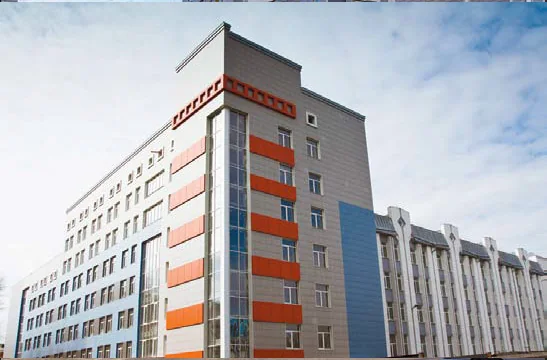
The Faculty of Environmental Management developed from a hydraulic land-reclamation specialism introduced in 1980; a separate faculty followed in 1981. Its subsequent history includes the expansion of water-supply engineering, land management, cadastral study and the integrated protection of water resources. The faculty describes bachelor’s and master’s education in environmental management and water use, and in land management and cadastres. Its teaching facilities include laboratories addressing pumps, hydraulic structures, geology, hydrogeology, water chemistry, cartography, photogrammetry and geographic information for property cadastres. It also identifies research laboratories for water-resource use and remote sensing. Departments have occupied building 7A on Merzlikina Street since 2008. Across these activities, the faculty connects engineering infrastructure with the measurement, use and protection of land and water.
Research structures serving agriculture
The university’s research description groups specialist work around innovative agricultural technologies and soil-agrochemical studies, animal and veterinary research with product-quality evaluation, and agricultural engineering. The listed facilities include laboratories for plant micropropagation, soil fertility, water resources, animal physiology, marker selection, food quality and wool analysis. Engineering research facilities address agricultural machinery, protective and repair coatings, the microclimate of livestock buildings, electrical technologies and energy auditing. The university also describes an experimental agricultural station and a protected-cultivation teaching laboratory. Research results are shared through scientific conferences and the university journal, Vestnik of Altai State Agricultural University, which began publication in 2001. These structures place research alongside teaching in crop production, livestock systems, agricultural equipment and the use of natural resources.
A multidisciplinary agricultural education
The university’s English-language overview sets its agricultural specialisms within a wider educational structure. Alongside agronomy and animal science, it identifies agricultural engineering, economics, management, veterinary medicine, environmental management and land cadastres. Agricultural engineering is described through technical systems for farm enterprises, electrical equipment and technologies, storage and processing equipment, and technical service in agriculture. The economics portfolio includes the organisation and management of economic activity as well as public and municipal administration. The same overview identifies soil fertility, resource-saving farming, agrobiotechnology, agricultural digital technologies and the sustainable development of rural economies among its research directions. Together, these fields show how the university approaches agriculture through biological, technical, environmental and organisational questions, rather than treating farming as a single isolated discipline.
University buildings in Barnaul
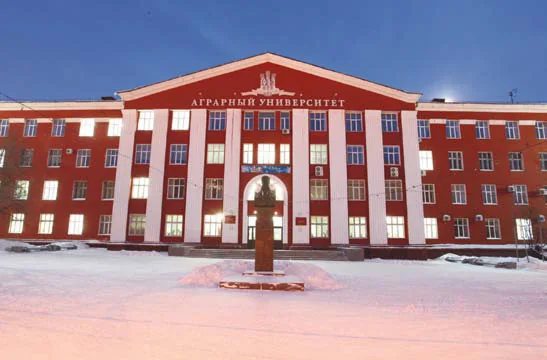
The university’s campus information describes teaching premises distributed across Barnaul. The main institutional address is on Krasnoarmeysky Prospekt, while other teaching buildings are listed on Molodyozhnaya, Popova and Merzlikina streets. Its building directory presents photographs of the different premises, including the main building and building 7 on Merzlikina Street. The main-building facilities description includes lecture rooms, subject laboratories, computer classrooms and spaces for practical work. Chemistry, horticulture, soils, crop production, forestry and agricultural machinery are among the subjects represented in its laboratory listing. Sports facilities also appear in the campus description. This distributed arrangement provides a physical setting for the university’s combination of classroom teaching, laboratory-based study and applied agricultural education.
Sources: University buildings in Barnaul ↗