Visa


About Alliance University
From business education to a multidisciplinary university
Alliance University is based in Bengaluru, Karnataka, India. Its educational origins lie in Alliance Business Academy, launched in the city in November 1997. The institution's published chronology records the establishment of Alliance Business School in 2005 and the creation of Alliance University under Karnataka state legislation in 2010. This sequence distinguishes the university's establishment from the earlier business education initiative that preceded it.
Its subsequent development extended beyond management education. The institutional history places the introduction of engineering and law schools in 2012 and the first liberal arts cohort in 2022. The university now presents a wider collection of schools covering business, computing, engineering, law, economics, design, sciences, liberal arts and creative practice. Its stated educational philosophy connects teaching and research with public service, academic integrity and inquiry across humanistic and scientific subjects. These principles describe the purposes the university sets for its academic community.
Sources: Institutional history and educational philosophy ↗
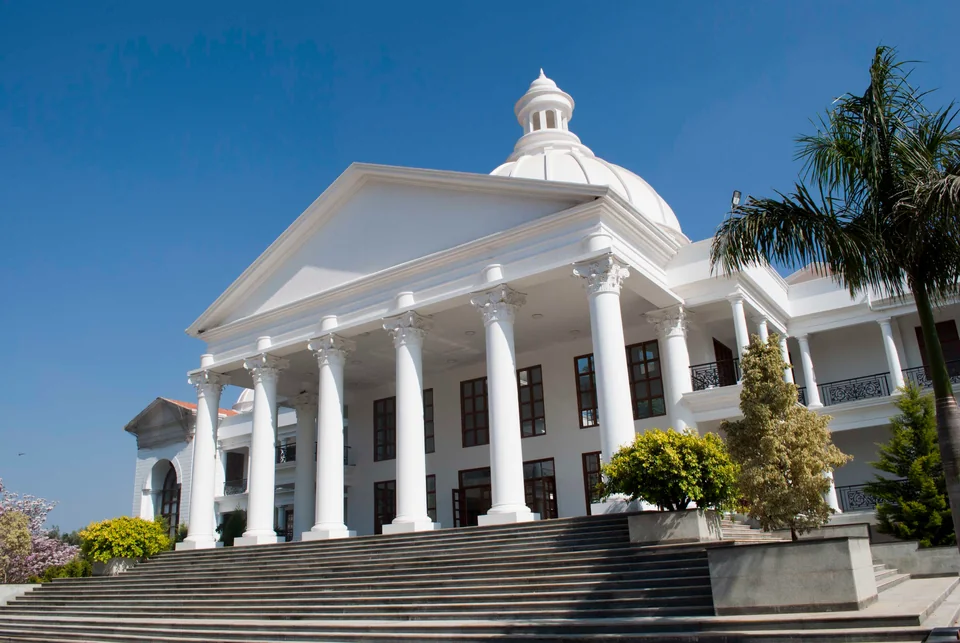
A central library for study and research
The Central Library has served the institution since 2008, preceding its transition to university status. Its dedicated domed building accommodates four floors of resources and study areas. The library identifies circulation, reference, periodicals, audiovisual material and a book bank among its sections, together with a collection for Kannada language resources. This organisation brings different types of academic material into a common setting for independent reading and research.
An online public access catalogue provides a route to searching the collection. Library services include borrowing, reservations and renewals, reference enquiries, referrals, digital resources and interlibrary loans. Newspaper clippings and current awareness services help readers follow developments relevant to their interests. The library also describes accessible learning spaces and resources for users with disabilities. Its physical facilities and digital services together support students and faculty working with material beyond the content presented during classes.
Sources: Central Library ↗
Organising research across academic fields
Alliance's Centre for Research coordinates doctoral education and research activity across the university's academic units. Its responsibilities include supporting doctoral admissions, assisting researchers and encouraging cooperation within and beyond the institution. The centre presents research as work that benefits from connections among disciplines rather than remaining confined to individual departments. Seminars, workshops and conferences are among the formats it uses for exchanging ideas.
The centre's framework includes research supervision, support for scholars and attention to academic integrity. It identifies departmental and institutional academic integrity panels within its responsibilities. A university seed grant scheme is intended to help researchers develop initial studies and preliminary findings that can underpin later funding applications. The centre also links to research policies and scholarly publications, including journals concerned with law, social sciences and language. These activities connect the administration of doctoral study with opportunities to investigate questions, discuss findings and publish research.
Sources: Centre for Research ↗
Residential life and everyday campus facilities
The university describes campus life through accommodation, food services, transport, academic spaces and cultural activities. Its residences include separate hostels for men and women, with several room occupancy options, common areas and wardens. Dining provision includes food courts, snack facilities and an on-campus restaurant. A university bus service connects the campus with pickup and drop points in Bengaluru, providing another practical element of daily attendance.
Classrooms and laboratories form the academic side of this environment. The university describes spaces for scientific, engineering, media and technology work, where students can experiment with ideas introduced through teaching. Cultural participation includes music, dance, drama, writing and public discussion. The Alliance Literary Festival brings authors, artists and other contributors into conversations, readings and workshops. Alliance One combines technological challenges with cultural performances. Together, these facilities and events provide several ways for students to participate in university life alongside their chosen programmes.
Sources: Campus life and amenities ↗

Student organisations and shared interests
The clubs and societies directory groups student activity into curricular, co-curricular, extracurricular, sports, hobby and community service areas. Computing interests appear through the Hack Club, a developer community and clubs for robotics, automation and immersive technologies. Other subject communities address psychology, journalism, literature, mathematics and data science. Business students can explore finance, operations, human resources and marketing through specialist clubs.
Creative and recreational interests have their own settings, including music, dance, painting, film, photography and food appreciation. A Model United Nations group and a debate club provide opportunities for discussion and public speaking. The National Service Scheme connects participation with community outreach, while the National Cadet Corps offers structured training and camps. The university's Entrepreneurship Cell organises workshops, pitch competitions and mentoring activities. This range makes student involvement possible through academic interests, creative expression, physical activity and service rather than through a single type of organisation.
Sources: Clubs and societies ↗
Developing ideas through business incubation
The Alliance University Technology Business Incubator supports students, faculty, researchers and external innovators developing technology-based ventures. Its stated remit extends from early ideas and prototypes to commercial development. The incubator identifies education technology, agricultural technology, financial technology, smart mobility, biotechnology, semiconductors and sustainable energy among its areas of interest. Artificial intelligence and machine learning also appear within its technology focus.
Its services include access to university laboratories, prototyping facilities, coworking space and specialist mentoring. Business support addresses market planning, communication, legal requirements and intellectual property. Training takes the form of development programmes, bootcamps, innovation challenges and demonstration events. The incubator also describes connections with potential funding routes and investors, rather than an automatic award of financial support. Located on the university's Chandapura–Anekal Main Road site, it provides an organisational setting in which academic knowledge and technical ideas can be developed into proposals for practical application.
Sources: Technology Business Incubator ↗