Visa
About All-Russia Thermal Engineering Institute
A research institute with a long technical history
The All-Russia Thermal Engineering Institute, commonly known by the abbreviation VTI, is a Moscow research organisation specialising in thermal power engineering and heat technology. Its history connects scientific investigation with the practical development of power generation and specialist training. Established on 13 July 1921, the institute grew from proposals advanced by Moscow engineering professors V. I. Grinevitsky and K. V. Kirsh. Leonid Ramzin became its first director. A building originally intended for a Moscow tram power station was adapted to accommodate experimental equipment, and the institute and its experimental combined heat and power plant were formally opened on 31 May 1925. The historical account describes early work on power-station testing, furnaces, turbines and heat supply. In 1992 the institution adopted the All-Russia name and became an open joint-stock company. These developments explain its identity as an industrial research institute with an educational role.
Sources: History of VTI ↗
Civil power-engineering research
VTI’s published areas of activity span several connected parts of thermal energy systems. They include experimental and theoretical investigation of boilers, work on steam and gas turbine units, and the development of heat-supply technologies. Other subjects concern the environmental effects of power generation, water treatment, and the behaviour of fluids and materials used in power plants. The institute also lists research into the service life of metals in boilers, turbines and pipelines, together with studies of the physical and chemical characteristics of fuels. Automation of power-industry processes forms another part of this range. The breadth of the list is significant: VTI examines equipment, materials, operating processes and environmental questions within the same technical field. Research and engineering services for energy systems provide a common focus for these varied technical activities.
Water chemistry and environmental work
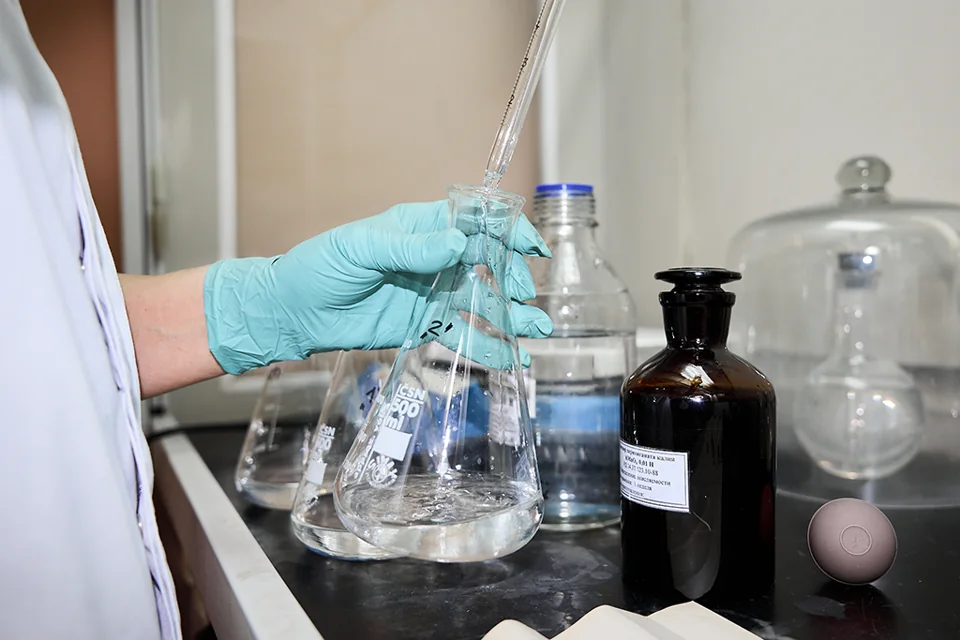
The water-chemical processes division illustrates this applied research in more detail. Established in 1952 from a chemical laboratory whose origins date to 1921, it investigates water treatment, water-chemical operating conditions and the use of water at thermal power stations. Its published work includes assessing existing treatment installations, developing approaches to wastewater reduction and reuse, and studying the protection of water bodies from power-station impacts. The division also addresses corrosion, deposits and protective surface films in energy equipment. These are described as research and engineering services, not as general chemistry teaching. Its account identifies laboratory analysis and experimental test facilities as resources supporting this work. Collaboration with equipment and reagent manufacturers is also part of the division’s activity. Together these subjects connect chemical investigation with the reliability, environmental management and operation of civil energy installations.
Sources: Water-chemical processes division ↗
Shared materials-research facilities
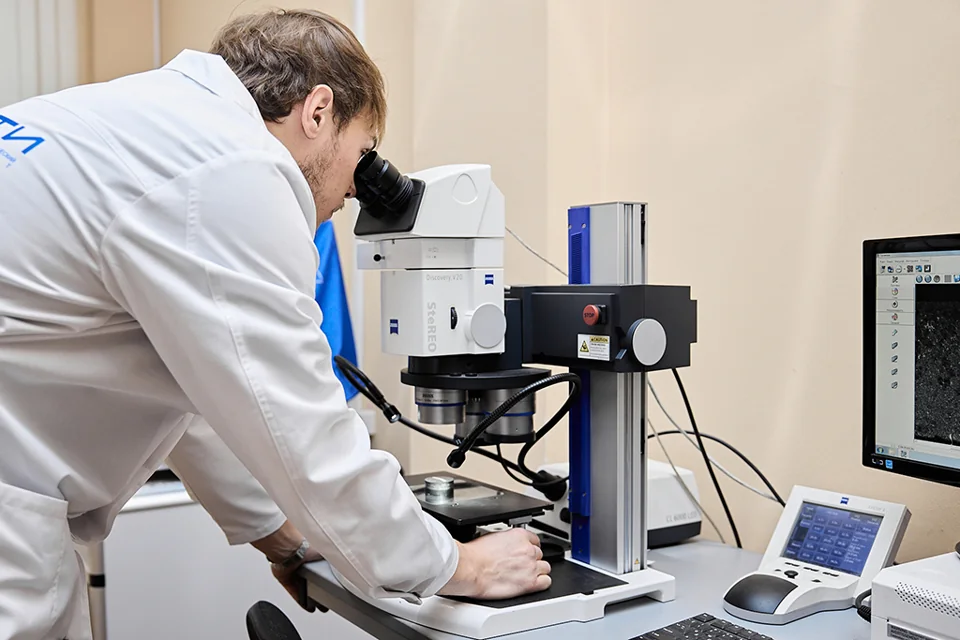
VTI’s shared-use centre for structural materials in thermal energy was created in 2009 within its metals division. It provides interested organisations with access to scientific equipment and methods for testing and research. The centre’s account describes investigations of strength, creep, heat resistance and changes in the structure of steels and alloys. Its facilities include mechanical-testing machines, furnaces, hardness-testing equipment, optical and stereo microscopes, and a scanning electron microscope with microanalysis capability. Chemical and phase analysis and nondestructive examination are also represented. The centre is organised into sectors covering mechanical properties, chemical and phase analysis, metal structure, long-term behaviour and nondestructive testing. This arrangement brings different methods of materials assessment together in one research setting. The description also identifies seminars, schools, conferences and workplace learning as ways in which the centre’s staff maintain and develop their expertise.
Sources: Shared materials-research equipment centre ↗
Postgraduate research training
VTI’s 2026 postgraduate information identifies the institute as a scientific organisation conducting fundamental, exploratory and applied research in thermal power engineering. Its research training is delivered through the Professor L. K. Ramzin scientific and educational centre for professional competencies and qualifications. The published postgraduate fields are Energy Systems and Complexes, and Turbomachines and Piston Engines. The page specifies full-time programmes with a standard duration of four years and describes preparation of scientific and teaching-research personnel. It also identifies a dissertation council working in these two technical specialties. This provision places advanced study within the institute’s own research environment. The educational role is therefore closely related to its specialist scientific work: postgraduate researchers pursue subjects connected with energy systems and machinery, while the educational centre and dissertation arrangements provide an institutional framework for that training.
Professional development for energy specialists
The institute also publishes a range of additional professional education programmes. Shorter professional-development courses are listed alongside longer retraining programmes, with in-person, mixed and distance formats described as options that can be adapted to participants and commissioning organisations. Course subjects include turbine technologies, boiler equipment, combined-cycle and gas-turbine installations, environmental protection in thermal energy, water treatment, and chemical monitoring. Other topics concern transformer-oil analysis, the assessment of metals in energy equipment, district-heating systems and technical-economic indicators for power stations. The retraining list includes theoretical and practical foundations of thermal power engineering and water treatment in power-station chemical departments. These subjects show how VTI translates its specialist research areas into structured learning for people already working in technical fields. Its educational activity thus includes both the preparation of researchers and the continuing development of professional knowledge.
Sources: Additional professional education ↗