Visa
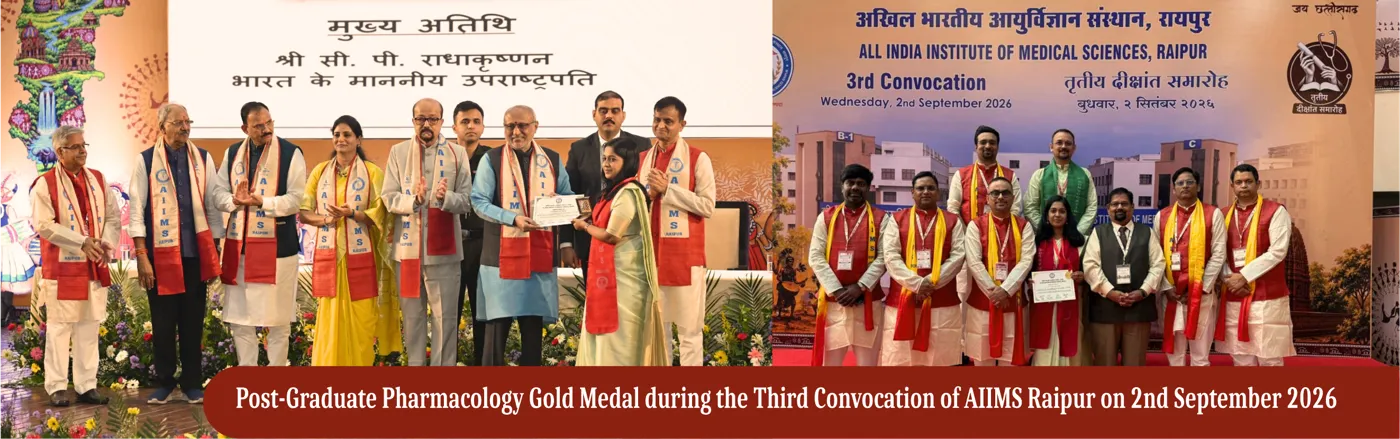
About All India Institute of Medical Sciences Raipur
Medical education and regional service
All India Institute of Medical Sciences Raipur is a medical education, research and healthcare institution in Chhattisgarh, India. It belongs to the group of six AIIMS institutions established through the Government of India’s Pradhan Mantri Swasthya Suraksha Yojana. The Ministry of Health and Family Welfare developed this group to address regional differences in access to advanced healthcare and strengthen undergraduate and postgraduate medical training. AIIMS Raipur combines a medical college, hospital services and academic departments within that broader public purpose.
Sources: About AIIMS Raipur ↗
A range of academic pathways
The institute’s academic course directory records the beginning of its MBBS programme in 2012. Its educational scope now includes postgraduate medical and dental study, doctoral research, public health and advanced specialist training. Basic medical sciences, laboratory disciplines and clinical specialties are represented across the institution.
The academic directory lists MD and MS study in subjects including anaesthesiology, anatomy, biochemistry, community medicine, general medicine, general surgery, microbiology, orthopaedics, paediatrics and psychiatry. It also includes radiodiagnosis, pathology, pharmacology and transfusion medicine. These programmes bring together areas concerned with understanding disease, investigating it and providing specialist care.
Dental postgraduate courses include oral and maxillofacial surgery and paediatric and preventive dentistry. The directory also identifies DM and MCh subjects, postdoctoral certificate courses and PhD programmes. Examples of doctoral fields include community and family medicine, physiology, nuclear medicine and pathology. The postdoctoral certificate listing covers focused areas such as hospital infection control, critical care and cardiac anaesthesia. This range illustrates the institute’s development beyond its original undergraduate intake.
Sources: Academic courses ↗
Anatomy and foundational teaching
Anatomy was among the departments operating when AIIMS Raipur began in 2012. Its departmental account describes undergraduate medical teaching from that year and teaching for BSc Nursing from 2013. The department is located in the medical college and links the study of the body’s large-scale and microscopic structures with medical understanding.
Its teaching facilities include a dissection hall, a modular microanatomy laboratory and a museum. The department describes tutorials, small-group discussions, student seminars, integrated teaching and collaboration between departments as part of its approach. Model and chart competitions are additional learning activities. Its account also identifies a programme of developing further facilities, including specialist anatomical collections and laboratory resources, alongside its established teaching spaces.
Sources: Department of Anatomy ↗
Public health and community learning
The School of Public Health places education alongside research, professional training and community healthcare. Its account dates the Master of Public Health programme to 2019. The programme draws students from different academic and professional backgrounds and uses a multidisciplinary approach to public health problems.
Learning methods described by the school include problem-solving exercises, case studies, field-based training and observerships in public health organisations. These activities connect classroom concepts with the settings in which public health work takes place. The school also emphasises interaction with healthcare systems, policymakers and communities. Its educational focus therefore extends beyond individual clinical encounters to the organisation, prevention and evidence that shape health across populations.
Sources: School of Public Health ↗
Library resources for study and research
The Central Library occupies three floors with different functions. Books and general reading are on the lower floor, a reading area occupies the middle floor, and the upper floor accommodates electronic resources and journals. Wireless internet is provided across the library. Its collections cover medical and nursing subjects as well as general reading.
The library’s electronic resources page identifies literature-search and citation databases, evidence resources, electronic books and journals. Examples include Scopus, EMBASE, the Cochrane Library and MedOne. It also lists research-to-publication learning materials and tools for checking textual similarity. MyLOFT provides an off-campus access route, while the online public access catalogue allows users to search holdings and check availability. Together these services support individual study, literature review and scholarly writing.
Sources: Central Library ↗
Research organisation and ethical review
AIIMS Raipur’s Research Cell publishes procedures for faculty research proposals, budgets, project progress reports and study completion reports. Its resources include sponsored clinical-trial documentation and a call for intramural funded projects for the 2026–27 financial year. These documents show the administrative framework through which research proposals and ongoing projects are handled.
A separate Institute Ethics Committee page provides submission materials for faculty and student researchers. The materials distinguish consent, assent, expedited review, exemption requests and socio-behavioural or public health research. Reporting forms cover amendments, protocol deviations and serious adverse events. The committee also provides research guidance and its January 2026 standard operating procedures. This framework accompanies the institute’s medical and scientific teaching.
Sources: Institute Research Cell ↗ · Institute Ethics Committee ↗
Academic exchange and medicine-safety education
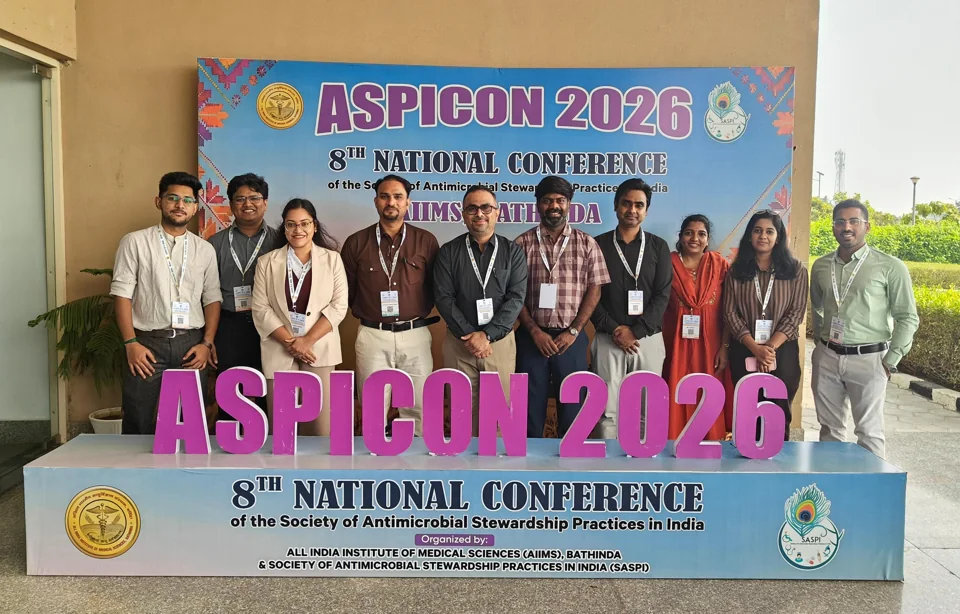
Academic participation extends beyond the Raipur campus. In October 2026, a multidisciplinary AIIMS Raipur delegation attended ASPICON at AIIMS Bathinda. The group included pharmacologists, microbiologists, an infectious disease physician, residents and an intern. Participants contributed research presentations and shared the institute’s antimicrobial stewardship experience with colleagues from other institutions.
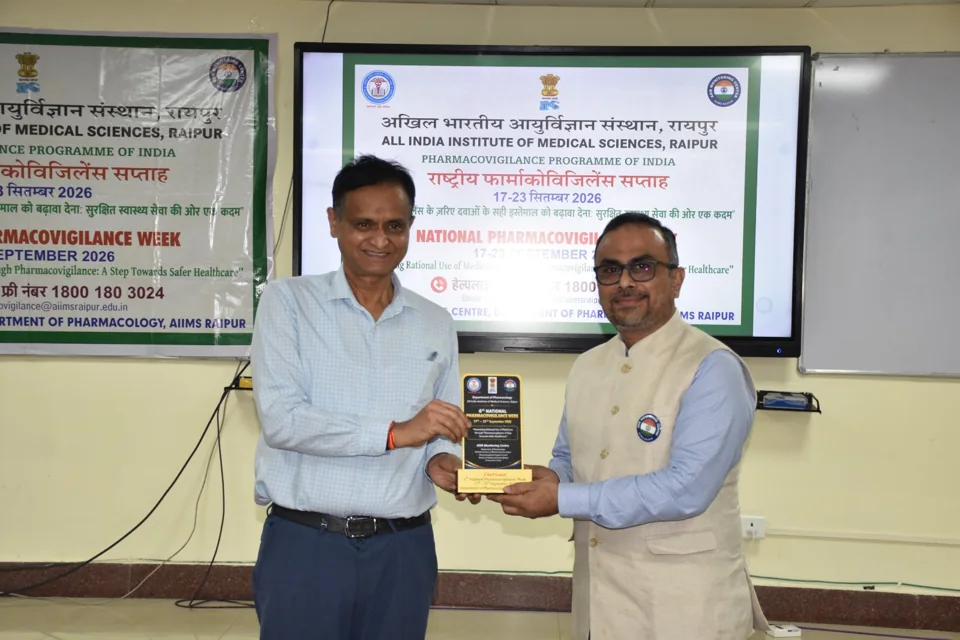
Within Raipur, the Department of Pharmacology organised activities for the sixth National Pharmacovigilance Week. As an adverse drug reaction monitoring centre within India’s pharmacovigilance programme, it brought together healthcare professionals and students for awareness work. The reported activities included a medicine-safety pledge and attention to adverse drug reaction reporting. These events illustrate professional exchange and education as continuing parts of institutional life.
Sources: AIIMS Raipur delegation at ASPICON 2026 ↗ · National Pharmacovigilance Week ↗