Visa
About Alipurduar University
A university rooted in the Dooars
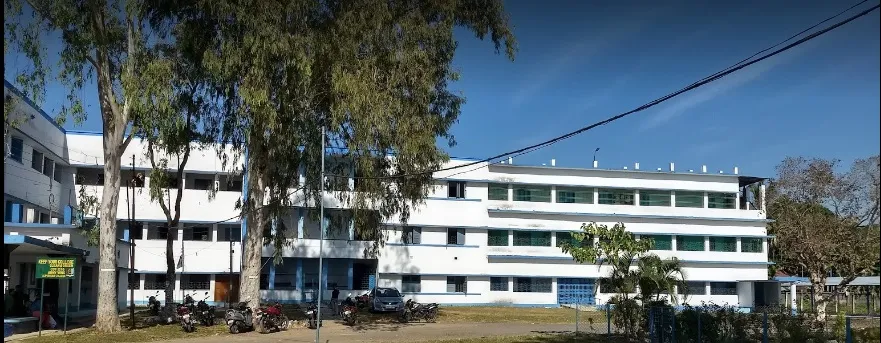
Alipurduar University is a public university in Alipurduar, West Bengal, with an educational history rooted in the former Alipurduar College. The university's account connects the college's creation with the demand for higher education in the Dooars following Indian independence and Partition. A local initiative sought a degree college under the Refugee Rehabilitation and Development Programme in 1956, and the institution opened in 1957. It was initially affiliated with the University of Calcutta and transferred its affiliation to the University of North Bengal after that university was established in 1962. The state government subsequently decided to upgrade Alipurduar College, and the Alipurduar University Act was notified in 2018. The university's institutional overview records the appointment of its first Vice-Chancellor and the beginning of active university life in 2020. The university and its college heritage therefore represent successive stages in expanding higher education in this part of northern West Bengal.
Sources: About Alipurduar University ↗
The statutory transition
A West Bengal Higher Education Department notification published in January 2021 sets out another stage in this transition. It identifies Alipurduar University as a state-aided university created by upgrading the existing college under the 2018 Act. The notification records that the first Vice-Chancellor had been appointed and that academic and administrative functions had begun. Certain transitional provisions of the Act were already effective. The Governor then appointed 7 January 2021 as the date from which all provisions of the Act would operate. This distinguishes the enactment establishing the university from the subsequent implementation of its complete statutory framework.
Study across arts, commerce and science
The university's published academic documents describe undergraduate and postgraduate education across arts, commerce and science. The 2025–26 undergraduate structure includes four-year programmes leading to honours or honours with research, with a single major and minor, alongside multidisciplinary combinations. Listed subjects include Bengali, English, history, philosophy, political science, geography, economics and Sanskrit. Science routes include physics, chemistry, mathematics, botany and zoology, while the commerce major is identified as accounting and finance. Multidisciplinary options are listed separately for arts, commerce, pure science and biological science. The postgraduate matrix for 2024–25 covers the corresponding language, humanities, social-science, commerce and science subjects. The 2024–26 postgraduate document distinguishes MA, MCom and laboratory-based science categories and presents study through four semesters. These dated documents describe the breadth and organisation of the university's teaching.
Sources: Undergraduate programme structure and subject matrix, 2025–26 ↗ · Postgraduate subject matrix, 2024–25 ↗ · Postgraduate programme categories, 2024–26 ↗
Physics and its research groups
The Physics Department's profile dates its establishment within the university to 2020. It describes bachelor's and master's study organised through a semester system. Research groups work in relativity, cosmology and astrophysics; plasma physics; and theoretical nonlinear optics. Students in the specialist part of the programme choose among these areas. The department identifies a library, computer laboratory and other laboratories as facilities supporting its academic work. Its faculty expertise includes solid-state physics, astronomy, X-ray astronomy and astrophysics alongside plasma and optical research. Seminars, conferences and outreach programmes extend activity beyond regular classes. The profile also describes collaborative research both within the university and with researchers at other institutions in India and abroad.
Sources: Department of Physics profile ↗
English and the college heritage
The English Department traces its own history to the opening of Alipurduar College in 1957. Its profile identifies English as one of the first departments established when the college became a university, maintaining undergraduate and postgraduate teaching in parallel. The department describes a student community drawn from the Dooars, neighbouring districts and lower Assam, giving its teaching a regional setting. Faculty specialisations listed in the profile include Indian writing in English, American literature, postcolonial literature and gender studies. These areas bring together different literary traditions and approaches to cultural analysis. The department's continuity across the college and university periods is an important part of its account of academic development.
Sources: Department of English profile ↗
Botany and plant-related research
Botany combines undergraduate education with an MSc programme. The department's profile describes major and minor courses within the four-year undergraduate framework and also identifies the earlier CBCS honours route. Laboratory instruments and equipment support its teaching and research activities. The faculty specialisations span plant biochemistry and physiology, mycology, plant pathology, algal diversity and microbiology. Other listed research interests include cell biology, nanotechnology and genetic toxicology. Together, these interests show the department's engagement with plants at several scales, from cellular processes to microorganisms and biological diversity. The profile distinguishes the course structures from the individual research interests of its teaching staff, providing a concise picture of its academic scope.
Sources: Department of Botany profile ↗
The Central Library
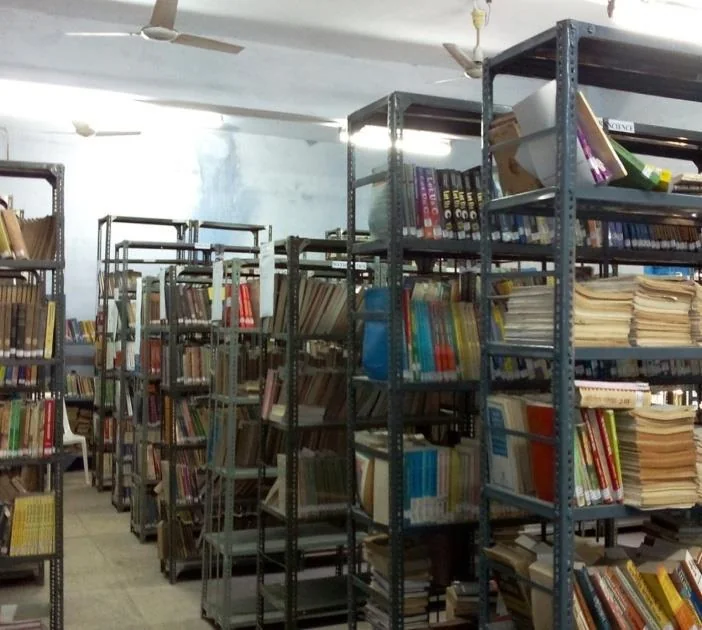
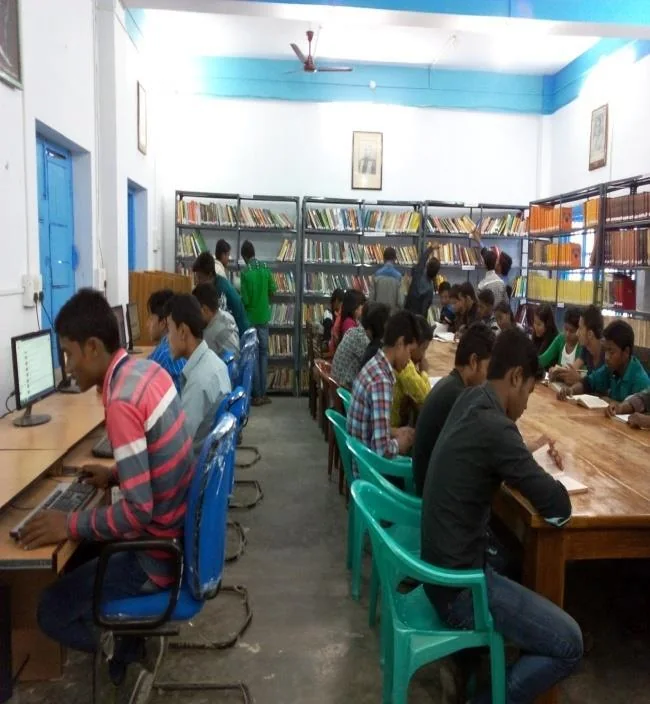
The Central Library supports teaching and research with books, periodicals, reference materials and electronic resources. Its profile describes reading space, internet-connected computers and access to N-LIST and other online material. Book and journal searching uses e-Granthalaya software. Services include lending, reference access, new-arrival displays and user orientation or information-literacy activity. Separate stack areas serve science and commerce, and arts subjects. A circulation counter and help desk connect these collections with readers. The library's published photographic gallery documents its reading room, shelving and orientation activities, providing a view of the facilities supporting individual study and access to academic information. Its rules describe barcode-based membership cards and session-by-session renewal, with reference books and periodicals retained for use inside the library.
Sources: Central Library profile and photographic gallery ↗