Visa
About Aligarh Muslim University
From MAO College to a university
Aligarh Muslim University developed from the educational work of Sir Syed Ahmad Khan in northern India. The university's history records the foundation of Muhammadan Anglo-Oriental College at Aligarh on 7 January 1877 and its transformation into AMU in 1920. Sir Syed's approach combined engagement with English education and Western science with the preservation of Islamic values. His earlier Scientific Society, established in 1864, translated scholarly works into Indian languages. The college's residential organisation became an important part of its educational character. The university's establishment consequently represented a new institutional stage in a broader educational movement, rather than the beginning of teaching at Aligarh.
Sources: University history ↗
Academic breadth and campus life
AMU is a public university in Aligarh, Uttar Pradesh. Its academic offer extends across the humanities, social sciences, natural sciences and professional education, with specialist institutions for engineering, medicine, dentistry and other subjects. Women's education, technical and vocational study, and interdisciplinary fields also form part of its institutional structure. Beyond Aligarh, the university identifies study centres at Murshidabad in West Bengal, Malappuram in Kerala and Kishanganj in Bihar. Residential halls are a significant feature of the main campus. Cultural clubs, sports and student activities complement teaching, while study in Indian, Oriental and Western languages reflects the university's breadth of linguistic traditions.
Sources: University facts and academic scope ↗
English, language and literary study
The Department of English places its own history within three stages: the Madrasatul Uloom school of 1875, MAO College from 1877 and the university from 1920. Today its work includes English language teaching alongside literary and cultural studies at undergraduate, postgraduate and research levels. Shakespeare studies and comparative literature sit beside newer fields such as digital, medical and environmental humanities. Research also considers Indian and South Asian writing, including multilingual literatures studied in translation. The Raleigh Literary Society and student discussion forums provide settings for literary debate. General English teaching extends the department's contribution beyond its own specialist students to learners across other university departments. English language teaching students receive practical teaching experience, while translation research includes rare texts of historical, literary and cultural significance associated with Aligarh and Uttar Pradesh.
Sources: Department of English ↗
Computing education and research
Computer science at AMU grew from computing facilities established in 1971 and became an independent department in 1988. Its educational history includes the introduction of postgraduate computer applications teaching in the 1980s and the later development of undergraduate and doctoral study. The department's description addresses computing foundations, software systems, mathematical modelling, research methods and professional ethics. Artificial intelligence, machine learning, cyber security and digital forensics appear in its developing postgraduate specialisations. Its facilities include computing laboratories, smart classrooms and a conference room. Programme objectives connect technical problem-solving with communication, teamwork and responsible handling of research. This places the study of computing within both a practical and a scholarly educational setting.
Sources: Department of Computer Science ↗
Plant science at Aligarh
The Department of Botany was established independently in 1923, with postgraduate teaching beginning in 1930 and research in 1935. Its teaching and research areas include plant pathology, plant physiology, cytogenetics, plant breeding, environmental botany, biotechnology, systematics and allelopathy. Undergraduate, master's and doctoral education are supported by a departmental library and a botanical garden at the university fort. The department also organises seminars, conferences and scientific talks. Its educational objectives give attention to laboratory and field techniques, scientific communication and ethical research. The combination connects the observation and classification of plants with experimental study of their functions, environmental responses and applications.
Sources: Department of Botany ↗
Maulana Azad Library
Maulana Azad Library is AMU's central library and holds manuscripts, rare books and other research materials alongside modern scholarly resources. It supports a wider network of college and departmental libraries. Its published objectives include acquiring and organising relevant material, providing user-oriented services and introducing readers to the resources available to them. Digital access includes the AMU e-library platform, bringing together subscribed and open-access books, journals, lectures, theses and other materials. The library also participates in accessible reading provision through Sugamya Pustakalaya for eligible readers with print disabilities. User orientation and staff training complement the collections, helping connect preservation of older scholarship with contemporary study and research. An online catalogue, institutional repositories and thesis collections provide further entry points into scholarly material. The library also participates in India's One Nation One Subscription initiative, connecting its research community with journals available through the national scheme.
Sources: Maulana Azad Library ↗
Coordinating research
The university's Research and Development Cell has a remit to encourage research, innovation and technology development with industrial and societal relevance. Its organisational structure includes committees concerned with research policy, collaboration, finance and infrastructure, product development, commercialisation and intellectual-property matters. These functions provide an institutional framework alongside the research undertaken within individual departments and specialist units.
Sources: Research and Development Cell ↗
Academic exchange and collaboration
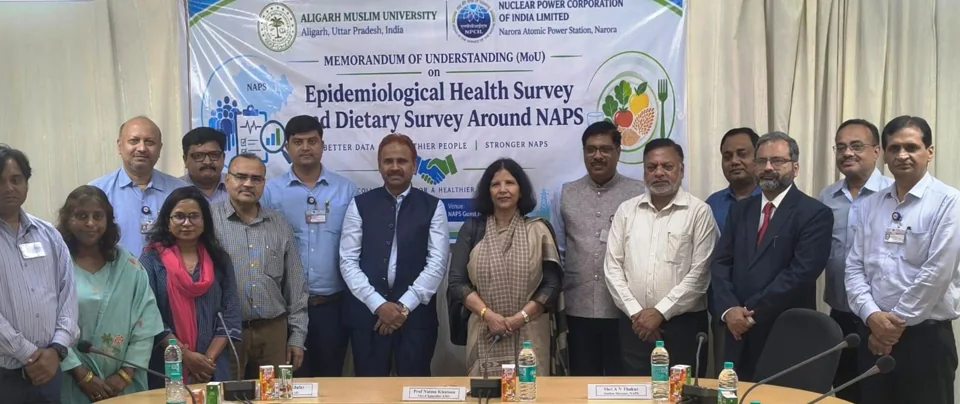
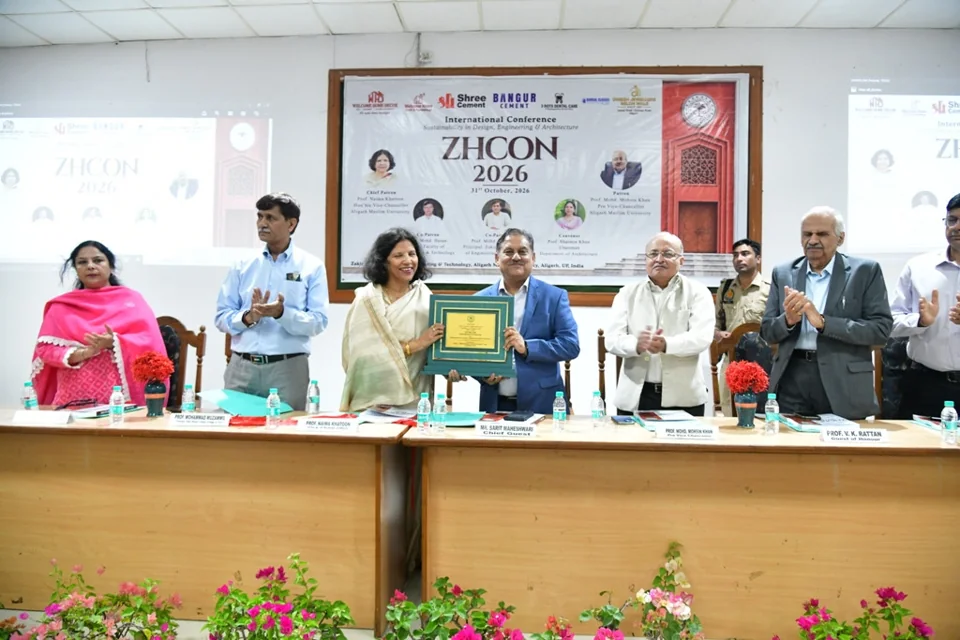
Recent university reports provide examples of this academic activity. A report published in November 2026 describes an engineering and architecture conference addressing sustainability, renewable energy, green buildings and resource conservation through contributions from several disciplines. Another November report documents an agreement between AMU and the Nuclear Power Corporation of India Limited for proposed health and dietary surveys around Narora Atomic Power Station. The latter project involves the Department of Community Medicine and is described as requiring ethical approval before the studies proceed. Both reports illustrate connections between university scholarship and questions raised by professional and public-sector organisations.
Sources: Engineering sustainability conference report, November 2026 ↗ · AMU and NPCIL research agreement report, November 2026 ↗