Visa
About Alagappa Government Arts College
A college rooted in Karaikudi
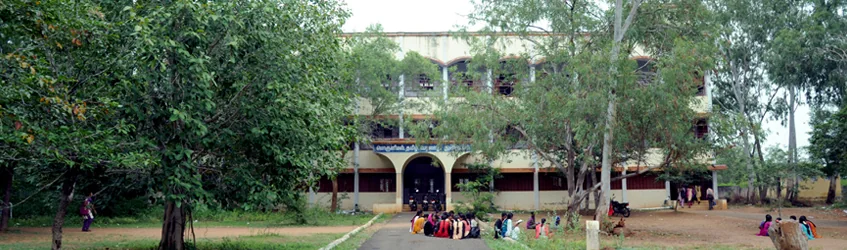
Alagappa Government Arts College is a coeducational government college in Karaikudi, Tamil Nadu. Its published address places it in Iluppakudi village in Karaikudi taluk, Sivaganga district. Dr RM Alagappa Chettiar founded the institution on 11 August 1947 with the aim of widening access to higher education in the former Ramnad district. Teaching initially took place in Gandhi Maligai, followed by the inauguration of a new college building in 1948. Originally privately managed and affiliated to the University of Madras, the college came under Tamil Nadu government management in 1985. Its history also records a period of affiliation to Madurai Kamaraj University; today the college identifies Alagappa University as its affiliating university. The institution has developed from its original arts-college foundation into a setting for undergraduate, postgraduate and research study.
Sources: College history ↗
The undergraduate subject range
The undergraduate programme list shows a combination of humanities, commerce, management, computing and science. Arts subjects include Tamil, English, History and Economics, alongside the Bachelor of Commerce and Bachelor of Business Administration. Science provision includes Mathematics, Physics, Chemistry, Botany, Zoology, Geology and Computer Science. The list also includes the Bachelor of Computer Applications. The published teaching-medium information identifies Tamil for the Tamil and History programmes and English for the other listed undergraduate subjects. Several programmes are organised across two shifts. This range places language and historical study alongside laboratory sciences, quantitative subjects and commercially oriented study within the same college.
Sources: Undergraduate programmes ↗
Economics and classroom participation
The Economics Department traces its teaching to the opening of the college in 1947 and describes provision extending from degree study to research. Its account combines the study of economic theories and the national economy with decision-making and communication skills. Departmental activities include seminars, conferences, workshops, quizzes and role play. Students also encounter computer education, soft-skills programmes and preparation for competitive examinations. Smart-class teaching and opportunities to give PowerPoint presentations in seminar classes are identified as part of the learning environment. Books, journals, magazines and newspapers provide material for reference and discussion.
Sources: Economics Department ↗
Computing teaching and departmental resources
Undergraduate Computer Science began in 1998, and the postgraduate course followed in 2005. The department describes a computer laboratory and its own subject library, together with an audiovisual room equipped with an LCD projector. These resources support technical teaching and presentations. Faculty act as mentors during courses, and the department holds parent-teacher meetings following the publication of semester results. Its listed research interests span networking, data structures, software engineering, compiler design, neural networks, fuzzy systems and digital image processing. This account places practical computing facilities alongside a range of theoretical and applied research topics, connecting undergraduate teaching with more specialised areas of computer science.
Sources: Computer Science Department ↗
Geology collections and field-related study
Geology has a long institutional history: the undergraduate department began in 1949, with technical guidance from Professor P Muthusamy Iyer, and became a postgraduate and research department in the 2012–13 academic year. Its geological museum contains minerals, rocks and fossils, including specimens from several countries. The departmental facilities include laboratories with compasses, GPS equipment and different types of microscope for examining geological material. A sedimentology laboratory supports the analysis of sediments, while remote-sensing and geographical information systems facilities support work with aerial and satellite data. The department also maintains a subject library and journal collections. Its described research areas include storm and tsunami deposits, hydrogeology, hydrogeochemistry, natural-resource management and remote sensing. Seminars, workshops and invited lectures supplement the regular academic programme.
Sources: Geology Department ↗
Plant science and research
The Botany Department offers undergraduate, postgraduate and doctoral study and identifies Alagappa University as its affiliating university. Its facilities include a laboratory, museum, instrumentation room and classrooms. Research interests listed by the department include plant systematics, pharmacognosy, phytochemistry, seed physiology, environmental science, plant biotechnology and genetic engineering. The department also describes projects in crop biotechnology, plant physiology, plant pathology, medicinal-plant biology, secondary metabolites and algal biotechnology. These subjects connect the study of plant structure and classification with laboratory investigation and environmental questions. Faculty collaboration and research publication form part of the departmental account of its academic work.
Sources: Botany Department ↗
Library collections and access
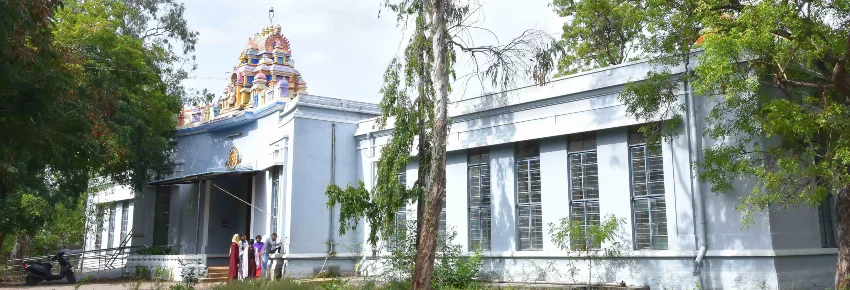
The college library occupies a traditional campus building with a circulation counter, reading hall, reference room and stack room. Its collections include textbooks, reference works, journals, magazines and newspapers, together with rare books and first editions. Students and staff use an open-access arrangement that allows them to browse shelves and select material. Rare and reference collections are reserved for consultation within the library. A reference-desk service helps users find books and periodicals, and new students receive an orientation at the beginning of the academic year. Internet facilities provide access to electronic resources through the N-LIST programme as well as freely available databases. Library development is supported by an advisory committee involving the principal and librarian.
Sources: College library ↗
Sport and the wider educational environment
The physical-education provision includes a multipurpose ground for activities such as cricket, athletics and handball. The college also lists football and hockey fields, courts for basketball, volleyball, ball badminton and kho-kho, cricket nets, table-tennis equipment and a multi-gym. A sports advisory committee forms part of the organisation of this provision. The college presents sport and games as an integral component of its educational programme and links participation with the broader development of students. These facilities provide opportunities for physical activity alongside classroom, laboratory and library work.
Sources: Sports and physical education ↗
Organising academic research
The college describes research as a component of postgraduate education and provides a Research Committee to facilitate and monitor scholarly activity. The committee meets periodically to assess research work and programmes undertaken by staff. Its published account also describes faculty supervision of final-year postgraduate science projects. At departmental level, this institutional framework is reflected in the specialised resources and research interests described in computing, geology and botany. Research organisation therefore operates both through a college committee and through the subject departments where students and faculty undertake their academic work.
Sources: Academic research ↗