Visa
About Al Noor University College
The college name and the university today
Al Noor University College is the earlier name of the private institution now operating as Alnoor University in Nineveh Governorate, Iraq. It began academic activity in 2013 with four departments: law, physical education and sports sciences, Arabic and English. Its official history records relocation to an alternative site in Al-Sheikhan, followed by a move to Bartella in 2017. A permanent campus was subsequently developed at Al-Shallalat, with construction completed in 2020 before the institution moved there. The college became Alnoor University under Ministry Order 7565 dated 1 April 2024. The directory's college name therefore refers to the same developing institution, rather than a separate college operating alongside the university. Its address places it on Al-Shalalat Road in the Mosul area.
A multidisciplinary institution in Nineveh
The university's 2026 introduction describes academic provision spanning medical and health subjects, technical and engineering fields, administrative studies and the humanities. Its development has included classrooms, laboratories and educational dental clinics, alongside research and community activities. Cultural heritage is another part of its public mission: the university identifies archaeological tourism, heritage-preservation research and Mosul Heritage Day among its connections with local history. Its environmental activities include tree planting, recycling and the adoption of solar energy. The same account describes electronic portals and digital payment mechanisms as part of university administration, with transport routes linking the campus to Mosul neighbourhoods and surrounding districts. This combines academic expansion with attention to the practical and cultural setting of university life.
Sources: University establishment and development ↗
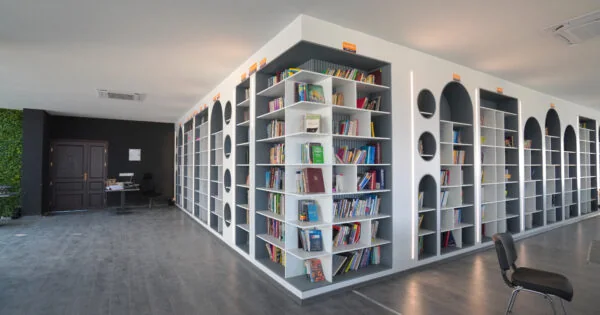
Library collections and reading spaces
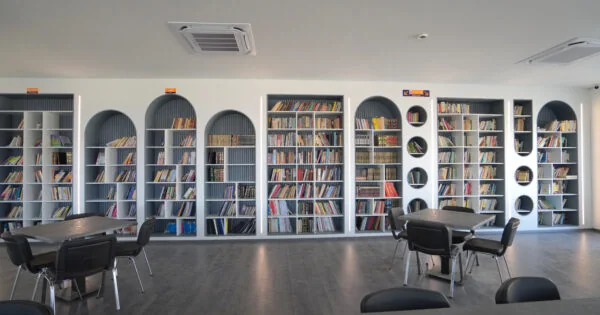
The university library brings together books across sciences, literature and other academic disciplines, as well as master's theses, doctoral dissertations, journals and periodicals. Its description lists medical and scientific materials, law and political science, Arabic language and literature, fiction, sport, psychology and religious subjects. The library uses open shelves so readers can approach materials directly and explore related subjects. Collections are supplemented through college deanships and gifts from faculty, staff, students and other contributors. A reading hall with tables provides space for reviewing course material, research and general reading. The library also describes electronic archiving of books as part of its continuing development, with a link to the university's electronic library.
Sources: Alnoor University Library ↗
Research and specialist centres
Alnoor's scientific-centres page identifies centres for smart agriculture, continuing education, cultural heritage preservation, and linguistics and languages. Their stated roles connect research with practical application and community activity. Continuing education is intended to develop people's capabilities through further learning, while heritage work addresses documentation and cultural identity. Smart agriculture contributes a technological and environmental focus, and language-related work supports linguistic research and communication between cultures. The university describes the centres as a platform for producing knowledge and developing cooperation with other institutions. Together, their different subject areas extend academic activity beyond individual degree departments, bringing professional development, cultural enquiry, environmental questions and language study into the university's research and service agenda.
Sources: Scientific and Research Centers ↗
English language and literature
The English Language Department in the College of Education dates its establishment to 2013. It awards a bachelor's degree in English language and literature and describes study through four academic stages. Students encounter grammar, pronunciation, writing and literature, together with methods of teaching English. The department's stated mission gives attention to modern teaching approaches and audiovisual aids. Its published 2023–2024 study tables illustrate this combination: language and literature courses appear alongside educational psychology, teaching methods, assessment, research and practicum-related work. The department also provides links to course descriptions, programme information and learning resources. The listed final-stage work includes graduation research, translation, language testing, advanced listening and speaking, and classroom observation and application. Its account presents curriculum review as an ongoing responsibility, connecting knowledge of English with how it is learned and taught.
Sources: English Language Department, College of Education ↗
Translating work on energy economics
On 2 November 2026, the university announced an Arabic translation of Oil and Gas Economics, a book authored by Xiaowei Mo. The translator, Jamal Mohammed Najeeb, was identified as an assistant dean and faculty member in the College of Technical Management with a specialism in oil and gas economics. The report describes a book following the industry from exploration and production to refining and marketing. Economic theories and analytical tools are discussed alongside technical and institutional knowledge. This publication offers a specific example of a faculty member's scholarly contribution through translation, making work on the economic and political dimensions of the energy sector accessible to Arabic-reading researchers and students.
Sources: Oil and Gas Economics book translation, 2 November 2026 ↗
Academic exchange with the University of Mosul
Another report dated 2 November 2026 records participation by Diaa Najm Abdullah of Alnoor's College of Health and Medical Technologies in a master's thesis discussion at the University of Mosul. The thesis was presented in analytical chemistry at Mosul's College of Science and concerned spectrophotometric methods for determining pharmaceutical compounds and analysing pharmaceutical preparations. The account places Alnoor's faculty member within an academic committee at another Iraqi university. This is a concrete example of exchange between institutions through postgraduate assessment and specialist discussion. It complements the university's broader descriptions of conferences, workshops and scholarly cooperation by showing a particular occasion on which academic expertise was shared.
Sources: Faculty participation in a University of Mosul thesis defense, 2 November 2026 ↗