Visa


About Aktobe Regional State University named after K.Zhubanov
Identity and institutional development
The directory name Aktobe Regional State University named after K. Zhubanov refers to the institution now known as K. Zhubanov Aktobe Regional University, or Zhubanov University. Located in Aktobe in western Kazakhstan, it connects a long history of teacher education with a wider range of university disciplines. Its namesake is the Kazakh linguist Kudaibergen Zhubanov, whose name was given to the pedagogical institute in 1990.
The university traces its teaching history to classes that began in January 1935, initially in history, physics and mathematics. The pedagogical institute later closed in 1958 and reopened in 1966. It became a university in 1996 and received state status in 2001. Following a separation involving the pedagogical institute in 2004, the two institutions were brought together under a May 2013 government resolution as Aktobe Regional State University named after K. Zhubanov. An October 2019 resolution reorganised the institution as the non-profit joint-stock company K. Zhubanov Aktobe Regional University, explaining the difference between the older directory title and its current name.
Sources: University history ↗
Academic range and professional preparation
Zhubanov University provides education at bachelor’s, master’s and doctoral levels. Its academic framework includes educational programmes, academic mobility, additional education and professional practice. The university describes its approach as combining academic knowledge with practical skills, supported by arrangements for research practice, teaching practice and placements. This extends professional preparation beyond classroom instruction and connects study with the activities of organisations outside the university. Additional education includes pedagogical retraining and advanced training courses.
The internship rules give a concrete account of that process. Placements follow the relevant specialist courses or theoretical preparation, while graduation internships take place after theoretical study has been completed. The responsible department develops and approves the placement programme. Enterprises and other organisations serve as practice bases. Students prepare a report afterwards, which is checked by the placement supervisor and defended before a departmental commission. The process therefore combines experience in a professional setting with an assessed account of what the student has learned.
Sources: Academics ↗ · Organisation of internships ↗
Engineering and industrial connections
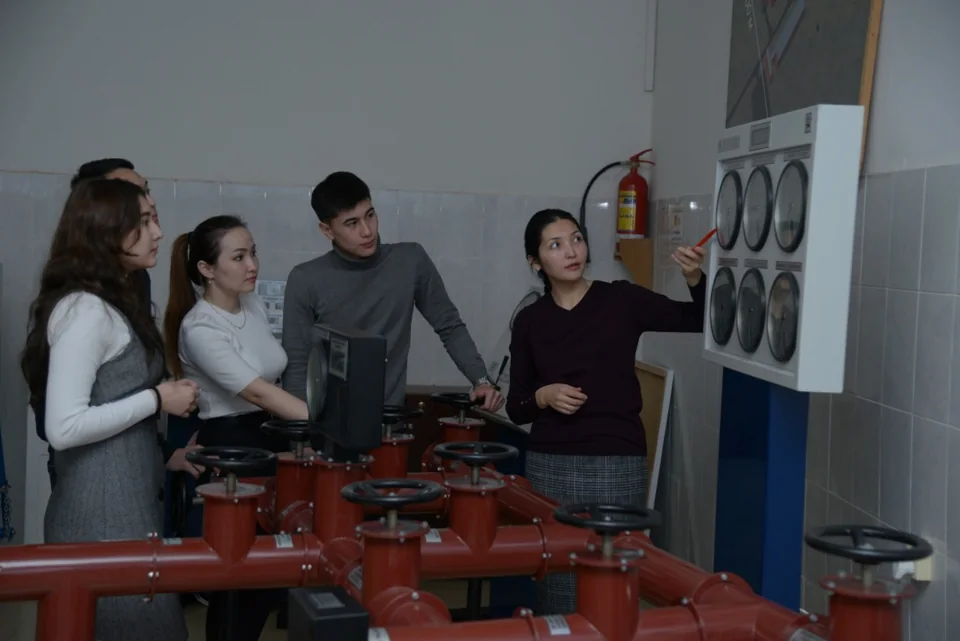
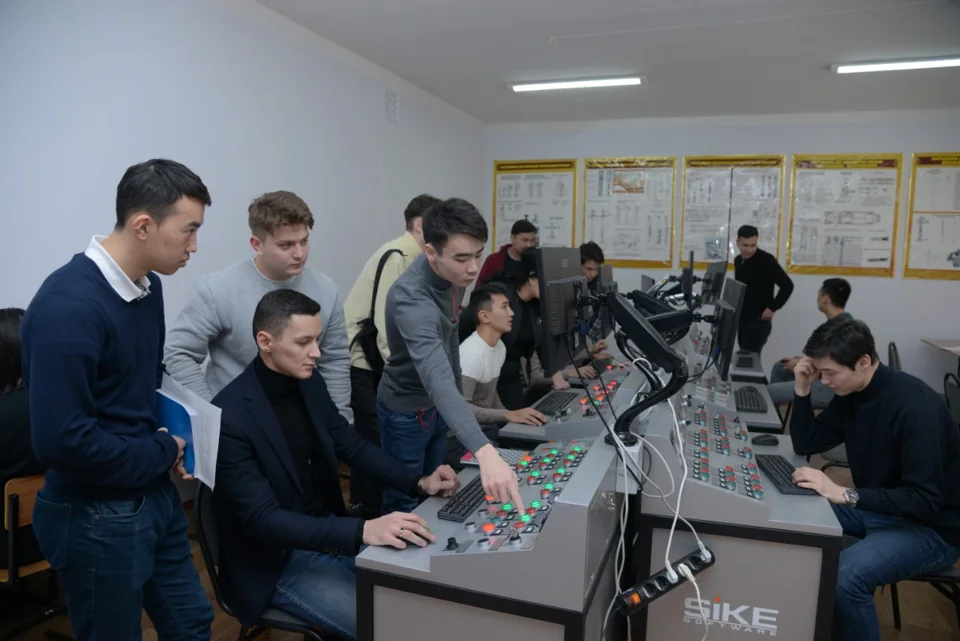
The engineering school developed from an engineering and pedagogical faculty, with its technical faculty established in 1991. Its early preparation for teachers of practical subjects provided foundations in mechanics, materials, hydraulics, drawing and standardisation. Technical specialisms subsequently expanded in response to western Kazakhstan’s industrial setting, including metallurgy, transport, construction, mining and oil and gas. The school’s history describes practical teaching with drilling and well-repair simulators, alongside software and hardware training systems. It also records research concerning oil-sludge processing and methods of intensifying oil production. These examples connect technical education with processes and equipment used in regional industry.
Sources: School of Engineering history ↗
A partnership with Heriot-Watt University
An international dimension is provided by the strategic partnership with Heriot-Watt University, launched in 2023. Heriot-Watt’s own description identifies four-year double-degree undergraduate programmes in Electrical and Electronics Systems, Petroleum with Transition Engineering, and Computational Sciences with Software Engineering. The partnership also sets out shared work in research capability, industry collaboration, teaching and learning, and staff and student exchange. These are specific collaborative programmes within the Aktobe setting, extending the university’s engineering and computing links through cooperation with an overseas partner.
Sources: Heriot-Watt University: strategic partnership in Aktobe ↗
Museum and educational heritage
The university museum preserves the history of education in the Aktobe region. It was developed in 1989–1991 through the initiative of Mukhtar Aryn, with the purpose of collecting valuable records and rare materials relating to the region’s educational development. Its holdings include archival documents, older textbooks, manuscripts, models, photographs and accounts of teachers’ lives and work. The museum describes preservation, documentation, research and educational activity as connected responsibilities.
Its educational role includes encouraging students to investigate original historical materials and develop their interest in research. The museum also identifies cooperation with schools, pedagogical higher education institutions and colleges as part of its work. This makes the collection relevant to the university’s own teacher-education heritage as well as to the wider history of regional schooling.
Sources: University museum history ↗
Student participation and wellbeing
Student self-government coordinates a range of activities beyond formal study. The university identifies debate and academic clubs, creative communities, an information technology community, volunteering and sports leagues among the areas of participation. Sporting activities include futsal, volleyball, basketball, tennis, Kazakh wrestling and togyzkumalak. These activities provide ways for students to organise shared interests and contribute to campus life, alongside their academic responsibilities.
The Health and Wellbeing Center was established in the 2021–2022 academic year to provide psychological support for students and employees. Its described work includes individual and group counselling, psychological training, support groups, assistance for students living in dormitories, and seminars concerned with wellbeing and professional burnout. The centre also undertakes educational and awareness activities. A student Mental Health club, established in October 2023, adds a peer-support element and encourages attention to emotional wellbeing within the student community. Its outreach includes participation in the international campaign against violence and Mental Health Awareness Week. Since 2023, the centre has also hosted an international forum on the psychological and mental health of young people, bringing these subjects into wider discussion alongside its individual support work.
Sources: Student life ↗ · Health and Wellbeing Center ↗