Visa
About Aktau State University
The historical Aktau State University name
Aktau State University is a historical name in the development of the institution now known as Yessenov University in Aktau, Kazakhstan. The university's official history identifies the creation of Aktau State University named after Shakhmardan Yessenov in 1996. Its faculty history independently confirms that the Aktau branch of Atyrau University and Aktau Polytechnic Institute formed the foundation of that institution. The consolidation widened the educational base beyond its original technical focus. Maritime specialities followed in 1998, and master's programmes began in 2000. Subsequent development brought new academic facilities, a larger campus and institutional reorganization. The present university uses the Yessenov University identity and describes its legal development as including reorganization into a non-profit joint-stock company in 2020. The historical name therefore belongs within this continuing institutional story, while the present-day services described below are those of Yessenov University.
Sources: Yessenov University institutional history ↗ · Pedagogy faculty history, independent confirmation of the 1996 consolidation ↗
Technical education and the route to consolidation
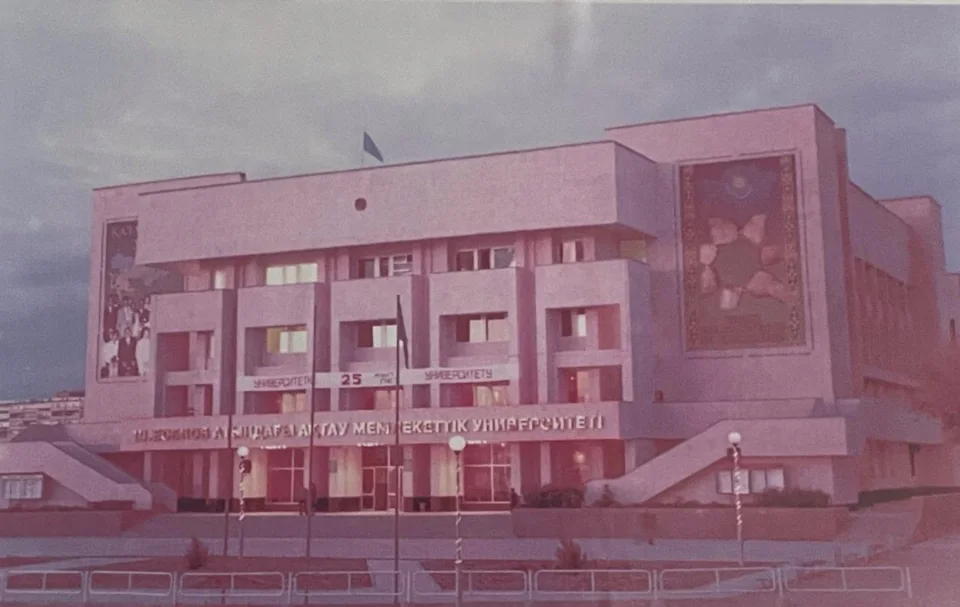
The earlier foundation was a general technical faculty of the Kazakh Polytechnic Institute, established in Shevchenko, now Aktau, in 1976. Its purpose was to develop an academic base for engineering education in western Kazakhstan. The institution subsequently passed through branch and institute structures as teaching and facilities expanded. In 1993, the Mangystau branch became Aktau Polytechnic Institute, creating an independent institution before the later university consolidation. The official archived history records the creation of Aktau State University from that institute and the Aktau branch of Atyrau University on 7 May 1996. It describes a multidisciplinary institution serving technical, oil and gas, legal, economic and pedagogical fields. Buildings, teaching workshops, a computing centre, a reading room, accommodation and sporting facilities supported education during this earlier phase of the university's development.
The successor university and its regional mission
The current university describes its mission in relation to education, research and the sustainable development of the Mangystau region. Its stated values are openness, engagement and creativity. Strategic objectives include developing a regional research and education hub, strengthening academic work, improving social and campus infrastructure and using digital systems in university management. This regional emphasis connects the institution with the Caspian setting in which it developed, while its educational ambitions also involve broader cultural and civic participation. The university identifies human development and the formation of a shared institutional culture among its priorities. These are stated objectives guiding the present institution's work, alongside the specialist teaching traditions inherited from earlier technical and pedagogical education. They provide context for the academic, international and student-life activities now presented under the Yessenov name.
Sources: Current university mission and strategic objectives ↗
Academic organization and learning support
Yessenov University's current academic organization includes pedagogy, philology, sport, business and tourism, law and international relations, computing and artificial intelligence, engineering and maritime education. Its academic information addresses undergraduate, master's and doctoral study as well as lifelong learning. Published policy areas cover assessment, academic integrity, course materials, blended learning, professional practice and doctoral research. Supporting units include academic affairs, registration, educational resources, the library and international services. An academic council reviews programmes and academic decisions, while published forms cover course syllabi, professional-practice agreements, practice diaries and student reports. The university also describes tutoring by senior students and master's students, with individual and group consultation for learners needing help with a course. Writing support concerns the structure of papers and theses, citation and academic style. Accessibility support includes adjustments to learning materials, timetables, classroom access and assessment arrangements. These services are part of the present university's academic framework, complementing the work organized through individual faculties and programmes.
International projects and academic exchange
The International Office coordinates partnerships, student and staff exchange, double-degree activity and scientific collaboration. Its published priorities include outgoing mobility, participation in international projects, visiting lectures, academic events and relationships with research organizations abroad. The university's project record includes KUTEL, a 2018–2021 initiative concerned with quality assurance for technology-enhanced learning in Kazakhstan, and UXiship, a 2019–2022 project involving entrepreneurship within engineering curricula. PICASP, listed for 2021–2023, focused on practical business courses linked to university-enterprise cooperation in the Caspian region. GEOCLIC, listed for 2021–2024, concerned geospatial engineering and coastal ecosystems. These dated projects show several forms of cooperation beyond an individual student exchange. It also identifies trilingual education and inviting international students and faculty as parts of its internal approach to internationalization. International activity connects educational development and research with partner institutions while the office provides an organizational point for those relationships within the current university.
Sources: Current international cooperation ↗
Campus spaces and student participation
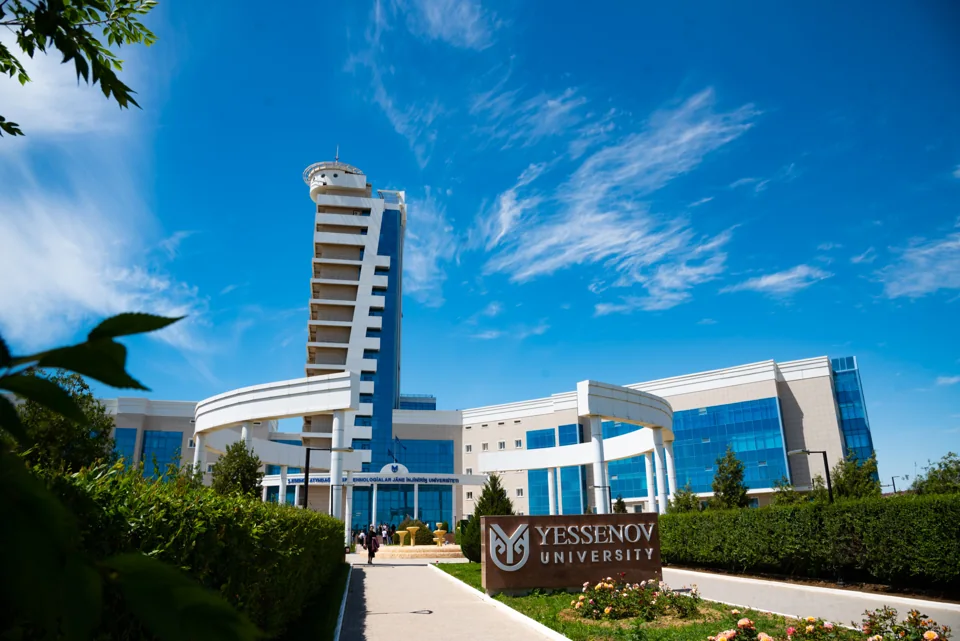
The present campus information describes educational and laboratory buildings, libraries, study halls, accommodation, dining facilities and spaces for sport and meetings. The main university campus is identified with Aktau's 32nd microdistrict, while another teaching location is in the 24th microdistrict. These facilities belong to the present Yessenov University environment and should be understood separately from the older building illustrated in the historical material. Student activities include creative groups concerned with singing, traditional instruments, dance and visual art, alongside sports such as judo, archery, chess, football and table tennis. The student council and student organizations provide further routes to participation. Shared spaces, clubs and recreational facilities create opportunities for contact across academic disciplines. The campus description therefore combines places for formal study with settings for cultural activity, student organization and everyday university life.
Sources: Current successor campus life and facilities ↗