Visa
About Aksu Education Institute
Identity and teacher-education history
Aksu Education Institute, known in Chinese as 阿克苏教育学院, is an educational institution in Aksu Prefecture in the Xinjiang Uyghur Autonomous Region of China. Its institutional history combines adult higher education with the work of a regional normal school. In September 2007, the institute merged with the former Aksu regional normal school and added full-time secondary vocational programmes, particularly in preschool education. This brought preparation for teaching, induction into the profession and subsequent teacher development within the same institution.
A new campus was inaugurated on 15 September 2020, alongside the opening ceremony for the autumn term. The regional newspaper described the relocation as a project to expand the institute’s educational space and improve its teaching environment. Xinjiang’s 2023 approved secondary vocational school register subsequently identified the institution as Aksu Education Institute, with the regional normal school name in parentheses, at 27 Fazhan Road in Wensu County.
Sources: Aksu Daily: new campus inauguration and institutional history ↗ · Xinjiang Education Department: 2023 approved secondary vocational schools ↗
Secondary vocational education
The 2023 register classified the institution as public and placed it under the Aksu Prefecture Education Bureau. Its entry listed full-time, three-year secondary vocational study in computer applications, digital media technology applications, painting, music performance, dance performance, childcare and sports training. These are dated programme records for the secondary vocational side of the institution, alongside its broader teacher-education history. The range includes computing, artistic disciplines and preparation related to children’s care and physical activity. The register records a common institutional code, 4265051717, for the education institute and regional normal school entry.
Sources: Xinjiang Education Department: 2023 approved secondary vocational schools ↗
Practical development for teachers
An account published by Lishui University in August 2025 provides a detailed example of teaching at the institute through the experience of visiting teacher Yang Yi. Her assignment ran from August 2018 to January 2020, when she worked as a training teacher in the institute’s adult education department. Her home academic background was mathematics, including probability, statistics and linear algebra, but the Aksu assignment involved the professional preparation of newly appointed teachers.
The training described in the interview concentrated on simulated teaching and essential classroom skills. Yang taught skills involving Geometer’s Sketchpad, connecting mathematical knowledge with a digital tool for instruction. Her experience illustrates a practical strand of the institute’s teacher development work: helping new teachers rehearse teaching activities and acquire usable classroom techniques. She worked within a visiting team drawn from universities and primary and secondary schools in Zhejiang.
Sources: Lishui University: interview with visiting teacher Yang Yi ↗
Continuing education and digital resources
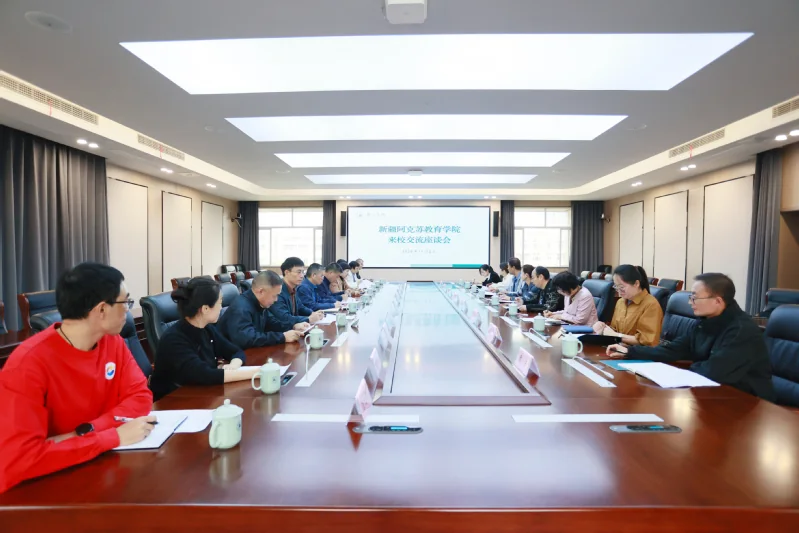
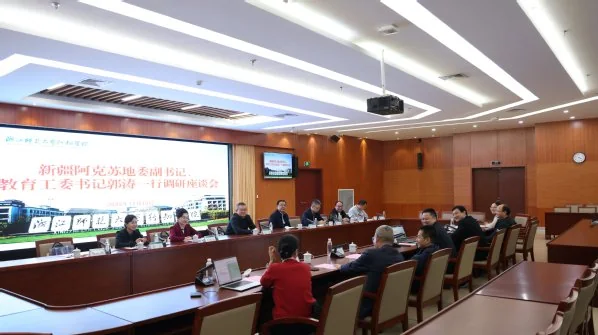
Continuing education remained a subject of institutional cooperation in 2025. In March, representatives of Northwest Normal University’s continuing education college visited the Aksu regional education authorities, Aksu Education Institute and Xinjiang Institute of Technology. Their discussions addressed training management and implementation, demand for adult higher education, the construction of digital resources, and possible cooperation in both qualification-based and non-degree continuing education. At Aksu Education Institute, the visitors toured an educational exhibition area and a digital integrated-media centre.
A separate Zhejiang Normal University visit in June 2025 described Aksu Education Institute as an off-campus teaching point for that university’s higher continuing education. The discussion reviewed the teaching point’s progress, subsequent work and issues requiring joint attention. This relationship places the institute within a continuing education network that includes an external university, rather than treating every course delivered locally as an independently awarded institute qualification.
Sources: Northwest Normal University: continuing education visit, March 2025 ↗ · Zhejiang Normal University: Aksu continuing education visit, June 2025 ↗
Institutional exchange and language education
Aksu Education Institute also maintains exchanges concerning teaching, research and institutional development. During a November 2024 visit to Lishui University, its delegation discussed teacher support, education and research cooperation, and training. The delegation included representatives connected with the Southern Xinjiang Chinese Language Teaching and Research Centre. Lishui had already sent teachers to support the institute, and the meeting considered further collaboration connected with Chinese-language teaching in southern Xinjiang.
In November 2025, representatives of the institute joined an Aksu education delegation visiting Zhejiang Normal University’s Xingzhi College. Discussions covered educational assistance, staff exchanges and cooperation, while the visitors examined the host college’s approaches to applied education, teaching and institutional management. The programme included a meeting in its library and visits to institutional history displays and teaching spaces. These exchanges provide concrete examples of professional contact with partner institutions outside Xinjiang.
Sources: Lishui University: Aksu Education Institute delegation, November 2024 ↗ · Zhejiang Normal University Xingzhi College: Aksu delegation, November 2025 ↗
Participation in educational publishing
The institute’s teachers have also contributed to a collaborative language publication. In November 2025, Xinjiang’s Education Department reported the release of a Chinese–Kyrgyz learner dictionary at the National Library of Kyrgyzstan. The editorial group included teachers from Aksu Education Institute, several other Xinjiang institutions and Osh State University. The dictionary was intended for beginning and intermediate learners of Chinese and teachers working in international Chinese education. Its entries drew on established Chinese dictionaries and vocabulary references, linking the participating teachers’ language expertise with the production of a practical learning resource.
Sources: Xinjiang Education Department: Chinese–Kyrgyz learner dictionary ↗
Physical activity and educational support
In December 2025, a Zhejiang sports-sector delegation visited Aksu Education Institute and another school in the prefecture as part of an educational support programme. The official report described the provision of equipment for activities including basketball, football, badminton, pickleball and fitness training. Coaches also introduced newer activities, including pickleball and drone football, during the visit. The institute’s leadership received the delegation. This engagement adds a physical education dimension to the institute’s documented educational links, alongside its classroom teaching, continuing education and language-related collaborations.
Sources: General Administration of Sport of China: Zhejiang sports education support visit, December 2025 ↗