Visa

About Aksaray University
A university with earlier educational roots
Aksaray University is a public university in Aksaray, Turkey, established on 17 March 2006 under Law 5467. Its local educational history reaches further back. Technical vocational education began in 1986–87 through a school affiliated with Selçuk University. Existing units became part of Niğde University in 1992 before their transfer into the newly established Aksaray University in 2006. This distinction separates the beginning of higher education activity in the city from the creation of the present university. Today, its academic organization includes faculties spanning engineering, computing, education, arts and sciences, economics and administrative sciences, communication, theology, architecture and design, health, sport, medicine, tourism, dentistry and veterinary medicine. Graduate institutes cover science, health sciences and social sciences. Vocational schools and a foreign-languages school form additional parts of the university's teaching structure. These units provide different academic settings within one institution.
Sources: University history ↗ · University academic units ↗
Shared laboratories for research and analysis
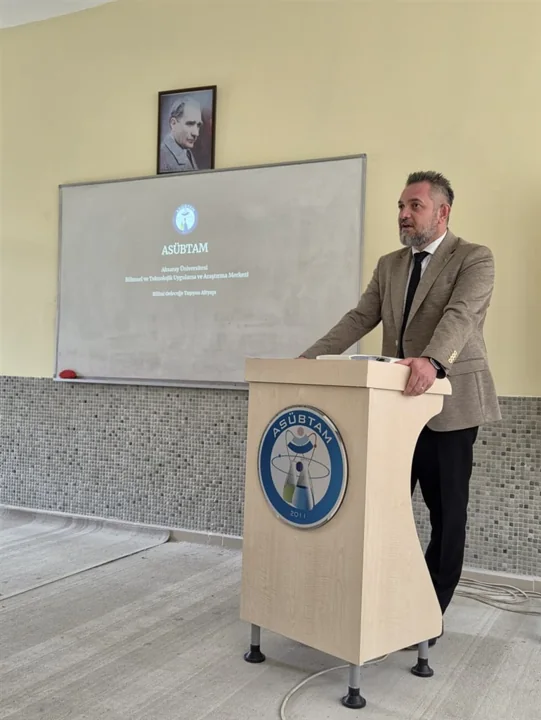
The Scientific and Technological Application and Research Center, ASÜBTAM, began work on 18 July 2011. It provides shared laboratory infrastructure for research and analysis, with student laboratories, project-support space and rooms for scientific meetings and seminars. Its published facilities cover geology, chromatography, spectroscopy, electron microscopy, analytical chemistry, biodiversity, biotechnology, microbiology and molecular biology. Further laboratories address geochemical analysis, aquatic toxicology and the structure of materials. The centre's role includes supporting cooperation between public institutions, the university and industry. Water, soil, environmental and chemical analyses connect its equipment with questions arising outside individual academic departments. Students and researchers can therefore work within a shared analytical environment that brings together several scientific disciplines and different types of laboratory investigation.
Sources: Scientific and Technological Application and Research Center introduction ↗ · Research-centre laboratories ↗
Connecting research with industry
The Technology Transfer Office coordinates the movement of university knowledge toward practical applications. It was established within the rectorate to support public- and private-sector cooperation in research and innovation, protect intellectual property and help translate discoveries into use. Its objectives include developing university-industry relationships, communicating project ideas and funding opportunities, supporting patent applications and encouraging entrepreneurship. The office organizes its activities into five areas: awareness and training, access to support programmes, university-industry cooperation, intellectual and industrial property management, and enterprise development. These functions place project preparation, protection of inventions and cooperation with businesses within one coordinating framework. The office also seeks to help researchers understand industrial needs, connecting the generation of knowledge with possible uses beyond the university.
Academic access and individual adjustments
The Disadvantaged and Disabled Student Unit coordinates academic adjustments according to individual requirements. Its work involves cooperation with academic and administrative departments to identify barriers, plan arrangements, implement them and review their effectiveness. Published examples include accessible course materials, electronic sharing of content, appropriate seating, support for assistive technologies and coordination of note-taking or peer assistance. Assessment arrangements can include additional time, a suitable examination setting, accessible formats and other measures determined through individual evaluation. Laboratory and practical training environments are also considered. Students begin the process by contacting the unit and explaining the difficulties they encounter. The stated purpose is to improve access while preserving academic learning requirements, with attention to privacy, independence and the different needs of individual students.
Library guidance and access to material
The university library offers guidance on its collections, services and research resources. Individuals and groups can request introductory or training sessions to learn how to use the library and locate relevant information. Reference and education staff provide a contact point for questions about those services. An interlibrary document-supply service is also described for academic personnel who need books outside the local collection. Staff first check the university catalogue, then use the national collective catalogue to identify another holding library. Requests are submitted to the document-supply unit through the published form. Together, these services combine help with finding information locally and an organized process for seeking material from elsewhere.
Sources: Library education and reference services ↗ · Interlibrary document supply ↗
Student organizations and shared interests
The student-organization directory shows opportunities to participate in activities across academic, cultural and social interests. Listed groups include creative drama, theatre, photography, archaeology, birdwatching, English conversation and international students. Other organizations focus on engineering, software, cybersecurity, entrepreneurship, climate change, sustainability and energy. Community-oriented interests include children's rights, accessible living and disaster awareness. The university publishes a student leader and an academic adviser for each listed organization, providing an identifiable structure for group activity. This variety creates settings in which students can meet around subjects outside their own courses as well as develop interests connected with their academic departments. Student organizations form part of the wider provision coordinated through health, culture and sport services.
Sources: Student organizations ↗
International academic connections
International Relations coordinates cooperation through Erasmus+, bilateral agreements, mobility programmes, joint projects and academic events. Its stated mission includes developing and maintaining strategic relationships while supporting international experience for students and academic and administrative staff. The office also emphasizes an inclusive campus environment in which people from different cultural backgrounds can participate. Academic networks and cooperation with overseas researchers are part of this remit, alongside student movement between institutions. Its published objectives connect international activity with teaching, research and the university's contribution to society. This gives internationalization a coordinating role across several areas of institutional work, from arranging exchanges to building relationships that may support shared academic projects and meetings.
An applied engineering environment
A university report published on 2 November 2026 describes engineering faculty members, undergraduates and graduate students visiting the National Technology Workshop operating on campus. The visit introduced the workshop's technical facilities and ongoing work. Discussions concerned possible cooperation and opportunities for students to participate in technological and scientific projects. The account provides a specific example of contact between engineering education and a shared campus workshop. It also shows students at different study levels encountering the same applied technical environment alongside their academic staff.
Sources: Engineering visit to the National Technology Workshop, November 2026 ↗