Visa
About Aklan Catholic College
From Aklan College to Aklan Catholic College
Aklan Catholic College is a Catholic educational institution in Kalibo, Aklan, in the Philippines. It began as Aklan College, with classes opening on 9 July 1945 for collegiate and elementary students. Early provision included teacher preparation and liberal arts. The first enrolment comprised 90 college students and 90 elementary pupils. Its initial accommodation was a concrete building at the corner of Plaridel, now Pastrana, and 19 Martyrs Streets. The institution moved to the location now called its Main Campus in June 1948.
The college’s Catholic character developed through the participation of church leaders in its administration and teaching. Its current name was formally adopted after consultation with stakeholders and a board resolution in February 2004; amended incorporation documents were approved on 27 April that year. The historical account also records the establishment of graduate education in 1964 and the reopening of law studies in 1992. These developments form part of the background to the college’s present academic range.
Sources: Brief History ↗
Campuses and academic provision
The college identifies two Kalibo locations: its Main Campus on Archbishop Gabriel M. Reyes Street and Mabasa Campus in Andagao. Its educational provision spans basic education and higher education, including nursery, kindergarten, school-level programmes and college studies. The current programme list includes teacher education, liberal arts, business, computing, criminology, nursing and law.
Teacher-education options include elementary education and secondary education with English, Filipino, mathematics and science specialisations. Business-related subjects include accountancy, accounting information systems, real estate management, tourism, hospitality and business administration. Computing provision includes computer science and information technology. The college also lists postgraduate education and business study alongside its Juris Doctor programme, giving its academic community several levels and fields of study.
Sources: Academic Provision and Campuses ↗
Catholic educational philosophy
The college describes education as equitable, transformative and integral. In its philosophy, equitable education concerns opportunities for learners to participate and develop, while transformation involves considering the world from an ethical perspective. Integral education brings spiritual, emotional, social, ethical and academic development into the same educational approach.
This philosophy connects classroom teaching with co-curricular activity and service. It is grounded in Catholic teaching and presents education as preparation for responsibilities towards other people as well as individual achievement. The emphasis on formation therefore extends beyond subject knowledge to the way learners understand their choices and participate in community life.
Sources: Philosophy of Education ↗
Values and service
Faith is the college’s central stated value. Fidelity concerns commitment to religious belief and church teaching, while excellence is expressed as striving beyond ordinary standards in institutional and personal endeavours. Its accompanying framework uses the letters FACES for fidelity, accountability, character, excellence and service. Accountability includes taking responsibility for tasks and their consequences; character concerns integrity, discipline and behaviour. Service places particular emphasis on caring for others, including marginalised members of society. Together, these values provide the vocabulary through which the institution expresses its expectations for its educational community.
Sources: Core and Care Values ↗
Teacher education and regional exchange
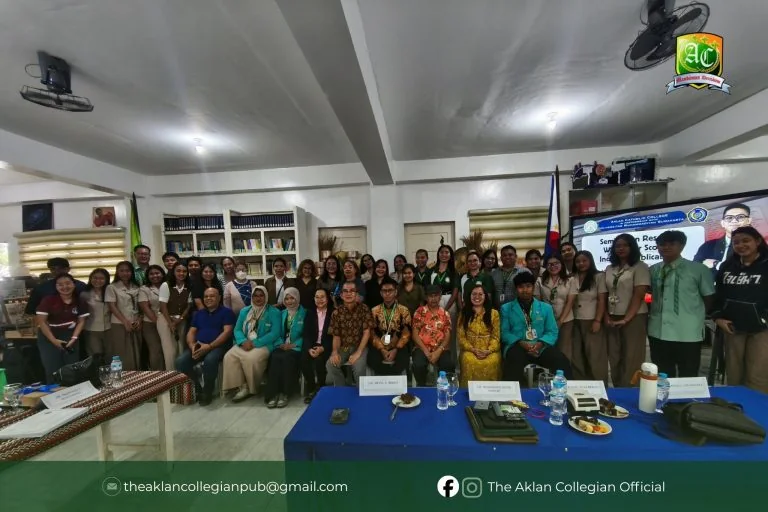
The Faculty of Teacher Education has hosted pre-service teachers from Universitas Muhammadiyah Surakarta in Indonesia through the Southeast Asian teacher-exchange initiative. The college’s account describes a welcome programme in the Annex Campus Library, followed by presentations, an exchange of institutional gifts and performances by its own students.
The visit also included a research-writing seminar led by a representative of the Indonesian university. The project connects teacher preparation with exposure to educational settings in another Southeast Asian country, while the welcome activities brought academic exchange and cultural interaction together within the college.
Sources: SEA Teacher Exchange ↗
Professional learning for educators
Teacher education also involves development work for college staff. The faculty reports a two-day in-service programme with educators from the University of Santo Tomas. Its sessions addressed the mission of Catholic teacher-education institutions, benchmarking, experiential learning and the preparation of future teachers.
Further sessions considered professional formation, coaching and mentoring, and curriculum design. The college’s account describes work on course plans and clinical-practice designs as outcomes of this activity. These topics connect the development of the faculty’s own teachers with the practical experiences offered to pre-service teachers.
Sources: Teacher Education Activities ↗
Nursing formation and institutional traditions
The Faculty of Nursing held its twelfth Ring Hop and Pinning Ceremony in April 2026 at a convention venue in Kalibo. The event included a Mass, messages from academic leaders and recognition of clinical practice. In the college’s account, the ceremony marks the completion of clinical exposure and encourages students to consider the ethical responsibilities associated with their future work. It is an institutional tradition within the nursing programme rather than a statement about individual licensing outcomes.
Sources: Nursing Pinning Ceremony ↗
Recognising student participation
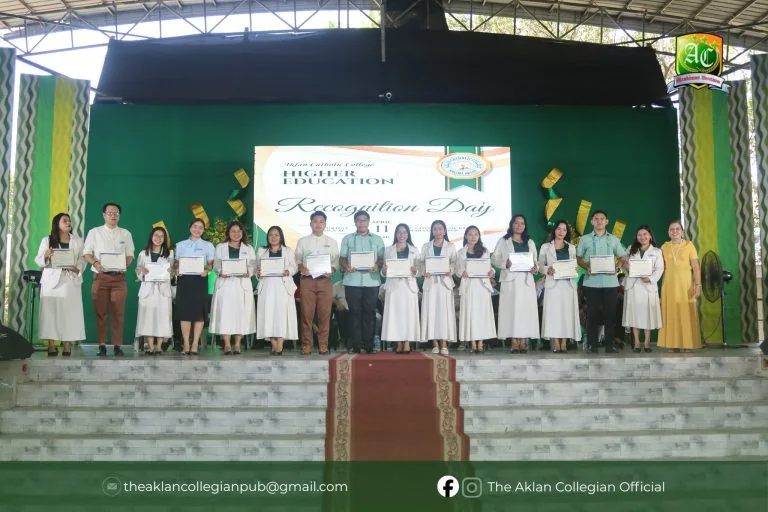
The Higher Education Department’s April 2026 Recognition Day took place at the covered court on Mabasa Campus. It recognised academic and non-academic achievement for the 2025–2026 academic year. Messages from students and college leaders connected recognition with discipline, responsibility and service, placing student accomplishments within the institution’s wider educational values.
Sources: Higher Education Recognition Day ↗
Developing institutional processes
In August 2026, administrators, office heads and other personnel participated in a five-day internal-audit training workshop. The sessions concerned educational-organisation management, reviewing institutional processes and identifying areas for improvement. The college described the activity as preparation for future certification, showing a staff-development effort concerned with the systems supporting education rather than simply classroom provision.
Sources: Internal Audit Training ↗