Visa
About Akhmet Baitursynuly Kostanay Regional University
A regional university with several educational traditions
Akhmet Baitursynuly Kostanay Regional University is a multidisciplinary university in Kostanay, Kazakhstan. Its present identity brings together teacher education, agricultural training and a broader university tradition. The institution’s history begins with the Kustanai Teachers’ Institute, established in 1939 with physics and mathematics and natural geography faculties. In 1955 it became a pedagogical institute, and in 1992 that institution was reorganised as Kustanai State University.
The university received the name of the educator and scholar Akhmet Baitursynov in 1996. The agricultural institution, whose roots lay in a branch opened in 1966, joined the university in 2000. A pedagogical institute separated in 2004 and later became the university named after Umirzak Sultangazin. The official chronology records the 2019 reorganisation bringing the state university and pedagogical university together as the regional university. Today its academic structure includes the pedagogical institute and faculties covering social and humanitarian sciences, economics and law, agricultural sciences, and engineering, energy and information technologies.
Sources: Institutional history ↗
Degree studies and professional practice
The university’s educational framework includes undergraduate and postgraduate study, with separate programme information for bachelor’s, master’s and doctoral degrees. Undergraduate curricula combine general education with basic and specialised disciplines, together with professional practice in the relevant field. Programmes are organised around learning outcomes and the applicable qualification frameworks, connecting classroom study with preparation in a particular professional area.
Postgraduate education adds advanced theoretical study, professional practice and research. The university describes dissertation work as part of this structure, while specialised master’s programmes can involve a project. Its educational portal also provides information about additional minor programmes and professional internships. These elements place subject specialisation, practical experience and research within the broader academic organisation.
Sources: Educational programmes ↗
Applied research and laboratory facilities
The Research Institute of Innovative Technologies brings together biological, environmental and engineering work. Its physical and chemical research laboratory examines environmental samples, mineral raw materials, metals, alloys and protective coatings. Food-related research includes the detection of pesticides, toxic elements and veterinary-drug residues, alongside the identification of microorganisms in products and raw materials.
Molecular-genetic work includes animal DNA identification, genetic profiling and sequencing. The institute also incorporates a science and technology park with unmanned systems, predictive analysis, prototyping and reverse engineering. Its listed projects address water-resource monitoring and hydraulic structures in northern Kazakhstan, environmental consequences of mining, and sustainable development of the Kostanay Region’s agro-industrial sector. The institute lists specific engineering applications such as three-dimensional scanning, digital modelling and verification of parts and assemblies. Unmanned-system applications include vegetation assessment, mapping and investigation of the relief of water-body bottoms. This range links laboratory analysis with questions arising in the surrounding economy and environment.
Innovation through the Smart Center
The regional Smart Center provides another setting for collaboration between university researchers, students and business. Its functions include technology transfer, commercialisation of ideas and the development of digital approaches to production. The centre has a technology-transfer office that helps identify promising developments, advises on intellectual property and funding, and supports the preparation of innovative projects.
An IT centre offers training, pilot projects, software development and activities such as seminars and hackathons. Qostanai IT Hub operates there as a regional branch of Astana Hub, while coworking activities support startup development and meetings with business practitioners. The laboratory network covers biotechnology, agricultural chemistry and physical chemistry, with examples including organic-waste technologies, soil and grain quality, chromatography and electrochemical research.
Sources: Regional Smart Center ↗
Library and information resources
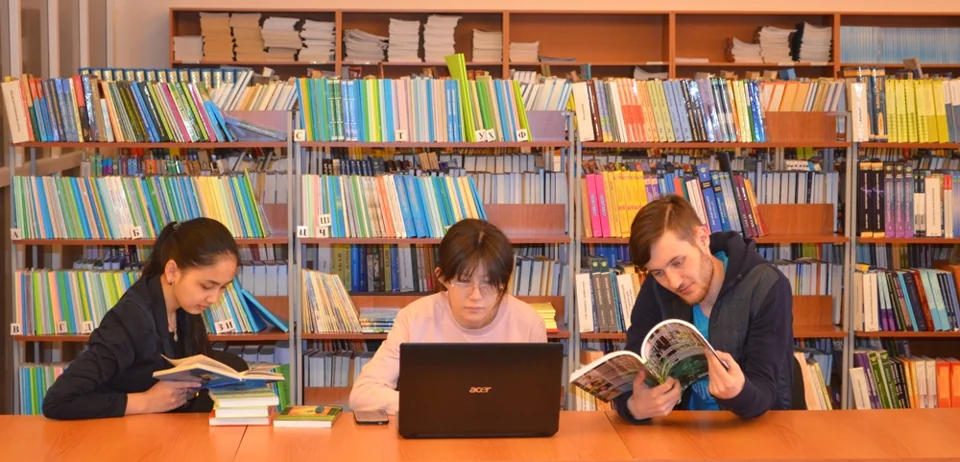
The Scientific Library supports teaching and research through its collections and information services. It uses an automated library information system and develops electronic resources alongside its scientific and educational holdings. Information literacy is part of its work: the library seeks to help users understand and use information rather than simply obtain individual publications.
Its services include bibliographic information, electronic exhibitions, a repository and a virtual help desk. The library also promotes Kazakhstan’s cultural heritage and maintains professional relationships with other university libraries. Beyond the university, it serves as a regional methodological centre for libraries in vocational and higher education institutions in Kostanay and the surrounding region.
Sources: Scientific Library ↗
Inclusive education and student creativity
The Center for Inclusive Education and Psychological Support was established in September 2025. Its responsibilities include support for students with special educational needs, consultation for teaching staff and the preparation of methodological resources. It also coordinates university units and works with external organisations. Accessibility, individual learning pathways, confidentiality and psychological support are included in its stated remit, with research and training activities supporting the development of inclusive practice. The centre also prepares information materials, participates in relevant projects and organises conferences, seminars and workshops for the exchange of knowledge.
Music, performance and cultural participation
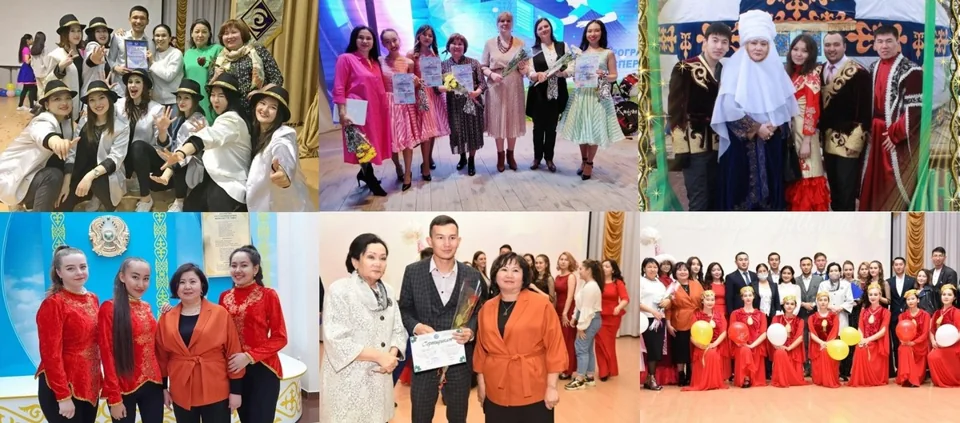
Student cultural activity is supported by the House of Creativity Oner, whose studio opened in 2001. Its programme includes vocal performance, instrumental music, choreography, poetry, artistic reading and theatre. Participation extends beyond students enrolled in creative subjects. The university describes vocal and dance classes, a dombra ensemble and the Badrisafa dance group, alongside concerts marking national commemorations. These activities give students opportunities to develop artistic skills and perform with fellow members of the university community.
Sources: House of Creativity Oner ↗