Visa

About Ajeenkya DY Patil University
A multidisciplinary university in Pune
Ajeenkya DY Patil University, commonly abbreviated ADYPU, is located at D Y Patil Knowledge City in Charholi, Pune, Maharashtra. Established under a Maharashtra government act in 2015, it presents innovation and the application of knowledge as central parts of its educational purpose. The institution is distinct from other universities carrying the D Y Patil name.
Its academic range includes architecture, business, engineering and technology, design, film and media, law and liberal arts. The university describes provision at undergraduate, postgraduate and doctoral levels. Across these areas, its educational approach connects theory with practical activity, critical thinking and creative responses to problems. This disciplinary breadth gives the university several settings for exploring how technical, professional and creative knowledge can be used together, rather than organising its identity around a single field.
A competency-based approach to learning
The university describes its curriculum as competency-based and informed by business needs. Its emphasis is on what students can understand and do, bringing theoretical knowledge together with practice. The published approach includes classroom teaching, field projects, internships, community involvement and studio-based work.
General education is another stated component, organised around expression, logic, identity and innovation. The university uses the idea of a T-shaped professional to explain the relationship between specialist expertise and an ability to understand connections across disciplines. Deep knowledge in one area is therefore intended to sit alongside a wider perspective on people, society and other professional fields. The curriculum page also describes the use of international subject frameworks as benchmarks, placing learning outcomes and the demonstration of competence within its account of academic design.
Sources: Standards Based Curriculum - Ajeenkya DY Patil University ↗
Personalising an academic pathway
ADYPU’s account of customised education describes opportunities to select subjects in line with a student’s interests and ambitions. Its range of disciplines provides a basis for combining perspectives from the arts, sciences, business and technology. Collaborative projects and interdisciplinary learning are presented as ways to investigate questions that extend beyond one department.
Academic advisers support students in considering course choices, career directions and extracurricular opportunities. The university also identifies online and part-time formats within its broader provision, allowing different approaches to arranging study around other commitments. The central educational idea is that students take an active role in shaping their learning while receiving guidance. This complements the competency-based approach by connecting structured academic study with individual interests and future plans.
Sources: Customize Your Education | Ajeenkya DY Patil University, Pune ↗
The Knowledge Resource Centre
The Knowledge Resource Centre, established in 2015, serves as the university’s central library. Its collections support areas including design, law, engineering, liberal arts, media, management and information technology. The university describes access for students, researchers and faculty, as well as learners from the wider community.
The centre uses Koha library management software and Dewey Decimal Classification to organise resources. Its digital provision includes online databases, open-access materials and connections with learning platforms such as SWAYAM-NPTEL and the National Digital Library of India. Remote access is provided through the Knimbus platform and a library application, while campus connectivity supports digital information use. The centre’s stated objectives include encouraging reading, supporting research and using information technology for retrieval. Printed collections and digital services therefore form complementary parts of the university’s study resources.
Sources: Knowledge Research Centre - Ajeenkya DY Patil University ↗
Student interests and support
The student-experience programme brings together clubs, events, service and recreation. Its listed interests include entrepreneurship, reading, debate, photography, music, food, film, gaming, badminton and animal-related volunteering. Students can explore more than one club, and the university describes a process for forming a new group when there is sufficient interest.
A club festival during orientation gives students an opportunity to discover activities and meet people with shared interests. The Student Services Division provides another point of connection with campus life. Its remit includes academic guidance, personal development, residential experience, financial-assistance questions and wellbeing. An on-campus counsellor is available for appointments. These arrangements place social participation and practical support alongside teaching, recognising that university life includes decisions, relationships and concerns beyond the timetable.
Sources: The Student Experience | Best University in Pune India - ADYPU ↗
Entrepreneurship and innovation
The Entrepreneurship and Innovation Centre works across the university’s schools to support ideas, projects and early-stage ventures. Its published framework includes mentoring, professional networks, maker facilities, meeting rooms and office space. Training, workshops and investor-pitching events appear among the forms of support described.
The centre’s areas of expertise extend beyond developing a technical idea. They include business-model assessment, market-entry planning, technology transfer, financial modelling and intellectual property guidance. Project-based learning is linked to industry and societal challenges, with projects originating from students or external partners and developing through repeated refinement. Academic and industry mentors contribute to that process. This combination connects experimentation with the organisational work needed to explain an idea, consider its audience and develop a practical route forward.
Sources: Entrepreneurship Innovation Cell - Ajeenkya DY Patil University ↗
Spaces for different kinds of study
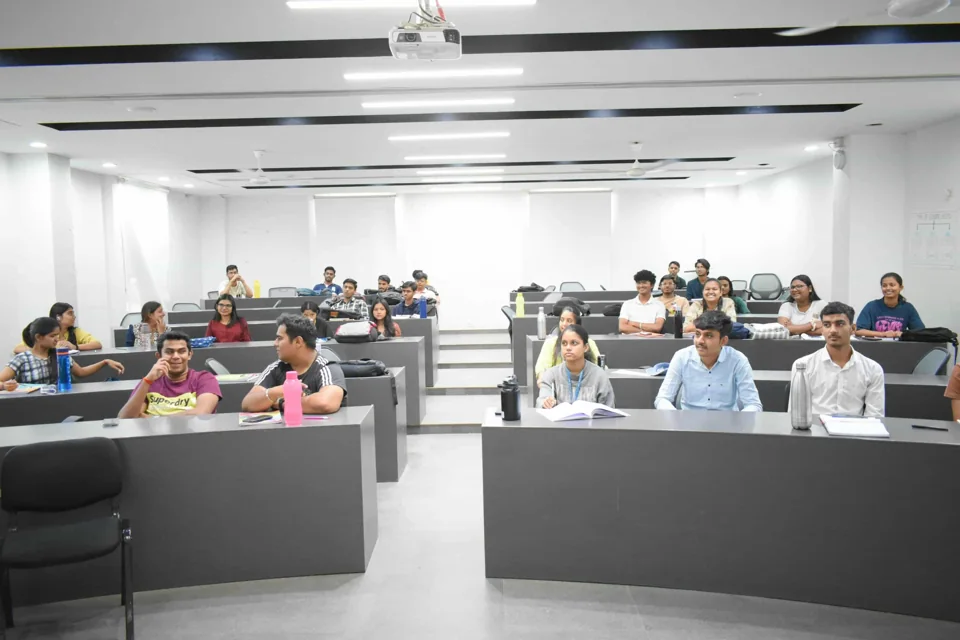
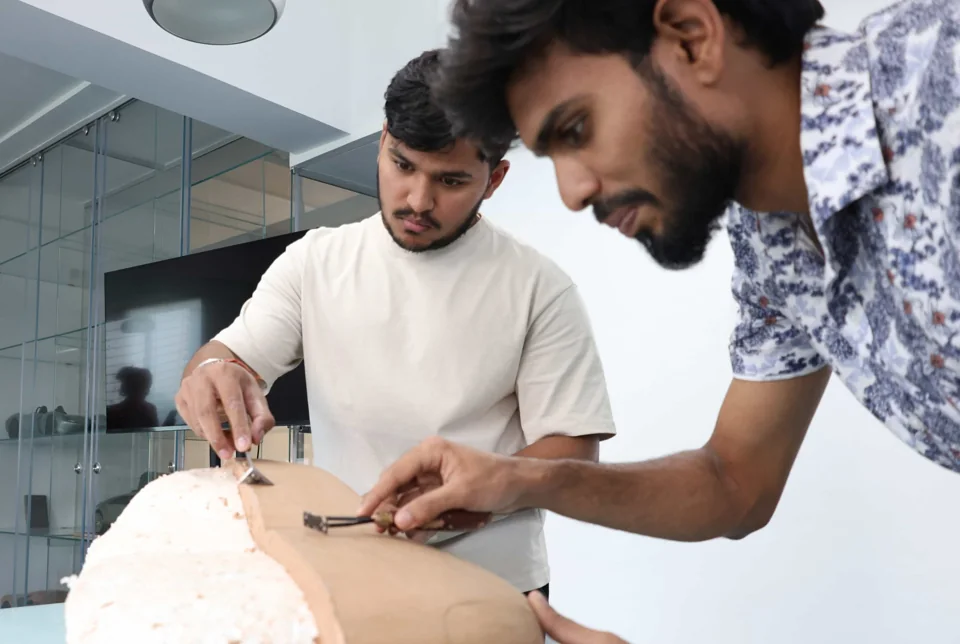
The official learning-spaces gallery identifies smart classrooms, a seminar hall, an automotive clay studio, laboratories, a film studio, a moot court, computer laboratories and a mini auditorium. These facilities reflect the range of subjects taught at the university. The gallery’s classroom and clay-modelling photographs give concrete examples of settings for lectures and practical design work, alongside the spaces provided for film, computing and legal education.
Sources: Learning Spaces - Adypu ↗