Visa


About AISECT University
From AISECT University to Rabindranath Tagore University
The institution listed as AISECT University in Bhopal is now Rabindranath Tagore University, commonly abbreviated RNTU. Established in 2010, it was renamed in 2018, as recorded in the AISECT Group’s institutional timeline. Its registered address is at Mendua, near Bhojpur and Bangrasiya Chouraha, on the Bhopal–Chiklod Road in Raisen district, Madhya Pradesh.
RNTU belongs to the AISECT educational group. The group’s history separately records the establishment of AISECT University in Hazaribagh, Jharkhand, in 2016. The Madhya Pradesh university’s current identity, campus and academic work provide the focus of this profile.
Sources: Current RNTU institutional identity and overview ↗ · AISECT Group history, 2010 foundation and 2018 renaming ↗
Multidisciplinary education and entrepreneurship
RNTU’s academic provision spans engineering, education, management, law, arts, science, commerce, agriculture and medical sciences. Its institutional description emphasizes practical skills and entrepreneurship alongside subject knowledge. Cultural activity also forms part of the university’s identity through Vishwarang, its international festival of art and culture.
The Atal Incubation Centre at RNTU was launched in 2019. The university describes support that includes mentoring, industry connections, investor meetings, laboratory access and shared working space. These activities connect the university’s educational setting with the development of ideas and early-stage enterprises.
Research organizations and scholarly activity
The university’s research framework covers scientific, technical, social and cultural subjects. Listed research centres include advanced materials, agriculture, renewable energy, the Internet of Things and advanced computing, science communication, women’s entrepreneurship and livelihoods. Other centres focus on languages, translation, literature, art and cultural traditions.
The Core Research and Innovation Group was established in 2017 to help develop research facilities and an environment for innovation, skills, consultancy and entrepreneurship across the AISECT Group universities. At RNTU, the research website also sets out university policies and provides information about research projects and collaboration. The stated approach encourages multidisciplinary work and the application of findings to problems encountered in society.
Two journals illustrate that disciplinary range. Anusandhan covers science, technology and management, while Shodhaytan addresses arts, social sciences, education, paramedical subjects and law. Both are described as biannual publications. The research portal also presents patent-related work and partnerships, placing publications, practical innovation and institutional cooperation within the same framework.
Sources: University research framework ↗
Agriculture linked with field experience
The Faculty of Agriculture began in the 2015–16 academic session as a constituent college of the university. Its founding account connects agricultural education with the needs of underserved areas of Raisen district. The faculty describes a four-year undergraduate agriculture programme alongside postgraduate and doctoral provision in agricultural subjects.
Practical learning includes outdoor training, work on research farms and participation in Rural Agricultural Work Experience. The faculty’s research farms are supervised through the dean, farm management and technical staff. Its published areas extend across agronomy, horticulture, soils, agricultural economics, extension, genetics and plant breeding, plant pathology and entomology.
The Agriculture Research Centre coordinates research and extension activity. Its description includes organic management and the conservation of crop germplasm, covering cereals, pulses, oilseeds, fodder and vegetables. The faculty also identifies relationships with organizations concerned with rural livelihoods, soils and food-industry skills. This combination brings teaching, experimentation and engagement with agricultural practice together within the faculty.
Sources: Faculty of Agriculture ↗
Theatre education and creative production
The Tagore National School of Drama was established in July 2021, with its first session inaugurated on 7 October that year. Its stated objectives include encouraging imagination and artistic creation and identifying theatrical talent beyond major urban centres. The school forms part of the university’s humanities and liberal arts setting.
Its published highlights include acting, craft making, production design and play production. Students also encounter film production and immersion in Kalaripayattu and Kathakali. Guidance by national and international specialists forms part of the school’s educational description. These activities combine different elements of performance-making: the performer’s work, the design and construction of a production, and the process of bringing the result before an audience.
Sources: Tagore National School of Drama ↗
The J. P. Choubey Central Library
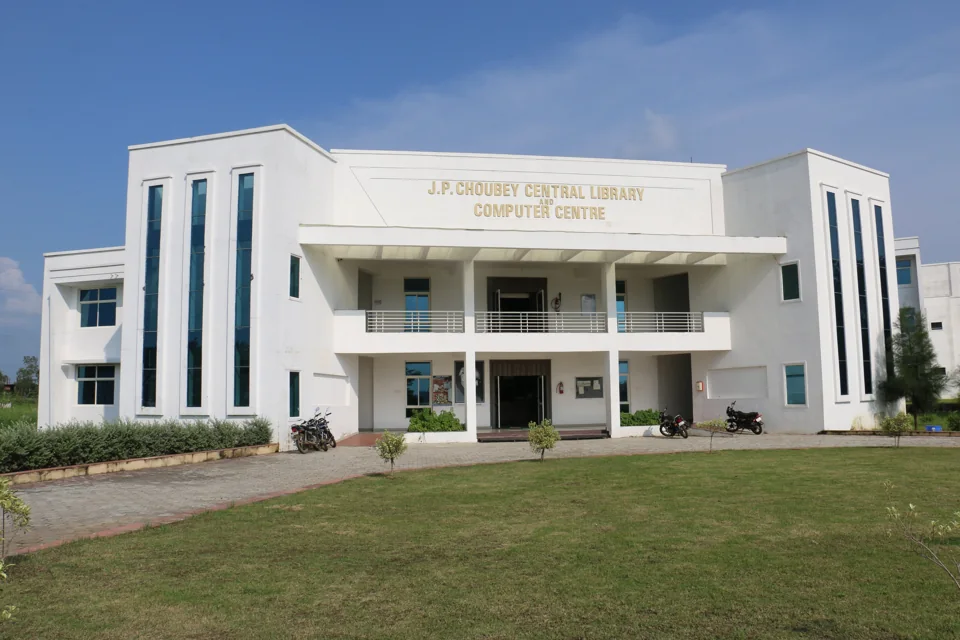
The J. P. Choubey Central Library was established in 2010–11. Its resources support undergraduate, postgraduate and research study, with textbooks and reference works alongside journals, electronic books, periodicals, newspapers and magazines. The library also makes syllabuses and question papers available as academic resources.
The library describes computerized cataloguing and circulation, with an online public-access catalogue through which students can search for material. Its published account identifies library automation and digital-library software alongside electronic resource packages. This brings the organization of printed collections and access to digital information into the same service. The dedicated library and computer-centre building, shown in the university’s official photographs, provides a visible part of the campus’s learning infrastructure.
Sources: J. P. Choubey Central Library ↗

Student activity and community involvement
The university’s 2023–24 student handbook documents several forms of participation beyond classes. It describes National Service Scheme activity under the JAGRITI banner, including work with nearby villages on education, hygiene and general awareness. The examples listed include tree planting, environmental programmes, women’s empowerment activities and blood donation camps.
The handbook also sets out a framework of student support and institutional committees. These include counselling, an international student cell, alumni activity, entrepreneurship and innovation, and an intellectual property rights cell. Its account of community service emphasizes gaining experience through taking part in activities outside the campus. As a dated handbook, it provides a record of how the university connected student participation, support and social responsibility during that academic year.