Visa
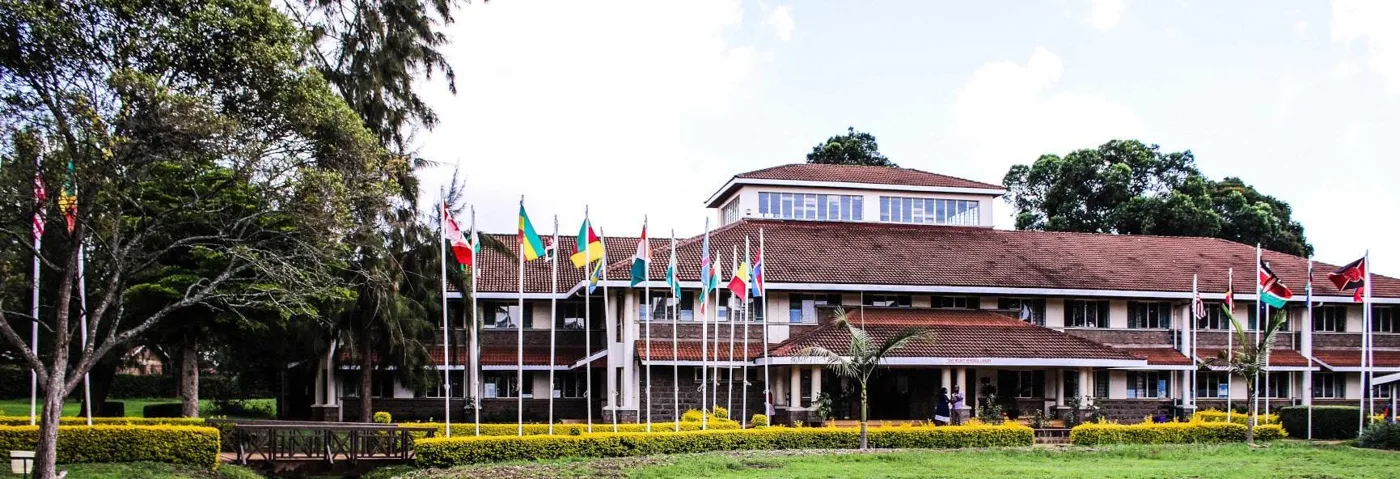

About Africa International University
A Christian university in Nairobi
Africa International University, commonly known as AIU, is a private Christian university in Karen, Nairobi, Kenya. Its campus lies along Karen–Dagoreti Road. The institution developed from Nairobi Evangelical Graduate School of Theology, whose name is usually shortened to NEGST. That theological foundation continues to shape a university which now brings together professional education, research and Christian leadership formation. AIU received a university charter from the Kenyan government in 2011, marking an important stage in its development beyond its original graduate theological identity.
The university traces its beginnings to the vision of Byang H. Kato, an early African leader of the Association of Evangelicals in Africa. NEGST opened in 1983 with four students. Its history recalls Tony Wilmot as its first principal and Gottfred Ose-Mensah as chair of the board. These beginnings place the institution within the development of African evangelical scholarship and leadership education.
The institutional history also records support from church networks and partner organisations for scholarships and physical development. Such relationships helped the original graduate school establish its teaching environment and continue to feature in the university’s account of its development.
Sources: Institutional history ↗ · Mission and vision ↗

Mission and educational values
AIU connects education with service to churches, communities and wider society. Its mission combines the preparation of Christ-centred leaders with innovative programmes, research and community engagement. This gives its academic work an explicitly Christian purpose while also directing attention to practical social questions.
The university groups its values around relevant excellence, integrity in faith, servant leadership, stewardship, and innovation within community. Its description of leadership emphasises personal humility alongside responsibility. Its approach to innovation stresses collaborative responses to problems and the common good. Together, these values provide the institutional framework within which its schools teach and its research activities develop.
Sources: Mission and vision ↗
Business and interdisciplinary scholarship
The School of Business and Economics organises its academic provision through Business Studies and Leadership, Governance and Public Administration. Its published structure includes study at undergraduate and postgraduate levels, with Business Studies also identifying diploma provision. This arrangement brings business education together with the study of organisational leadership and public affairs.
A different strand of advanced scholarship is represented by the Centre for World Christianity. The centre focuses on research and writing about the history, theology and mission of Christianity, particularly Africa’s contribution to a wider international story. It identifies regional studies of Africa, Asia and Europe, alongside themes such as Pentecostalism, globalisation, renewal movements, church–state relations and religious pluralism. Its academic provision includes MTh and PhD study in World Christianity, linking specialist historical and theological enquiry with the university’s longstanding graduate tradition.
Sources: School of Business and Economics ↗ · Centre for World Christianity: About ↗
Research, innovation and community engagement
AIU’s Research, Innovation and Community Engagement office coordinates institutional research and supports links between scholarship and communities. Its responsibilities include strengthening research capacity, developing partnerships, supporting access to funding and encouraging the practical use of knowledge. The office connects university research with public concerns through collaboration involving academic institutions, industry, government and civil society.
Its published thematic priorities cover environmental effects on vulnerable populations’ health, technology and digital transformation, social justice and governance, and entrepreneurship and economic empowerment. The research office also provides access to institutional research policies, the university’s online journal and information about its Institutional Scientific Ethical Review Committee. A Climate Finance Knowledge Series illustrates its interest in connecting research with questions of adaptation, mitigation and financing community development. These activities sit alongside the university’s broader emphasis on ethical enquiry and service.
Library spaces and academic resources
The library provides several kinds of study environment rather than a single general reading space. Its ground floor includes circulation services for borrowing and renewing materials, an online catalogue area, open book stacks, reading areas and a display of newly received publications. Books are organised using the Library of Congress Classification system. A multimedia section supports information technology instruction, online research and related activities, while reprographic services include copying and binding.
Provision for postgraduate work includes study cubes for master’s students and first-floor study carrels for doctoral researchers. The first floor also contains a discussion room for collaborative learning and a special collection holding dissertations and rare materials. A serials and classical section accommodates biographies, older serial publications and fiction. This combination of general collections, research material and specialised workspaces supports the different stages of academic study represented at AIU.
Sources: Know your library ↗

Residential life and daily services
Campus accommodation includes family housing and rooms for individual students. Family provision consists of two- and three-bedroom flats. Individual accommodation includes rooms shared by one or two students, with shared kitchen and bathroom facilities, as well as flats with communal facilities. Housing is limited, so the university describes an allocation process which gives priority to admitted full-time students who have met the required financial conditions, starting with international students.
Part-time, short-term and cohort students may be accommodated when space permits. The housing committee also helps identify accommodation in the surrounding area. Food services are provided through an outsourced campus cafeteria serving members of the university community and visitors. Alongside the library and academic departments, these residential and daily services form part of the practical setting in which students live, study and participate in university life.
Sources: Cafeteria and student housing ↗