Visa


About Aegean University
One public university across six islands
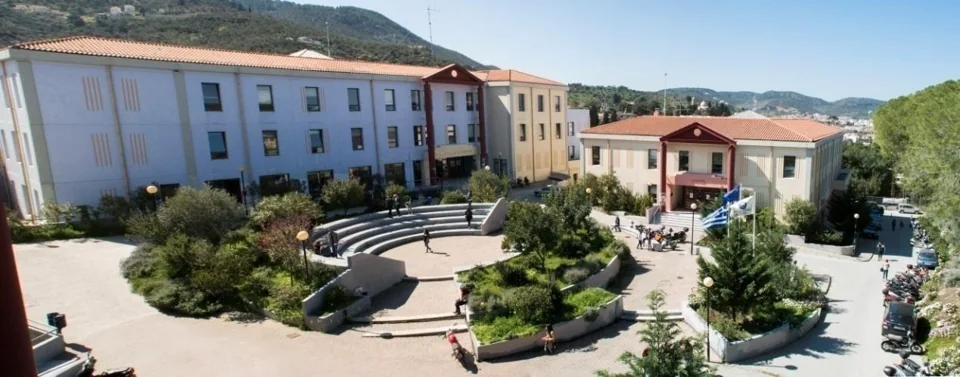
Aegean University is known officially in English as the University of the Aegean. It is a public university in Greece organized as a network across six islands: Lesvos, Chios, Samos, Rhodes, Syros and Lemnos. Its administrative headquarters are in Mytilene on Lesvos, while academic units operate in Mytilene, Chios, Karlovasi, Rhodes, Ermoupolis and Myrina. This distribution is central to its identity. The university connects higher education and research with the cultural, social and economic development of the Aegean, bringing university activity into island communities rather than concentrating everything at a single metropolitan campus.
Sources: University identity, mission, history and geography ↗
Modern foundations and regional purpose
The modern University of the Aegean was established in 1984. Its institutional history connects that foundation with an earlier vision associated with mathematician Constantin Carathéodory and a planned university in Smyrna that never opened to students. The present university developed initially through departments on Lesvos, Chios, Samos and Rhodes, later extending to Syros and Lemnos. Its founding goals included decentralizing university education, introducing new areas of study and strengthening the cultural and economic life of the islands. The network model also shaped its organization: academic and administrative units had to work together across geographic distances, with information and communication technology helping connect their activities.
Sources: University identity, mission, history and geography ↗
A broad interdisciplinary academic structure
The university's academic directory groups its departments into social sciences, environment, business, humanities, sciences and engineering. Social science subjects include anthropology and history, geography, sociology, and cultural technology and communication. Environmental teaching extends from environmental studies and marine subjects to food science and nutrition. Business-related areas include business administration, shipping, trade and transport, and tourism economics and management. Engineering covers information and communication systems, financial and management engineering, and product and systems design. Mathematics and actuarial-financial statistics sit alongside humanities fields such as primary education, preschool education and educational design, and Mediterranean studies. This combination reflects the university's emphasis on interdisciplinary fields alongside established disciplines.
Sources: Schools and departments ↗
Culture, communication and digital technology
The Department of Cultural Technology and Communication offers a concrete example of this interdisciplinary approach. Located in Mytilene within the School of Social Sciences, it was founded in 2000. Its work connects cultural studies and heritage with computing, communication and multimedia technologies. The department examines how digital tools can represent, analyze and promote culture, while also contributing to new forms of cultural production. Its educational purpose includes preparing people who can combine the creation of cultural content with technological methods. The departmental account in the university's research postgraduate study guide describes this combination as an everyday feature of its academic environment, linking cultural management questions with technical practice.
Sources: Official research postgraduate study guide, university and Cultural Technology sections, pages6–9 ↗
A library organized as a shared network
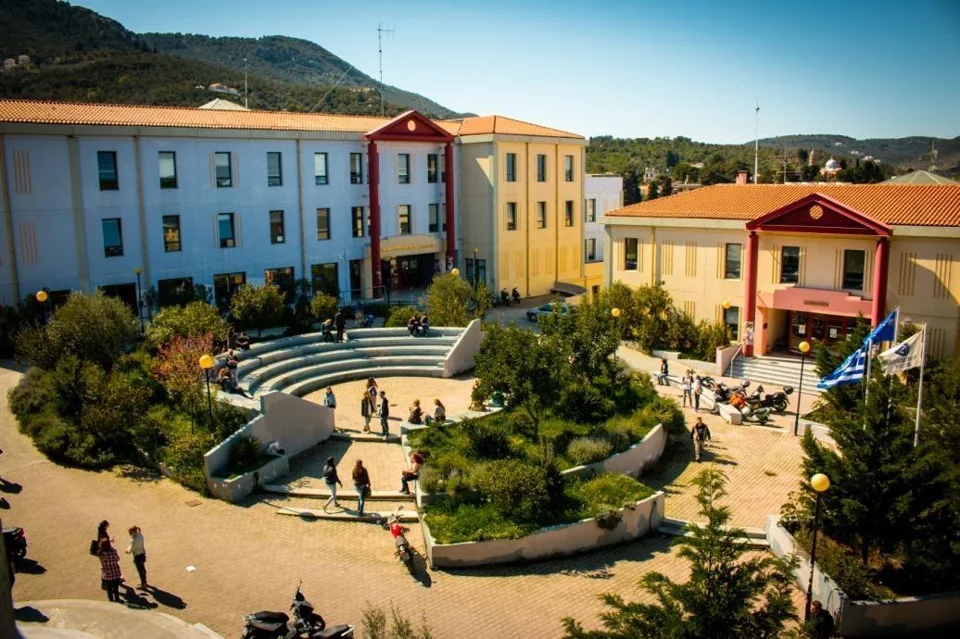
The University of the Aegean Library mirrors the institution's geography, with a central service and branches on all six islands. Despite that dispersion, it operates as one service, using common policies for cataloguing, processing collections, planning and development. Students can locate books through the online catalogue and request material held at another island branch through interbranch lending. Interlibrary services extend access beyond the university's own collections, including requests for journal articles from other Greek libraries. Library staff also help users search electronic resources, identify material and understand borrowing procedures. This shared structure gives the distributed campuses access to a coordinated information service rather than six unrelated local libraries.
Sources: Library administration and branches ↗ · Library services and repository: frequently asked questions ↗
Historic buildings and research resources
Several library locations illustrate the relationship between the university and the built heritage of its island communities. The central library is housed in Mytilene's restored neoclassical Komninakeio building. In Karlovasi on Samos, the library occupies the refurbished Hatzigianneio building, originally a girls' school founded in 1903. The Syros branch is in the former Kornilaki tannery, while the Lemnos branch is in Myrina's Kydadeio building. Alongside physical collections, the library maintains the Hellanicus institutional repository. It collects and preserves work produced by the university community, including theses, research and teaching material, scientific articles, presentations and multimedia. These resources connect preservation of buildings and collections with access to contemporary academic work.
Sources: Library services and repository: frequently asked questions ↗ · Library buildings and locations ↗
European academic cooperation
The University of the Aegean participates in the European Reform University Alliance, or ERUA. Its official alliance page identifies partners in France, Lithuania, Germany, Bulgaria, Poland, Italy and Spain. ERUA connects institutional development with cooperation in teaching and research, encouraging universities to explore alternative approaches to their role in society. For students, the university lists opportunities such as intensive courses, semester courses, summer and winter schools, and career-related services. This cooperation adds a European dimension to an institution whose own campuses are already geographically distributed. It creates another setting for exchanging knowledge and participating in learning activities beyond a student's home department and island.
Student representation and cultural life
Student associations provide a structure for representation within departments. Their general assemblies are forums for discussion and decisions about academic matters and the quality of student life. The university's island pages also describe cultural initiatives involving theatre, photography, music and other interests, with activity depending on student participation. On Lesvos, these include theatrical and photographic groups and initiatives concerned with the marine and natural environment. On Lemnos, the campus account describes a botanical garden, a student vegetable garden, cooking activities and volunteer projects. These examples connect university life with the particular surroundings of each island, while giving students ways to contribute to shared cultural, environmental and community activities.
Sources: Student life on Lesvos ↗ · Student life on Lemnos ↗