Visa
About Academy of Athens
A national institution for scholarship and the arts
The Academy of Athens is a modern Greek institution devoted to the sciences, humanities and fine arts. Its name recalls Plato’s Academy, but the present organisation was established in 1926 after a long series of efforts to create a Greek academy. Its founding constitutional decree dates from 18 March 1926, and its inaugural plenary session took place on 25 March that year. The academy’s intellectual community brings together distinguished scholars, scientists, writers and artists.
Its chartered purpose includes advancing knowledge and maintaining connections with other academies and their members. The institution conducts research, supports publications, awards prizes and grants scholarships. It also provides expert opinions and proposals to public authorities. Its published description identifies research concerning agriculture, industry, shipping and the national economy among its activities, showing how scholarly work connects with questions facing the state and wider society.
Sources: History ↗ · Objectives ↗
Three sections and an elected membership
The academy organises its work in three sections. The Sciences section encompasses subjects including mathematics, physics, chemistry, medicine and astronomy. The Letters and Fine Arts section includes prose, poetry, music, the visual arts, literature, archaeology and history. The Ethical and Political Sciences section brings together theology, philosophy, law, political science and economics. Each section has a president, vice-president and secretary responsible for its minutes.
Membership categories include ordinary, honorary, associate, foreign and corresponding members. For ordinary membership, the published process begins with a public announcement. A committee of three academicians evaluates candidates’ work, after which the relevant section decides whether to forward candidacies to the plenary body. The final election follows discussion in a closed plenary session. This structure makes evaluation by the academy’s scholarly community central to the selection of its ordinary members.
Sources: Sections ↗
A building conceived before the institution opened
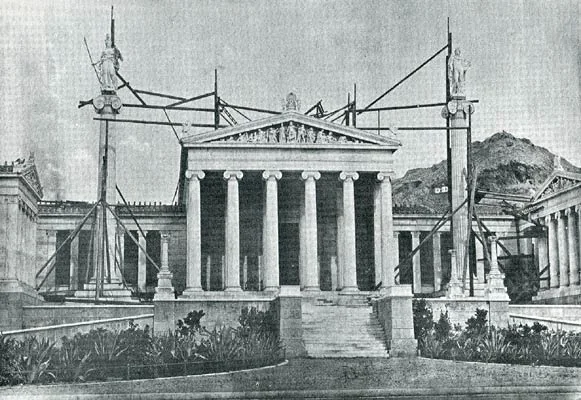
The academy building forms part of the architectural grouping with the neighbouring university and National Library in central Athens. Designed by Danish architect Theophil Hansen in 1859, it draws on classical Athenian architecture, particularly the Ionic features of the Erechtheion on the Acropolis. The project followed a substantial donation by Simon Sinas in 1856 for a building intended to house the future academy.
The cornerstone was laid in August 1859. Hansen’s student Ernst Ziller assumed responsibility for executing the designs in 1861. Construction was interrupted in the 1860s before resuming in 1868. After Simon Sinas died in 1876, his widow Ifigeneia continued the project, which was completed in 1885. The building was formally delivered to Prime Minister Charilaos Trikoupis in 1887. It accommodated museums and the General State Archives before the Academy of Athens took up residence in 1926.
Sources: Introduction ↗
Sculpture and the exterior
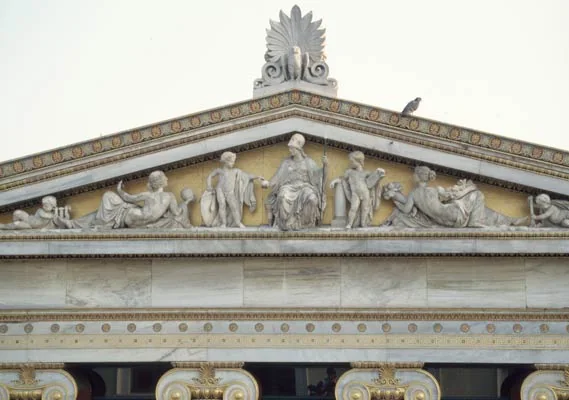
The marble facade faces Panepistimiou Avenue, while the surrounding garden extends towards Akadimias Avenue and Sina Street. A central block and two wings define the composition. The entrance is marked by a sculptural pediment depicting Athena’s birth, executed by Leonidas Drosis from a design by Karl Rahl. Much of the building’s sculptural decoration was produced between the 1870s and the middle of the 1880s.
Statues of Apollo and Athena stand on tall Ionic columns on either side of the entrance composition. Seated figures of Plato and Socrates occupy the forecourt. Drosis made their models, which the sculptor Piccarelli translated into Pentelic marble; they were installed in 1885. The smaller pediments on the wings contain works by Franz Melnitzki based on Hansen’s designs. These details link the building’s scholarly purpose with references to ancient philosophy, artistic activity and the sciences.
Sources: The Exterior ↗
Interior spaces and artistic decoration
A long corridor connects the two wings behind the entrance. It contains a marble statue of Simon Sinas by Drosis, while an inscription above the Main Hall acknowledges both Simon and Ifigeneia as the building’s benefactors. The Eastern Hall accommodates donated libraries and art collections and serves as a venue for scientific conferences and exhibitions. Other spaces contain the academy’s administrative offices.
The Main Hall has three tiers of marble seating along its sides and marble wall surfaces recording donors’ and benefactors’ names. Christian Griepenkerl realised its painted decoration between 1878 and 1880 according to Hansen’s conception. Eight scenes develop the story of Prometheus, including the theft of fire, his punishment and eventual release. The decoration gives the hall a sustained visual theme concerning knowledge, human effort and the relationship between classical tradition and modern intellectual life.
Sources: The Interior ↗
Library services and the wider scholarly mission
The academy’s Library Department is based at 28 Panepistimiou Street. Its published organisation distinguishes acquisitions from cataloguing and circulation, alongside a supervisory committee. These functions support the collection, organisation and use of scholarly material within an institution whose work depends on research and publication. The library is part of the academy’s continuing intellectual infrastructure as well as its historic architectural setting.
The broader mission extends beyond meetings in the central building. Members make scholarly announcements, contribute to conferences and international research projects, and publish their work. The academy also identifies the establishment of its Biomedical Research Foundation as an important contribution to research. Together with its grants, awards and advisory activity, these functions explain its role as an institution for producing, supporting and communicating knowledge across both scientific and humanistic fields.
Sources: Library Department ↗ · Objectives ↗