Visa


About Adyghe State University
A state university in Maykop
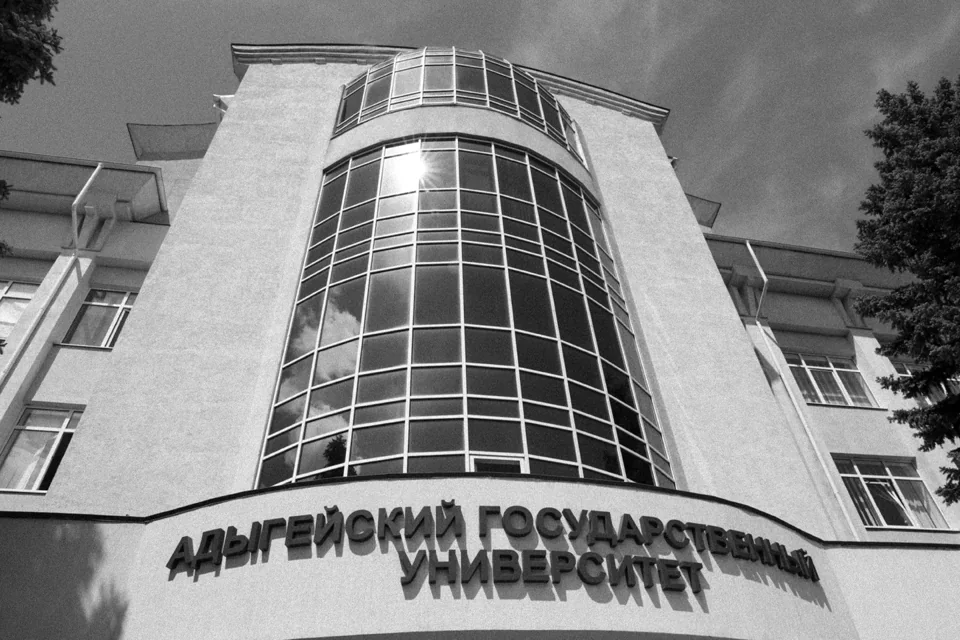
Adyghe State University is officially named Адыгейский государственный университет. It is a federal state higher education institution in Maykop, the capital of the Republic of Adygea, Russia. Its official institutional disclosure gives 22 June 1940 as its establishment date and identifies its principal address as 208 Pervomayskaya Street. The university's educational and research environment includes specialist institutes, scientific centres, a library and museum collections that support both university study and public engagement with knowledge.
The current academic structure includes an Institute of Exact Sciences and Digital Technologies. Its published organisation brings together algebra and geometry, mathematical analysis and mathematics teaching methods, applied mathematics, information technology and information security, automated information processing and control systems, and theoretical physics. Associated research and educational units include laboratories concerned with renewable energy, mathematical methods in precision agriculture and biotechnology, mathematics education, differential equations, algorithmic optimisation and combinatorial geometry. These areas show how mathematical and computational study connects with scientific applications and teaching.
Sources: Official institutional disclosure ↗ · Institute of Exact Sciences and Digital Technologies ↗
Mathematics across the educational pathway
The Caucasian Mathematical Centre is a university unit focused on mathematical research and education in Adygea and southern Russia. The university obtained the opportunity to establish the centre through a competitive selection in 2017, with a team working in partnership with the Moscow Institute of Physics and Technology. Its stated purpose combines research development with improvements in mathematics teaching, linking work at school, university and postgraduate levels rather than treating each stage as an isolated activity.
The centre's published priorities include strengthening research, modernising educational programmes, supporting mathematically talented children and developing cooperation with other scientific and educational institutions. It also works toward public engagement with mathematics among adults and children. The description identifies information and distance-learning technologies as part of mathematics teaching development. Together, these activities place the centre at the intersection of university research, teacher and student education, and wider interest in mathematical ideas within the region.
Sources: Caucasian Mathematical Centre ↗
A botanical garden for research and learning
The university Botanical Garden was established in February 2009, building on a dendrological collection whose development began at the university's agrobiological station in 1981. Its purpose includes research into the introduction of ornamental plants, the study and conservation of plant diversity, and environmental education. The garden's collections encompass trees and shrubs, ornamental herbaceous plants, medicinal plants, rare species and plants from natural habitats. A scientific herbarium named after M. D. Altukhov forms another part of its botanical resources.
The garden's displays are organised in several ways. Geographical sections represent North America, East Asia, the Mediterranean and Europe, while other areas group related plants such as maples, oaks, magnolias, lilacs and pines. Thematic displays include medicinal plants, ornamental grasses, an East Asian-style garden and a garden of the five senses. Its research description includes plant adaptation, conservation and restoration of rare species, monitoring natural populations and assessing the invasive potential of introduced plants.
Teaching is also part of the garden's role. The university describes it as a setting for student field practice in botanical and zoological disciplines and for collecting material or conducting experiments for research projects. This combination of living collections, herbarium material, environmental education and research offers students several ways to encounter plant science beyond a conventional lecture room. The garden connects the university's educational work with the biodiversity and environmental questions of its surrounding region.
Sources: University Botanical Garden ↗
Scientific information and mineral collections
The Scientific Library supports study through scientific, educational and literary material, periodicals and electronic documents. Its description identifies an electronic catalogue with different kinds of records, including local studies, theses and dissertation abstracts, rare holdings and foreign-language literature. The library's published account also describes work on electronic library services and converting older catalogue information into digital records. These activities connect the university's printed collections with information systems used to locate and organise academic resources.
The Geological and Mineralogical Museum is named after Igor Georgievich Volkodav, whose collecting began during geological work in Yakutia in the 1950s and continued after he moved to teach in Adygea in 1993. The collection includes material gathered by students during field practice and specimens donated by colleagues and travellers. Its displays include adygeite, a mineral named after Adygea. The museum's educational purpose is directed toward visitors of different ages, combining the visual appeal of mineral specimens with an introduction to geological diversity and the history of their collection.
Sources: Scientific Library ↗ · I. G. Volkodav Geological and Mineralogical Museum ↗

Zoological collections and public education
The Zoological Museum traces the development of its collection to 1963, when a zoology department was established within the natural sciences faculty. Its original collecting concentrated on invertebrates and vertebrates, with a particular emphasis on Caucasian animals. The collection encompasses groups such as molluscs, insects, fish, amphibians, birds and mammals. Students participate in collecting, studying and preparing material, making the museum part of practical scientific education as well as a place for displaying specimens.
The museum also takes part in university open days, science festivals, conferences and other public activities that include guided visits. Its published account describes cooperation with regional schools, support for biology classrooms and involvement in school biology competitions. These activities extend the use of university collections into the surrounding educational community. Alongside the botanical garden, mathematical centre and mineral museum, the zoological collection illustrates the university's role as a regional setting for scientific study, specialist teaching and public learning.
Sources: Zoological Museum ↗