Visa
About Admiral Nevelskoy Maritime State University
A maritime university in Vladivostok
Admiral Nevelskoy Maritime State University is a state educational institution in Vladivostok, in Russia's Far East. Its main institutional address is 50a Verkhneportovaya Street. The university's Russian name identifies it as the Maritime State University named after Admiral G. I. Nevelskoy, connecting its identity with a figure central to the history of Russian maritime exploration.
The institution traces its higher education history to 1944, when the Vladivostok Marine College became a higher maritime college. Subsequent stages included the engineering-college name in 1958, the addition of Admiral Nevelskoy's name in 1965, maritime academy status in 1991 and reorganisation as a maritime state university in 2001. These stages distinguish its institutional development from the longer history of maritime training in the region.
Education connected with maritime practice
The university's published educational account combines maritime specialisms with wider technical and professional subjects. Navigation, ship power plants, electrical equipment and maritime radio systems feature prominently in its description. Its wider academic fields extend into computing, transport management, economics, law and psychology, reflecting the different technical and organisational tasks associated with maritime activity.
Practical preparation is described through laboratories, workshops, shipboard training and experience at ports and ship-repair facilities. Simulation is another important component: the university identifies ship-handling, communications and electronic-chart training among its facilities. This approach links theoretical study with controlled practice and exposure to working environments. The educational account presents these resources as complementary means of developing knowledge and skills, rather than treating classroom study and practical preparation as separate parts of the institution.
Learning through marine research
The Far Eastern Floating University provides a distinctive example of the institution's research and teaching relationship. Its official account describes the sailing training ship Nadezhda as a platform for investigating climate-related processes and marine ecosystems in the northwestern Pacific and Far Eastern seas. Students and postgraduate researchers worked with scientists through expeditions combining research, lectures and practical classes.
The published history records expeditions between 1997 and 2012 involving measurements of seawater, phytoplankton, atmospheric aerosols and other environmental parameters. It also documents a 2013 Arctic expedition aboard the training vessel Professor Khlyustin. These dated activities show the breadth of the project without implying that every historical voyage or funding arrangement continues unchanged. The central educational idea is research conducted in the environment being studied, using shipboard equipment and collaboration between university and research institutions.
Sources: Far Eastern Floating University ↗
Student scientific activity
The Student Scientific Society brings together subjects ranging from navigation safety and shipbuilding to information technology, economics and humanities. Its published areas include ship repair, marine instrumentation, robotics, electrical automation, communications, logistics and transport technologies. Language learning and sociocultural activity also appear within its scope, showing a wider conception of student research than engineering alone.
The society lists conferences and technical creativity events as settings for participation. Its project records include a virtual-reality simulator for a ship power plant in 2022 and work on an autonomous surface platform in 2020. Other recorded projects concern navigation data and simulation of shipboard fire response. These examples illustrate students approaching maritime questions through design, modelling and applied investigation. The society provides an institutional framework for sharing such work beyond an individual course.
Sources: Student Scientific Society ↗
Maritime heritage and the university museum
The university history museum opened on 22 April 1970. Its official description connects the institution's educational history with maritime exploration, training ships, graduates, teachers and sporting achievements. A dedicated section concerns Admiral Nevelskoy, while other displays document shipboard training and voyages associated with the university.
Among the described exhibits are ship models, seamanship objects, photographs and personal materials connected with alumni. The museum also records material associated with the frigate Pallada and the packet boat St Peter. Its account presents museum visits as part of introducing new cadets to the history of maritime education in Primorye and Vladivostok. This heritage dimension complements technical training by showing the people, vessels and institutional traditions behind the university's present identity.
Sources: University history museum ↗
Exploring the university before admission
An official report published on 2 November 2026 describes an open day held on 31 October at the Far Eastern Maritime Training Center. Prospective students considering entry in 2027 attended with parents to learn about academic fields and the admissions process. Faculty representatives explained their programmes and the skills developed during study.
The event included an exhibition of educational programmes and opportunities to try simulators. This gave visitors direct contact with training resources rather than relying solely on written descriptions. The report illustrates how the university introduces its different disciplines and practical environments to people considering maritime and related professional study.
Sources: October2026 open day ↗
Communication as a practical skill
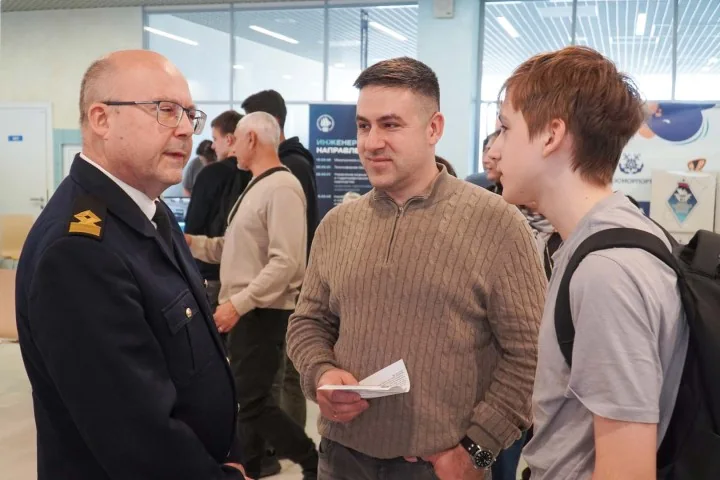
A separate October 2026 session introduced school students to professional radio exchange in English. The university's language-training department explained the role of communication in maritime safety and introduced the procedures and standard phrases used for radio exchanges. The published account specifically identifies the International Maritime Organization's Standard Marine Communication Phrases as part of the session.
Participants then used portable radiotelephones in a role-playing exercise. This example shows language teaching connected with a concrete professional context: students practiced exchanging information using the conventions of maritime communication. Alongside simulator demonstrations and student scientific projects, it illustrates the university's use of activities that make specialised knowledge tangible to learners.
Sources: October2026 maritime English session ↗