Visa
About Adamson University
A Catholic university in Manila
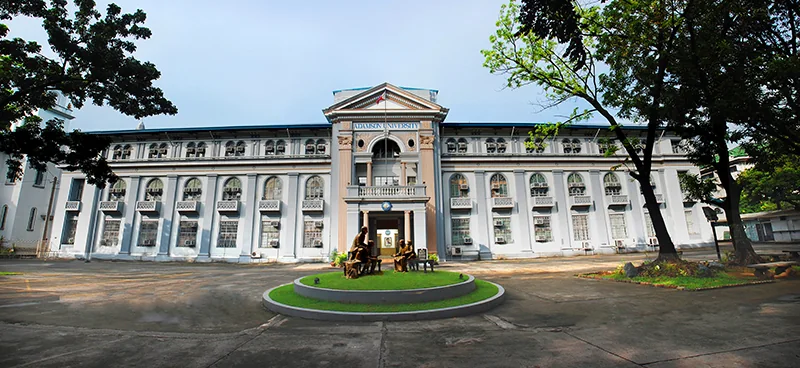
Adamson University is a Catholic and Vincentian university at 900 San Marcelino Street in Ermita, Manila, Philippines. Its identity brings together a scientific and technical educational heritage with the Vincentian emphasis on service to people facing social disadvantage. The institution has expanded from a specialised chemistry school into a university offering education across professional, scientific and humanities fields.
Its origins lie in the Adamson School of Industrial Chemistry, founded in 1932 by Greek chemist George Lucas Adamson with the involvement of his cousins Alexander and George Athos Adamson. The early school operated as a night class in Santa Cruz, Manila, before moving as enrolment grew. Engineering entered its institutional name in 1936, and university status followed on 5 February 1941. Following wartime destruction, teaching reopened in June 1946 at San Marcelino. Administration passed to the Congregation of the Mission, commonly known as the Vincentians, in December 1964. The university subsequently developed its Catholic identity while continuing its scientific and technical work.
Sources: About Adamson University ↗ · University history ↗
Vincentian educational purpose
The university’s educational philosophy groups its aims around competence, character and charity. These connect expertise in a chosen discipline with integrity in relationships and a moral commitment to others. Its mission describes the pursuit of knowledge as informed by Catholic teaching and Gospel values, while the example of St Vincent de Paul provides a model for responding to people in need.
Adamson presents discovery, learning and service as complementary responsibilities. Its mission includes the formation of creative and socially responsible leaders, and the provision of services intended to help communities become agents of change. This orientation gives its academic activities an explicitly social purpose. The declared core values include solidarity, social responsibility, the search for excellence and sustained integral development, alongside the spirit of St Vincent de Paul.
Sources: About Adamson University ↗ · Vision and mission ↗
Academic breadth and practical science
The academic directory identifies colleges covering architecture, business administration, computing and information technology, education and liberal arts, engineering, law, nursing, pharmacy and science. It also lists the Graduate School and St Vincent School of Theology. This range reflects the university’s development beyond its original scientific specialisation, while retaining engineering and chemistry within a broader academic community.
The Chemistry Laboratory provides a concrete example of practical learning infrastructure. Its mandate supports the chemistry degree and other science, technology, engineering and mathematics courses, including secondary and tertiary study. The laboratory works with the Chemistry Department on instruction, equipment operation and maintenance, and safe handling of chemicals. Its description places the facility in the Ozanam Building and identifies workbenches, instrumentation rooms and dedicated arrangements for weighing equipment and chemical storage.
Laboratory safety is described as an operational responsibility, including chemical waste management and support for teachers supervising practical sessions. The published account identifies emergency showers, eyewash stations, spill kits and other safety equipment. It also describes analytical services for external users and participation in community extension. These functions connect practical teaching with scientific services and the university’s wider engagement.
Sources: Academic colleges ↗ · Chemistry Laboratory ↗

Research organisation and scholarly development
The Center for Research and Development operates under the Vice-President for Academic Affairs. Its work supports researchers from proposal preparation through publication and the use of completed findings. Responsibilities include evaluating proposals for funding, helping researchers seek external grants, and coordinating intellectual property registration. The centre also represents the university in research partnerships and collaborations.
Research governance involves a University Research Board, an ethics review committee, an animal care and use committee, and college research coordinators. The board helps develop research policies and criteria for evaluating proposals. The ethics committee addresses studies involving human participants, while the animal care committee oversees relevant research and teaching activities. College coordinators provide an initial review of proposals, monitor approved work and assist with final papers. This structure distributes responsibility between university-level oversight and the colleges conducting projects.
Community extension
Integrated Community Extension Services coordinates the university’s community programmes and social action. It creates opportunities for students, faculty, administrators and other personnel to contribute their time and skills outside their usual academic roles. The office connects this work with the university’s Vincentian commitment to underserved and marginalised communities.
Its objectives include increasing awareness of community needs, strengthening the relevance of extension programmes and encouraging the self-reliance of participants. Community engagement is therefore described as both service and an educational experience for university members. It gives practical expression to the institution’s declared relationship between professional competence, social responsibility and concern for people experiencing disadvantage.
Student participation and communication
Student life includes recognised organisations grouped into academic, socio-civic and religious categories. These provide settings for involvement beyond coursework and connect different interests within the university community. The Adamson University Student Government, established in 1981, is another part of this participatory structure.
Students also have channels for publication and broadcasting. The Adamson Chronicle is identified as the official student publication, with a stated commitment to critical and objective reporting. Falcon Radio was established in 2011 through the university’s communication community and department. These activities give students additional opportunities to contribute to campus discussion, develop communication interests and participate in the life of the institution.
Sources: Student life ↗