Visa

About Adamas University
A multidisciplinary university in West Bengal
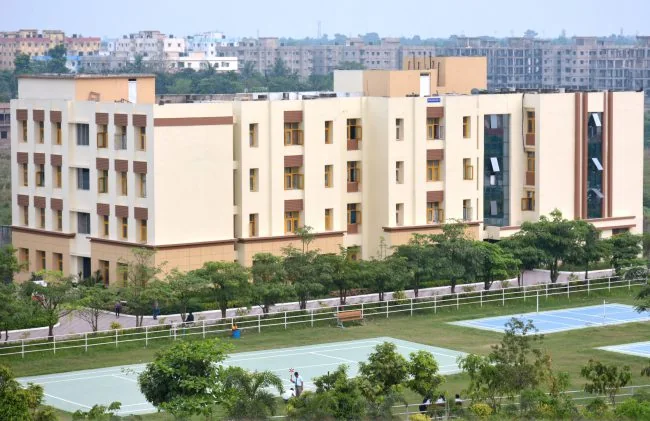
Adamas University is a multidisciplinary university based at Adamas Knowledge City in Barasat, North 24 Parganas, West Bengal, India. Its campus is situated on Barasat–Barrackpore Road at Barbaria, with a postal address in the Kolkata area. The institution combines a range of professional, scientific and humanities subjects within one university setting, with residential accommodation forming part of its educational environment.
The university was established by the Sachis Kiran Roy Memorial Trust under the Adamas University Act, 2014, West Bengal Act IV of 2014. The university’s institutional account states that the Act’s provisions came into effect on 11 April 2014 through a state government notification. Its background page also identifies the RICE Group as the parent organisation. The educational model described there is flexible and multidisciplinary, while collaboration with educational institutions and industry is intended to support research, projects and student exchanges.
Sources: University background ↗
Educational purpose
The university’s vision connects interdisciplinary education, research and innovation with the preparation of socially responsible individuals. Its mission translates that broad purpose into several educational priorities. These include updating curricula and teaching approaches, using technology in learning, and maintaining an outcomes-based approach to improvement. It also treats lifelong learning as something encouraged by a culture of enquiry rather than confined to a particular qualification.
Collaboration with research centres, industry and professional bodies is another stated priority. Alongside academic and professional development, the mission calls for ethical principles and an understanding of environmental and social realities. Respect, positivity, commitment, accountability and innovation are the university’s listed core values. Together these commitments describe the standards the institution seeks to bring into its teaching, research and relationships with the surrounding community.
Sources: Vision, mission and core values ↗
Schools and approaches to learning
Adamas organises its academic work through schools spanning engineering and technology, basic and applied sciences, business and economics, law and justice, education, life sciences and biotechnology, media and communication, liberal arts, medical sciences and agriculture. The school descriptions present different ways of combining subject knowledge with applied work. Basic and applied sciences emphasises laboratory learning and scientific curiosity, while engineering connects its curriculum with technology and industry practice.
Business teaching includes case studies, problem-solving and action learning. The law school describes clinical and experiential approaches, and media education combines classroom study with field projects and multimedia storytelling. Liberal arts study allows connections between major and minor areas and between schools. Life sciences and biotechnology gives interdisciplinary biological knowledge a central place. These examples show that the university’s multidisciplinary character extends beyond a catalogue of subjects to the teaching methods described by its academic units.
Sources: Academic schools ↗
Teacher education and engagement
The Department of Education provides a more detailed example of this approach. Its published account connects teacher preparation with curriculum innovation, research and engagement with educational institutions. Learning activities include case studies, field studies, seminar presentations and electronic learning. Internships and community outreach are described as complementary parts of the educational experience, bringing students into contact with settings beyond the university classroom.
The department also describes a mentoring system involving individual interaction with faculty, question-and-answer sessions and guidance by email. Self-directed assignments and collaborative projects are used to encourage students to engage with teachers, administrators and other participants in education. Seminars, workshops and exchange activities provide additional opportunities to discuss teaching practice. This emphasis places professional preparation alongside reflection on learning, institutional life and the social responsibilities of educators.
Sources: Department of Education ↗
Library resources and academic support
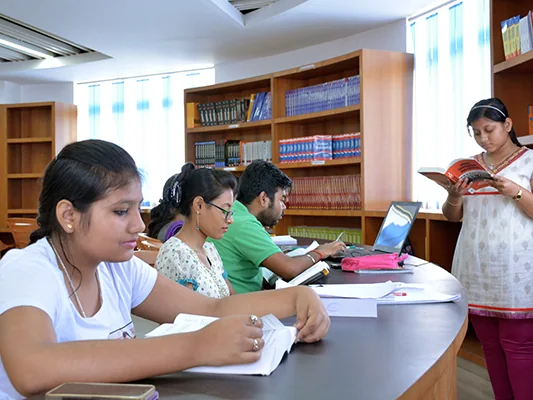
The university library system combines a central library with school-level collections. Its subject coverage includes liberal arts, sciences, engineering and technology, management, economics, law, media and pharmacy. Printed and electronic resources are managed together to support teaching, research and independent study. The library’s description identifies access through the institutional network and highlights its digital collection as an important part of its information services.
Services include reference assistance, guidance for users, circulation, interlibrary loans and document delivery. Students can search an online public catalogue, while scanning and digitisation provide additional ways to work with materials. Institutional participation in DELNET supports cooperation and document supply between libraries. The library also identifies eShodh Sindhu and ShodhGanga among its institutional connections, linking access to scholarly resources with the wider infrastructure for sharing research and doctoral theses in India.
Sources: Library resources and services ↗
Student activities and residential life
Student Affairs describes support through academic advice, tutoring, counselling and organised activities. Clubs create opportunities to pursue interests alongside formal courses. Examples include music, dance, film and drama, biotechnology, robotics and artificial intelligence, entrepreneurship, literature, environmental activity and social work. The Robotics and AI Club describes hands-on learning involving areas such as computer vision, automation and connected devices. Other groups focus on creative expression, community responsibility or environmental awareness.
Accommodation is provided in separate hostels for male and female students, supervised by wardens and their teams. The hostel page describes furnished rooms, wireless internet and a choice of room-sharing arrangements. Dining facilities serve students and faculty, with menus planned by the executive chef and hostel administration. This combination of accommodation, dining and co-curricular activities supports the university’s model of an educational campus where learning and daily community life share the same setting.
Sources: Student affairs and clubs ↗ · Hostel and food facilities ↗