Visa
About ACS Medical College and Hospital
Medical education in Maduravoyal
ACS Medical College and Hospital is based in Maduravoyal, Chennai. Established in 2007, it operates under the ambit of Dr. M.G.R. Educational and Research Institute. Its institutional overview links medical education with hospital activity, applied research and community health services. The college describes laboratories, skills facilities, a museum, library, classrooms and auditoriums as part of its teaching environment.
The institution’s mission places education, research and service to the community within a shared framework. It seeks to develop knowledge alongside professional responsibility and compassion, with attention to the different social and cultural settings in which medicine is practised. Campus life also includes cultural and sports activities. The hospital and its rural and urban training centres connect the institution with communities beyond the classroom, while departmental facilities support the scientific and practical foundations of medical study.
Sources: Institutional overview ↗ · Vision and mission ↗
Anatomy and the study of human structure
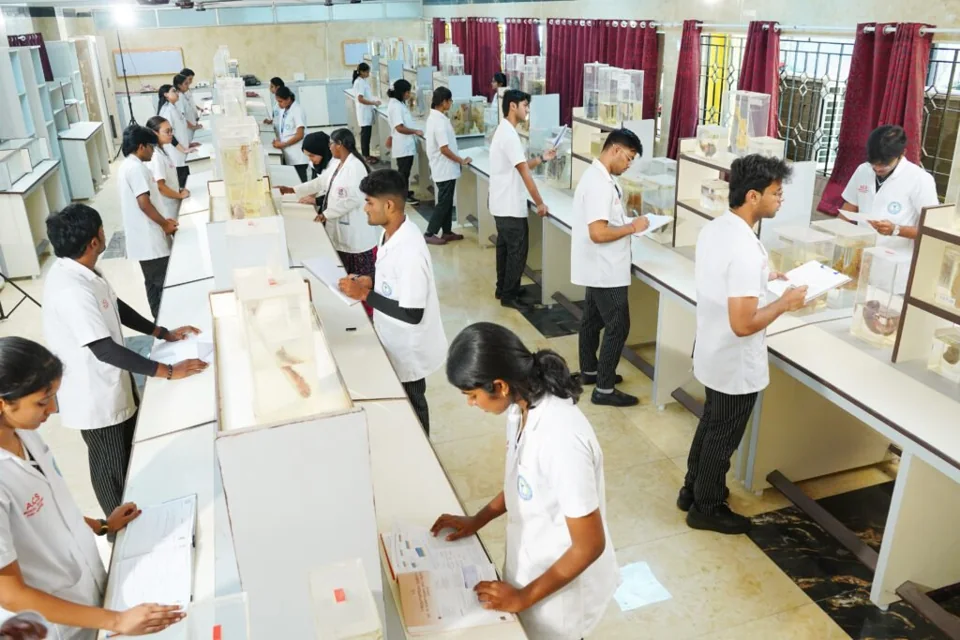
The Anatomy Department introduces medical and paramedical students to human structure and its relationship with clinical sciences. Its teaching facilities include a supervised dissection hall, a histology laboratory and a museum. Histology provides a setting for examining the normal microscopic structure of tissues. The museum arranges specimens by body region and includes descriptions intended to support independent study.
Models, charts and an imaging collection extend these resources. The department identifies radiographs, CT and MRI images among the materials used for teaching, linking different ways of understanding anatomy. A departmental library and research laboratory provide further support for students and staff. Its educational approach includes small-group teaching, integrated sessions, early clinical exposure and self-directed learning. These methods allow students to revisit the relationship between structure, observation and the wider medical curriculum through several forms of study.
Sources: Anatomy Department ↗
Physiology and the interpretation of evidence
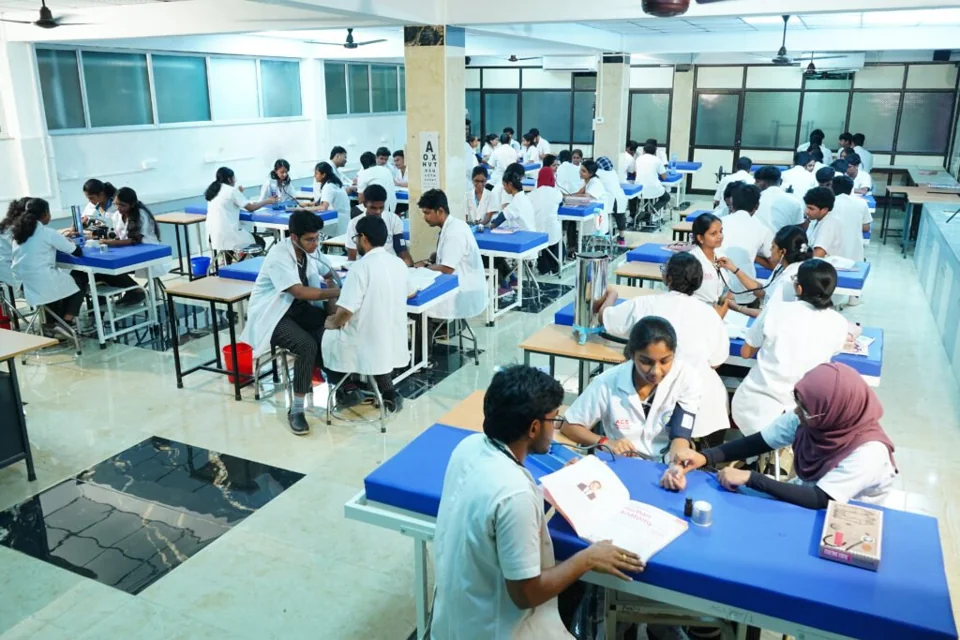
Physiology focuses on the normal functions of organ systems and how those systems interact. Its departmental objectives connect this knowledge with an understanding of the physiological basis of health and disease. Practical learning includes carrying out experiments, interpreting investigative data and distinguishing different findings rather than relying only on the recall of theoretical material.
The department describes haematology, clinical and experimental physiology laboratories for undergraduate teaching. More specialised facilities include neurophysiology, pulmonology and polysomnography, exercise physiology and autonomic-function laboratories for postgraduate study and research. Demonstration space and a seminar hall with library resources complement the practical rooms. The combination of teaching spaces and laboratory work supports an integrated view of organ structure, function and regulation, while giving students experience of working with evidence generated through observation and measurement.
Sources: Physiology Department ↗
Biochemistry across undergraduate and advanced study
The Biochemistry Department teaches the scientific basis of life processes at molecular level. Its stated objectives include helping students interpret biochemical information and understand its relationship with clinical questions. Teaching also addresses good laboratory practice, professional values and the responsible use of scientific knowledge. The department identifies undergraduate MBBS teaching, postgraduate MD study and PhD work in medical biochemistry within its academic remit.
Guest lectures, integrated teaching and enrichment courses supplement scheduled study. A student laboratory provides practical space, while the departmental library supports students and faculty with subject resources. The department also describes continuing training for staff in medical education and laboratory quality systems. These activities connect the development of scientific knowledge with the methods through which laboratory work is taught, organised and evaluated.
Sources: Biochemistry Department ↗
Community medicine beyond the campus
Community Medicine brings together academic teaching, outreach and research. The department participates in undergraduate medical education and internship, as well as postgraduate study. Its account describes teaching resources including a museum, a library combined with seminar space, and a research laboratory. Models, specimens, charts and reference material support learning about health at population level.
Its rural training centre is at Nayapakkam and its urban training centre at Nerkundram. The department describes activities involving school health, family surveys, sanitation, health education and national health programmes, alongside other community services. These settings allow students to encounter the relationship between health, living conditions and service organisation. Research interests include communicable and non-communicable conditions, and the department reports student participation in research projects. It specifically identifies faculty guidance for MBBS students undertaking Indian Council of Medical Research short-term studentship projects. Interns also undertake community-based studies during their placement, connecting field experience with the formulation and investigation of a research question.
Sources: Community Medicine Department ↗
A shared infrastructure for research
The Central Research Laboratory provides a common scientific facility for investigators across disciplines. It supports faculty, doctoral scholars, postgraduate students and undergraduates through technical assistance and access to research equipment. The institutional account records the inauguration of the renovated facility as an Advanced Research Institute on 1 October 2022. Its scope spans pathology, biochemistry, microbiology and molecular biology. The laboratory description identifies climate control and backup power among the provisions supporting its scientific work.
The equipment list includes spectrophotometry, ELISA reading and washing systems, electrophoresis, PCR, microscopy, centrifugation and automated analysis. Incubators, cold storage, sterilisation equipment and other laboratory resources support the working environment. Centralising these facilities gives researchers access to equipment that can serve different projects and academic departments. In the college’s educational setting, this infrastructure connects classroom science with dissertation work and the development of practical research skills.
Sources: Central Research Laboratory ↗