Visa
About Acharya Brojendra Nath Seal College
A government college in Cooch Behar
Acharya Brojendra Nath Seal College is a government college in Cooch Behar, West Bengal. Maharaja Nripendra Narayan founded it in 1888, and it was originally known as Victoria College. Its location in the town’s central area and its long educational history connect it with the development of higher learning in North Bengal.
J. D. Goodley was its first principal. Acharya Brojendra Nath Seal later became the first Indian to lead the institution, serving from 1896 to 1913. During his leadership, the college provided postgraduate teaching in English literature and philosophy, with law also forming part of its educational activity. Following the merger of the princely state with India, responsibility for the institution passed to the Government of West Bengal. In 1970 it was renamed in recognition of Seal’s contribution, preserving the association between its institutional identity and his scholarly and administrative work.
Sources: About the college ↗
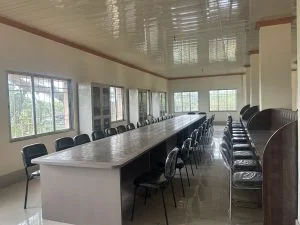
Languages, humanities and science programmes
The college’s published course list includes four-year undergraduate programmes under the National Education Policy framework. Language majors comprise Bengali, English and Sanskrit. The humanities and social sciences include economics, history, geography, education, philosophy and political science. Science provision covers physics, chemistry, mathematics, zoology, botany and physiology. This breadth allows the institution to support several distinct forms of academic enquiry within one college.
Postgraduate provision includes a two-year MSc in Zoology and two-year MA courses in Bengali, History and Sanskrit. The course page links postgraduate admissions with Cooch Behar Panchanan Barma University guidelines. Alongside its newer four-year listings, the website retains descriptions of the earlier three-year undergraduate structure. The undergraduate major list and the postgraduate courses show the college’s continuing combination of language study, social investigation, mathematical reasoning and laboratory science.
Sources: Courses offered ↗
MANAN: print and digital learning resources
The central library, known as MANAN, brings printed collections together with digital services. Its published description identifies approximately one hundred thousand books, including rare and older materials held as special collections. A three-storey building accommodates textbooks, general works, reference materials, periodicals, heritage books, an electronic library, a seminar hall and career guidance resources.
Library services include lending, an online public catalogue, research support, reference assistance and access to electronic books and journals. Koha library software and barcoding support collection management. The hybrid reading room provides eighty places, while the electronic library offers desktop computers and space for readers using personal devices. The library also supports departmental collections, user orientation and access through DELNET. Its institutional repository includes publications about Acharya Brojendra Nath Seal, Cooch Behar’s heritage, teaching materials and previous examination papers. Audiobook services and arrangements for visually impaired students form part of the published provision.
Sources: Central library ↗
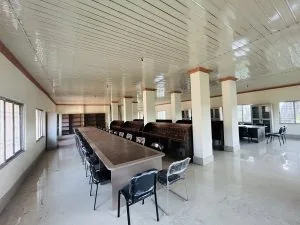
History, objects and regional enquiry
History has been taught at the college since its foundation in 1888. The department’s account dates the introduction of postgraduate History studies to 2010. Its resources include a seminar library, internet access and a museum containing rare artefacts. These facilities connect reading and classroom discussion with opportunities to encounter material evidence of the past.
The department describes educational tours, wall magazines, seminars and conferences as parts of its academic culture. During the pandemic it used online classes, internal assessments, discussion sessions and digital study materials to continue teaching. One documented webinar addressed the antiquities of North Bengal, with contributions from specialists associated with archaeology and museum work. Such examples show an interest in connecting the study of history with regional collections, sites and the interpretation of evidence, alongside the development of students’ written and spoken participation.
Sources: History department ↗
Physics through concepts and practical work
The Physics department presents practical project classes as part of its approach to learning. It emphasises conceptual understanding of fundamental principles and the ability to solve problems through qualitative and quantitative reasoning, including mathematical methods. A departmental seminar library supplements the central collection, providing another setting for reading around the subject.
Its published academic examples include talks on communication and on connections between people and the cosmos, with speakers from Indian research institutions. The department’s account also describes laboratory provision supporting the curriculum in use when the page was prepared. Together, these activities link formal study with practical investigation and exposure to scientific ideas beyond routine classroom exercises. The emphasis falls on developing ways to analyse physical questions and relate theoretical knowledge to problems encountered through projects and discussion.
Sources: Physics department ↗
Political science and civic participation
Political Science teaching is complemented by a departmental library and opportunities for students to discuss public questions. The department describes essay competitions, Youth Parliament activities, quizzes and extempore speaking as ways of encouraging engagement with its subject. Student seminar papers, wall magazines and educational tours provide additional forms of participation.
Its documented activities include observances of Constitution Day, National Youth Day and Ambedkar Jayanti. A June 2021 academic programme considered David Held’s ideas about democracy, while another addressed the impact of the pandemic on Indian federalism. These dated examples connect political concepts with public institutions and contemporary events. They also illustrate how a departmental community can develop analytical and communication skills through discussion, writing and the presentation of ideas to others.
Sources: Political Science department ↗