Visa

About Academy of the State Fire Service EMERCOM of Russia
A specialist academy in Moscow
The Academy of the State Fire Service EMERCOM of Russia is a Moscow institution devoted to education and research in fire safety, emergency situations and related areas of public protection. Its main address is on Boris Galushkina Street, near the VDNKh exhibition district. Teaching, laboratories and scholarly work form part of its institutional life, alongside student organisations and international educational cooperation. The academy’s campus brings together buildings constructed in different periods, reflecting the development of an institution whose formal history begins in 1933.
Sources: Official campus overview ↗ · Science and technology ↗
Historical development
The academy traces its origins to a fire-protection specialisation opened in 1933 within the sanitary engineering faculty of the Leningrad Institute of Municipal Construction Engineers. In 1936, this became a faculty for fire-protection engineers. The institution’s timeline then records a wartime period at the Azerbaijan Industrial Institute, followed by the Higher Fire-Technical Courses from 1948 to 1957. From 1957, its predecessor operated as a faculty of fire engineering and safety within the Higher School of the Soviet Ministry of Internal Affairs.
The Higher Engineering Fire-Technical School followed in 1973. In 1996, it became the Moscow Institute of Fire Safety, and in 1999 it acquired the status and name of an Academy of the State Fire Service. Its departmental affiliation changed to EMERCOM in 2002. The timeline identifies 2023 as the beginning of its Order of Honour academy designation. These successive names mark the institution’s progression from a university specialisation to a separate specialist academy.
Sources: Institutional history and timeline ↗
Teaching spaces and academic heritage
The Moscow campus contains lecture rooms, teaching laboratories and a student residence. Its facilities include classrooms equipped with multimedia and interactive teaching technology. The academy also lists educational facilities outside its main Moscow site, including provision in Noginsk and Divnomorskoye. The combination of teaching buildings, residential accommodation and specialised educational settings supports the different components of its academic work.
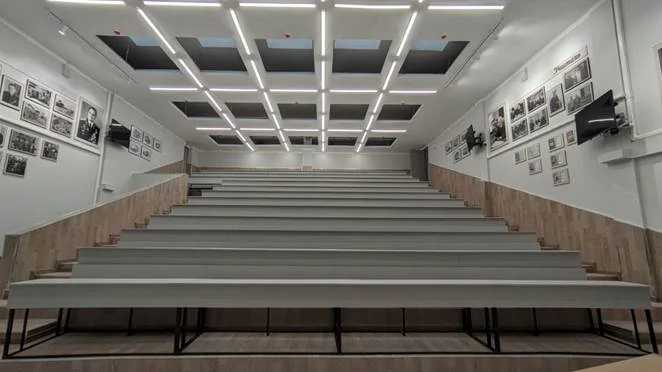
One distinctive teaching room is lecture theatre 505, named after M. D. Bezborodko. Its exhibition presents his life through three themes: soldier, teacher and scientist. Historical photographs and biographical displays surround the lecture seating, connecting the room’s everyday teaching purpose with institutional memory. The published room description identifies its use for specialist-level Fire Safety and bachelor-level Technosphere Safety teaching. Equipment includes a lecturer’s computer, an interactive board and additional monitors, combining a historical exhibition with classroom technology.
Sources: Official campus overview ↗ · M. D. Bezborodko lecture theatre ↗
Research and younger scholars
The academy describes itself as a scientific centre within Russia’s emergency services education system. Its science overview identifies nine scientific schools and two dissertation councils. Departmental scientific circles and educational-research complexes provide routes for students and cadets interested in research to become involved in scholarly work. The institution also connects this activity with postgraduate research training, placing the development of academic personnel alongside its wider educational responsibilities.
A Council of Young Scientists and Specialists represents early-career researchers, teachers and other eligible academy personnel. Its tasks include helping with research and dissertations, supporting conferences and spreading information about grants and professional literature. It also assists with publication and builds connections with similar councils at other institutions. The council’s role therefore covers both the practical organisation of research activity and the professional interests of younger members of the academic community.
Sources: Science and technology ↗ · Young Scientists and Specialists Council ↗
Three scholarly journals
The academy publishes three quarterly journals with different subject emphases. Fires and Emergencies: Prevention, Elimination began in 2004 and covers fire safety, emergency situations and specialist education. Its stated purposes include communicating research results and connecting researchers and practitioners. Technologies of Technosphere Safety, an online journal established in 2005, addresses informational, technical, regulatory and organisational aspects of safety.
Culture and Safety, published since 2021, adds an interdisciplinary humanities perspective. It examines questions of human and social safety and encourages links between social and humanities researchers and specialists in fundamental and technical sciences. Together, the journals give the academy publishing outlets that range from engineering and applied safety research to cultural and social questions. Their shared quarterly schedule provides a regular framework for scholarly communication.
International education
The academy’s international page describes both higher education and continuing professional education for overseas participants. It reports more than 200 cadets and officers from 24 countries across these programmes, as well as annual specialist-course education for personnel from foreign emergency agencies. Its published cooperation register includes agreements and memoranda with civil protection institutions, universities and humanitarian organisations.
Examples in that register include the University of Civil Protection of Belarus, the International Civil Defence Organisation and France’s national school for fire-service officers. It also lists cooperation with the Bulgarian Red Cross and institutions in Mongolia and Vietnam. Dates and documents accompany the entries, showing the academy’s international work as a series of institutional educational relationships.
Student participation
The academy’s Youth Union was founded in September 2012 to support student initiatives and represent the interests of cadets, students and other learners. Its activities cover academic innovation, cultural projects, sport, volunteering and a youth editorial team. The union works with teachers and educational departments while encouraging creativity and social responsibility. Its published account of the 2024–2025 year records 28 events across these areas, illustrating an organised programme of student participation beyond formal classes.
Sources: Youth Union ↗