Visa
About Academy of Scientific and Innovative Research
A national research academy
The Academy of Scientific and Innovative Research, generally known as AcSIR, is an Indian institution of national importance established in 2011. Its interim operations began in June 2010. The academy was created to develop science and technology researchers through teaching, research opportunities and academic approaches directed towards subjects that are not routinely covered by conventional university programmes. Its headquarters is at the CSIR Human Resource Development Centre campus in Ghaziabad, Uttar Pradesh.
AcSIR operates through a hub-and-spoke structure. The headquarters coordinates central administrative functions, while associated research institutes across India serve as academic campuses. This arrangement connects the academy’s degree framework with the specialist environments of working research organizations. Its institutional introduction also describes academic collaborations with other Indian and international educational institutions. The resulting network brings a geographically distributed research community within a shared academic organization. The campuses therefore form an essential part of the academy’s educational model: research instruction takes place within a national network rather than being concentrated exclusively at its administrative headquarters.
Sources: Institutional introduction ↗
Research education and its objectives
AcSIR’s mission places knowledge across disciplinary boundaries at the centre of scientific and technological leadership. Its objectives cover advanced teaching and research in emerging fields, including natural and life sciences, mathematical and computational sciences, medical sciences and engineering. They also recognize connections with applied arts, humanities, social sciences and relevant law. The academy describes scholarship as an activity extending beyond the pursuit of examination marks or grades.
Industry links, collaboration with universities, and research addressing social, economic, cultural and intellectual welfare are further stated objectives. Training, extension services and studies outside the regular curriculum also belong to this remit. The academic overview describes programmes conducted in active research environments at associated institutes, linking education directly with laboratory work. It also emphasizes access for learners from diverse social and geographical backgrounds and participation in wider scientific communities. These priorities connect specialist research preparation with the uses and consequences of scientific knowledge.
Sources: Mission and objectives ↗ · Academic overview ↗
Faculties and degree pathways
The academic structure comprises seven Faculties of Studies: Biological Sciences, Chemical Sciences, Physical Sciences, Engineering Sciences, Medical Research, Mathematical and Information Sciences, and Agricultural Sciences. Associated institutes include organizations within the Council of Scientific and Industrial Research and Indian Council of Medical Research networks, together with other research and development institutions. The faculty structure provides subject groupings across these different locations.
The programme catalogue lists doctorates in science, engineering and medical research, with coursework accompanying practical investigation. It also presents an integrated M.Tech and Ph.D. pathway hosted in specialist institutes. Examples include chemical and polymer engineering at CSIR-NCL in Pune, advanced electronics at CSIR-CEERI in Pilani, structural engineering at CSIR-SERC in Chennai, and environmental systems engineering and modelling at CSIR-NEERI in Nagpur. Standalone M.Tech provision includes food technology, instrumentation, machinery and corrosion science. These institute-specific examples show the relationship between programme content and the research expertise available at the host location.
Sources: Faculty of Studies ↗ · Programmes and courses ↗
Specialist postgraduate education
The catalogue extends to master’s study in food technology, clinical research, wildlife science, freshwater ecology and conservation, applied nutrition and sports nutrition. The listed host organizations include CSIR-CFTRI in Mysuru, the Wildlife Institute of India in Dehradun and ICMR-NIN in Hyderabad. Public health and healthcare quality management also appear among the master’s qualifications. One-year postgraduate diploma subjects include precision measurement, patinformatics, leather technology and semiconductor technologies. This range brings environmental, industrial and health-related research into AcSIR’s postgraduate portfolio.
Sources: Programmes and courses ↗
International doctoral collaboration
International joint doctorates form a substantial part of AcSIR’s collaboration model. Under its cotutelle framework, a doctoral researcher is enrolled at AcSIR and a partner university and receives supervision from both institutions. The arrangement combines supervisors’ expertise and access to research infrastructure across the participating organizations. The academy explains that successful completion leads to doctoral awards from both universities within the agreed framework.
Its official partnership account describes an RMIT joint Ph.D. programme initiated in 2017 and renewed in 2022. It also identifies cooperation with Deakin University and the University of Western Australia from 2022, an agreement with the University of Melbourne in March 2025, and a cotutelle agreement with Norway’s University of Agder in April 2025. A July 2026 webinar introduced scholars to programme structure, applications and partner institutions. Current researchers and alumni contributed practical accounts of working with international supervisors and adapting to different academic and cultural environments.
Sources: International collaboration ↗
Student scientific life and shared celebrations
Science clubs provide a meeting ground for AcSIR students across subjects and departments. The academy envisages discussion of scientific ideas alongside the history and culture of science, future directions and relationships with society. Activities can include debates, student seminars, literary work, cultural programmes and media activities. Clubs may be established at individual academic centres while sharing a wider interdisciplinary purpose.
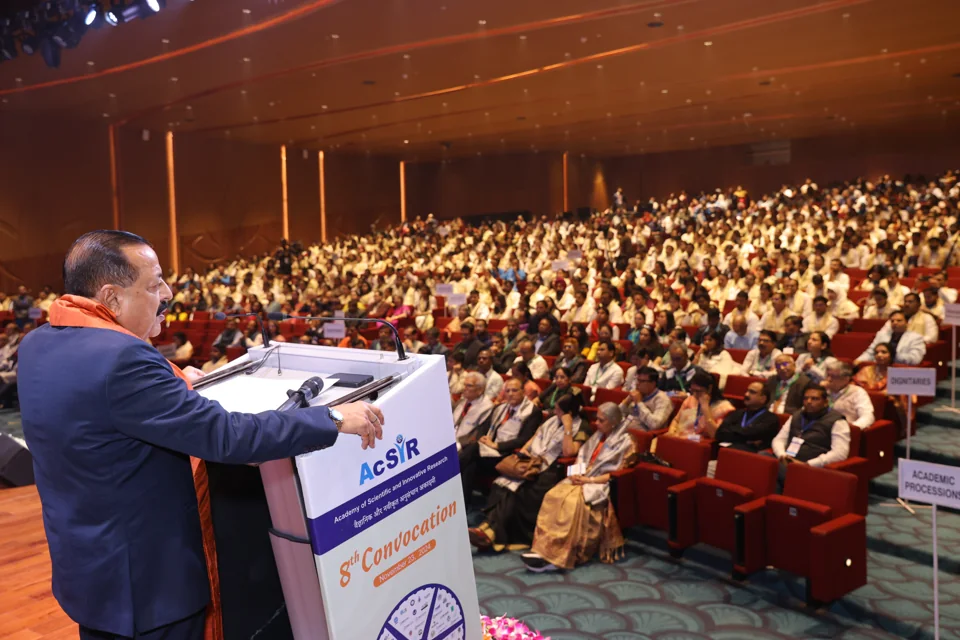
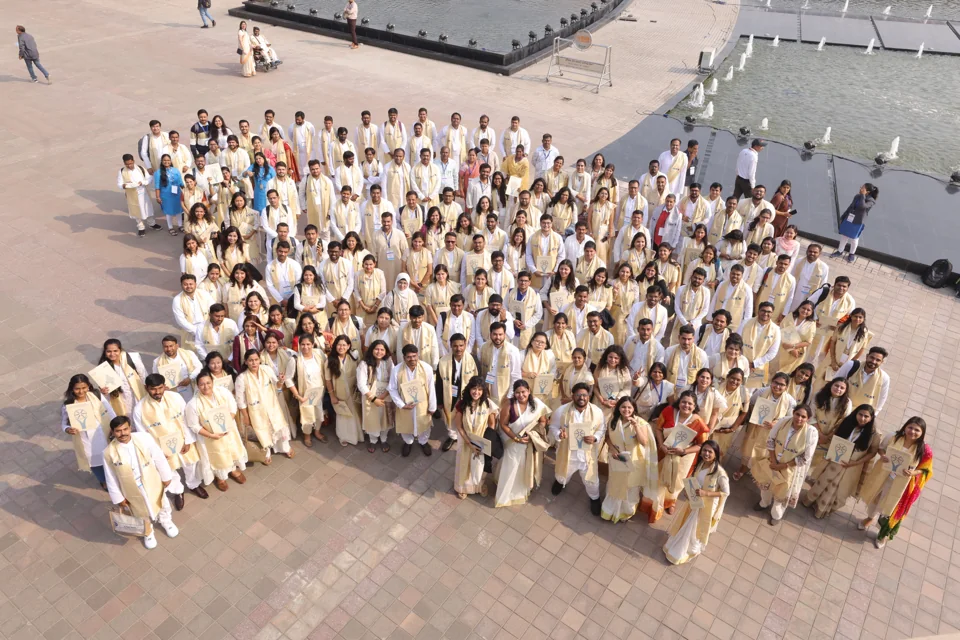
The reported Aagaz 4.0 event at CSIR-IIP in Dehradun on 27 March 2026 combined science celebrations with photography, graphical abstracts, quizzes and cultural performances. Academy-wide ceremonies offer another point of connection across the network. The eighth convocation took place at Bharath Mandapam in New Delhi on 23 November 2024. Its programme included doctoral recognition, research awards and the academy’s first conferment of honorary Doctor of Science degrees upon four scientists.
Sources: Science clubs ↗ · Eighth convocation ↗