Visa
About Academy of Drama and Film
A Budapest institution for theatre and screen arts
The Academy of Drama and Film is the Budapest institution known today in English as the University of Theatre and Film Arts, or SZFE. Its specialist education brings together performance, directing, filmmaking, writing and the study of artistic practice. The university produces theatre performances and student films as part of an educational mission concerned with making creative work and developing knowledge of theatre and cinema. Its institutional history begins with Hungarian-language theatre teaching on 2 January 1865, following an imperial decision to establish a theatre school in 1863.
The first classes occupied three rooms in an apartment on what is now Semmelweis Street. A permanent home at 21 Rákóczi út followed in 1905. Film acting entered the curriculum through a one-year class in the 1932–33 academic year and subsequently became a regular course. In 1948 the institution officially became the College of Theatre and Film Arts. This development from an acting school helps explain the breadth of its present theatrical and cinematic disciplines.
Sources: History: established 1865 ↗ · Karlovy Vary International Film Festival: For Some Inexplicable Reason, director biography identifying the Academy as SZFE ↗
Acting, directing and theatre production
The Sinkovits Imre Institute of Theatre Arts is based at Szentkirályi Street 32. Its areas include theatre directing, assistant directing, acting, puppetry and musical acting. Director training combines knowledge of historical and contemporary theatre with the ability to form an individual stage concept. It also addresses leading a group of artists or a company, connecting creative interpretation with the responsibilities of collaborative production.
Assistant-director education concentrates on the organisation of rehearsals and the sequence of work behind a performance. Supporting tasks can include props and prompting, alongside the coordination needed to keep productions running. Acting education covers both stage and screen, with preparation for radio work and dubbing. Puppetry prepares artists for work within a company and for independent creation, while also extending to other performance media. Musical acting builds on actor training with a stronger musical component. These related pathways reflect the different skills required within the same theatrical environment.
Sources: Sinkovits Imre Institute of Theatre Arts ↗

Cinema, television and visual creation
The Zsigmond Vilmos Institute of Cinematic Arts is located at Mészáros Street 48 in Budapest. Its academic presentation ranges from cinematography and television production to directing, documentary filmmaking and visual design. Master’s study in directing and cinematography emphasises the development of autonomous artists who build on earlier practical and theoretical experience. Visual design extends across moving-image culture, including games, animation and visual effects, with attention to the computer tools used in those fields.
Television programme production connects knowledge of society, public affairs, culture and visual art with practical production responsibilities. These include developing a concept, preparing a programme, directing, reporting and completing post-production. Other study areas address the specialist roles within a filmmaking team: sound work covers preparation, shooting and post-production; editing involves assembling filmed material with the director; and screenwriting combines cinematic knowledge with dramaturgy. The institute therefore presents film education as a set of distinct creative crafts that must work together in a finished production.
Dramaturgy and theatre education
The Németh Antal Institute of Drama Theory, at Rákóczi út 21, offers a five-year dramaturgy programme with specialisations in playwriting or art criticism. Its conception of dramaturgy includes mainstream and independent theatre, with applications in spoken drama, musical theatre, puppetry, dance, physical theatre, documentary theatre and theatre education. Students are prepared to address the interpretive and creative tasks that arise across these forms.
The institute also offers bachelor’s education in drama instruction. This concerns the design and organisation of activities that use theatre and dramatic participation in cultural institutions, public education and community settings. Drama pedagogy and theatre education supply both theoretical and practical foundations. The programme describes work that can be undertaken independently or as part of a group, linking artistic methods to collective learning and community participation.
Sources: Németh Antal Institute of Drama Theory ↗
Artistic research and doctoral work
The Doctoral School provides a further level of study in theatre, film and video arts. Its degrees include the Doctor of Liberal Arts, or DLA, in theatre arts and film and video arts, alongside a PhD in art studies. Doctoral preparation combines training and research, undertaken individually or in groups according to the discipline and the student’s work, with regular reporting on progress.
For the DLA, an original artwork is central to the research process. Students investigate the creative work and prepare a thesis bringing together the results of artistic practice and inquiry. Applications include a research proposal and a plan for an artwork developed over four academic years. The curriculum incorporates theatre and cinema history, theoretical approaches and classical and contemporary cultural contexts. The school lists its address at Vas Street 2/d, adding a research setting to the university’s professional artistic education.
Sources: Doctoral School ↗
International study and exchange
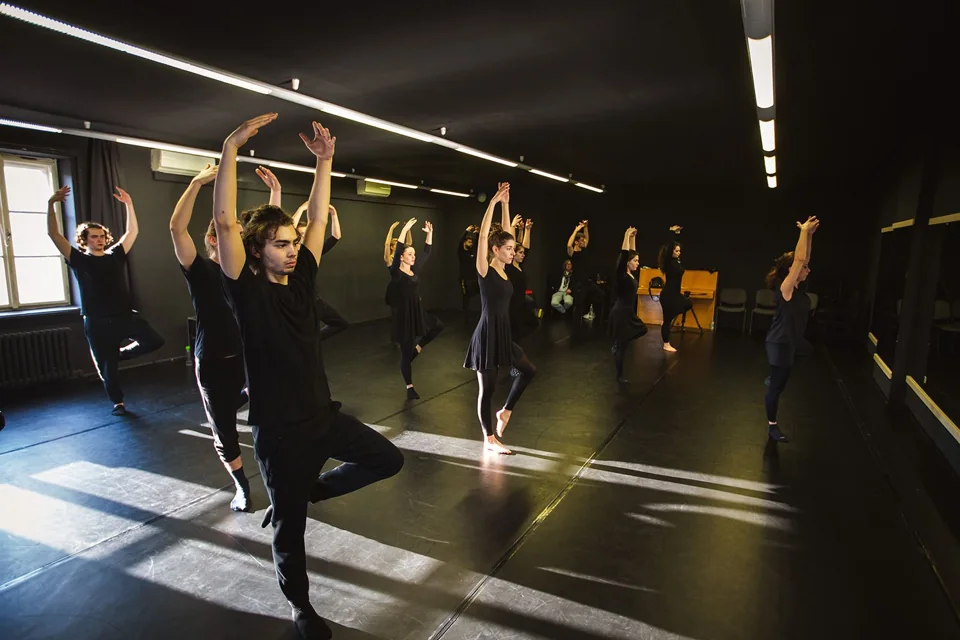
SZFE’s international-student information describes small classes and practice-oriented workshops supported by renovated studios and specialist equipment. Exchange arrangements can cover one semester or an academic year and depend on agreements with partner universities. The process begins with nomination by a student’s home institution, followed by an application including a curriculum vitae, motivation letter and academic transcript. Links to artistic work can accompany those documents.
The exchange information identifies English as the instructional language and asks for strong B2-level knowledge of English or Hungarian, without requiring a language certificate. Completed courses, grades and ECTS credits are recorded in a transcript issued after the exchange. Doctoral exchange applicants are accepted for Hungarian-language programmes only. The university also maintains a dormitory at Nagyszeben Street 24/B, although accommodation for exchange students depends on its limited capacity.