Visa
About Academician Yuriy Bugay International Scientific and Technical University
Origins and identity
Academician Yuriy Bugay International Scientific and Technical University is a Ukrainian higher education institution based in Kyiv. It is widely identified by the Ukrainian abbreviation MNTU and the English abbreviation ISTU. The university’s history records its foundation on 8 November 1992, followed by a founding agreement in April 1993 and the start of teaching for its first students on 1 September 1993. Its Kyiv address is 3 Khersonskyi Lane, formerly Mahnitohorskyi Lane, near Chernihivska metro station.
The institution carries the name of Yuriy Bugay, its first president, whose scientific career combined oil-and-gas research with education. Its development has included a research institute for innovative oil-and-gas technologies, established in 1997, and colleges created in Kyiv, Poltava and Lutsk in 2013. The current institutional name dates to a change recorded in 2020. Its mission connects higher education and lifelong learning with research, new knowledge and the preparation of creative, socially responsible specialists.
Sources: University history ↗ · About the university ↗
An interdisciplinary programme portfolio
The university’s bachelor programme directory brings digital and technical studies together with social and professional fields. Its listed programmes include software for intelligent systems, computer science and intelligent systems, and intelligent systems and data-transmission networks. Digital management and digital marketing place organisational subjects alongside technology. Psychology, law, physical therapy, and public management and administration complete the range presented in that directory.
This breadth is reflected in the university’s departmental structure, which includes management, marketing and public administration; information, communications and oil-and-gas technologies; law; psychology and humanities; and physical therapy. Its About pages also trace the establishment of a UNESCO chair concerned with information and communication technologies in education in 1996. The combination connects the university’s technical roots with learning, management and human services.
Sources: Bachelor programmes ↗ · About the university ↗
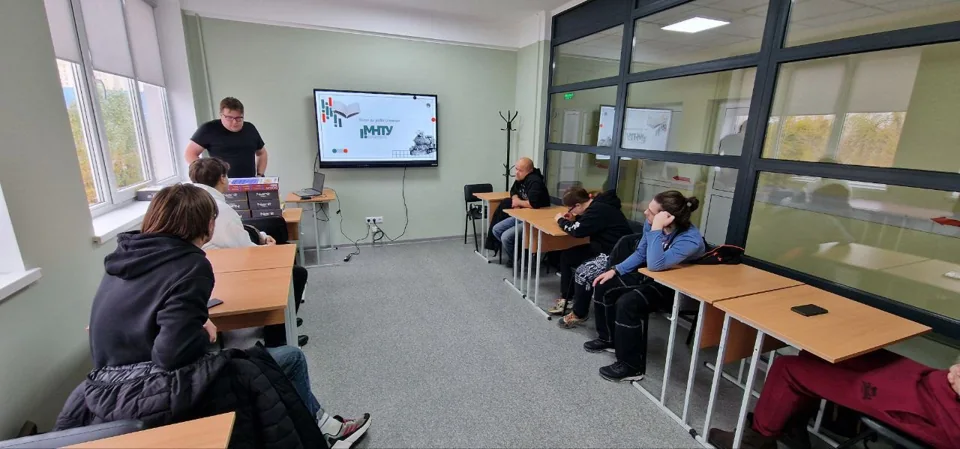
Immersive technologies for learning and research
The Immersive Technologies Laboratory provides a setting for investigating virtual, augmented and mixed reality. Its equipment list includes four HTC Vive and Vive Pro headsets, one Oculus headset and one HoloLens augmented-reality device. The laboratory supports work with digital environments and interactive visualisation, giving students and lecturers tools for simulations as well as the development of their own applications and services.
The university describes integrating immersive tools into physics, astronomy, biology and other subjects. Its teaching examples include examining anatomical structures and representing concepts that can be difficult to communicate through conventional demonstrations. Research is another part of the laboratory’s role: students can practise experimental methods and develop products based on virtual or augmented reality. This makes the facility both a teaching resource and a space for technical investigation.
Sources: Immersive Technologies Laboratory ↗
Robotics, electronics and computer vision
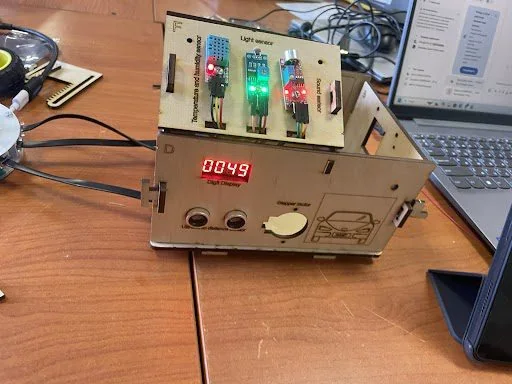
The Robotics and Computer Vision Laboratory combines educational activity with the development and testing of intelligent systems. Its work connects robotics, computer vision and machine learning, with attention to systems that analyse their surroundings and respond in real time. Students encounter robots, sensors, object-detection methods and prototype testing. Introductory construction kits support learning about electronic components and circuits before more complex projects.
The laboratory’s course progresses through basic robotics, electronics and electromechanics into Arduino programming. Later topics include digital and analogue inputs and outputs, sensors, device communications and ESP8266 wireless modules. Computer vision and machine-learning methods are introduced as components of more advanced systems. Final projects bring the elements together in integrated designs. The laboratory also identifies cooperation with Nanit Robot and the use of educational smart-home and drone kits.
Sources: Robotics and Computer Vision Laboratory ↗
Library collections and information skills
The Scientific Library supports teaching and research through printed and electronic resources, reference services and bibliographic assistance. It reports a collection of approximately ten thousand documents. Its electronic services include a catalogue, a digital library and an institutional repository. Readers can also use reference-search tools and internet access through Wi-Fi.
Information support extends to scientific events and the preparation of bibliographic, thematic and biobibliographic indexes. Library consultations help users describe documents, search for material and deposit academic publications in the repository. Its training programme addresses citation practice, plagiarism checking, open-access publishing and academic integrity. Alongside these research skills, the library organises cultural and educational activity such as literary evenings, book presentations and discussions.
Sources: Scientific Library ↗
Practical legal education and international exchange
The university’s Legal Clinic, established in 2026, combines practical preparation for students with free legal assistance for the public. Its published service areas include civil, family, labour, social-security, military, environmental, information and administrative law. Assistance includes oral and written consultations and help preparing applications, complaints, requests and other documents. The clinic also conducts legal-awareness events and professional discussions. It is located in room 100 at the university’s Kyiv address. Its service description excludes assistance in criminal proceedings and court representation. A team of lecturers and student consultants carries out the clinic’s educational and advisory work.
The international office’s student-mobility guidance describes both physical and virtual forms of exchange, including study, research and internships. It explains credit mobility and the recognition of work completed at a partner institution. Erasmus+ and Global UGRAD are among the opportunities introduced in its guidance. This activity complements a history of international projects, including the Knowledge Transfer Unit initiative and Erasmus+ HRLaw, by giving students a framework for academic experience beyond their home institution.
Sources: Legal Clinic ↗ · Academic mobility for students ↗