Visa


About Abu Dhabi University
Founding and institutional development
Abu Dhabi University, usually known as ADU, began teaching in 2003 after a planning process that started with the development of its charter in 2000. Its official history identifies Sheikh Hamdan bin Zayed Al Nahyan with that founding charter. The university initially welcomed students at locations in Abu Dhabi and Al Ain, establishing a presence in both cities from the beginning of its teaching activity.
The first academic colleges were Business and Arts and Sciences. Engineering was added in 2007, followed by Law in 2016. A Dubai campus opened during the 2017 to 2018 academic year. This sequence shows how the institution expanded both its subject coverage and its geographical reach. Its history relates programme development to the changing needs of the United Arab Emirates and to international trends, rather than presenting the initial group of colleges as a fixed limit on its educational purpose.
Sources: Our History ↗
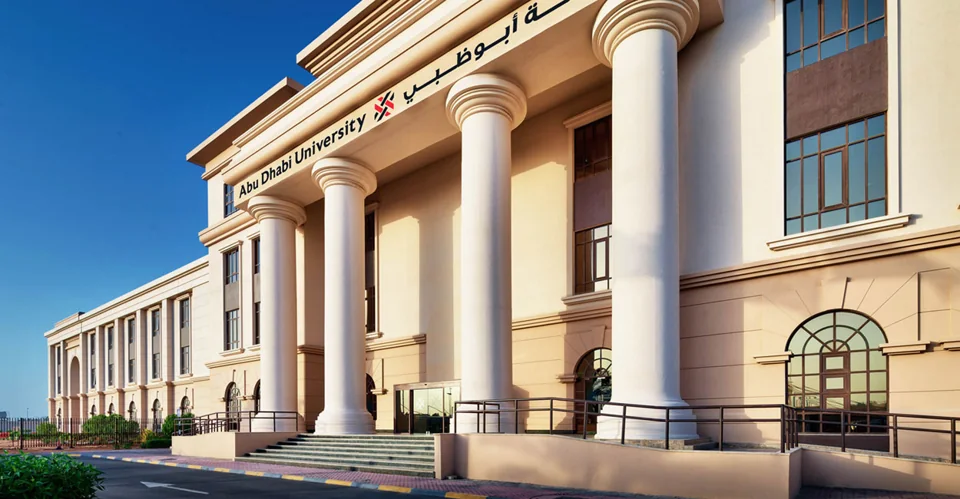
A university serving several cities
ADU is a private university in the United Arab Emirates. Its institutional profile describes teaching, the student experience, research and corporate education as major parts of its activity. Alongside established campuses in Abu Dhabi and Al Ain, the profile identifies a location in Dubai Knowledge Park. The university therefore serves more than one urban community within the country.
The profile also emphasises international participation and diversity as institutional strengths. This provides context for its interest in preparing graduates with knowledge and skills relevant to a wider regional and international environment. Its activities encompass academic learning and professional education, with research forming another part of the institution's public identity. The university's growth since its foundation can be understood through this combination of multiple locations, a broadening academic portfolio and engagement with the educational and professional needs of the UAE.
Sources: Our Profile ↗
Campus buildings and facilities
The flagship campus in Abu Dhabi is a purpose-built site that opened in 2006. The university's campus account describes spaces for teaching, laboratory work and extracurricular activity, together with residential facilities. Classrooms and laboratories sit alongside food outlets, cafés, accommodation and sporting areas. Football, basketball, tennis, volleyball and cricket are among the activities represented in the published facilities description.
An extension opened in 2017 to accommodate engineering teaching and laboratory infrastructure. At Al Ain, the campus description identifies computer laboratories, a micro-teaching laboratory, a learning support centre, library resources and specialist teaching rooms. Recreational provision is also included in the account. These examples show how the university combines academic buildings with services supporting daily campus life. They also demonstrate that its locations provide spaces for both individual study and practical or collaborative learning, rather than functioning simply as administrative addresses.
Sources: Our Campuses ↗

Library resources and research assistance
ADU's library service combines printed materials with electronic resources to support teaching, learning and research. The library account identifies facilities in Abu Dhabi and Al Ain and a research centre at the Dubai campus. Its collections include books, electronic books, journals, databases and dissertations, with discovery services helping users locate material across different formats.
Reference librarians assist students and staff with research questions and the use of information resources. The library also provides orientation and training, database searching and other practical services. Online tools allow users to ask questions, request articles, recommend books for acquisition and arrange library instruction. Borrowers can use the catalogue to renew items, while an online question-and-answer resource addresses common enquiries. This combination of collections, professional guidance and digital services is designed to help members of the university develop the information skills needed for independent learning and sustained academic work.
Sources: About ADU Library ↗
Research, teaching and wider impact
The Office of Research and Sponsored Programs supports research by ADU faculty and students. Its stated responsibilities include help with developing grant proposals, submitting them and following their progress. The university also connects research with teaching at both undergraduate and postgraduate levels, describing inquiry as part of the educational experience rather than a separate activity confined to specialist researchers.
The research overview emphasises questions relevant to national development and a knowledge-based economy. Its objectives include producing new knowledge, contributing to society through partnerships and consultancy, and improving teaching through research within academic disciplines. The university describes integrity, innovation, diversity and high standards of performance as values guiding this work. Its approach brings together students, academics and support staff as an intellectual community, with research partnerships intended to connect academic investigation with problems beyond the university itself.
Infrastructure for interdisciplinary work
ADU's research infrastructure is organised to allow collaboration across disciplines. The university identifies laboratories for artificial intelligence and robotics, biomedical and cancer research, environmental and sustainability work, and engineering fabrication and prototyping. High-performance computing is also included among its shared research resources. These facilities are described as supporting teams whose work crosses college and subject boundaries.
The infrastructure account links engineering, health sciences, business and emerging technologies within a common research environment. Library services form another part of that environment through access to databases and digital materials spanning several disciplines. Information literacy, reference assistance and interlibrary loan help researchers discover and use relevant knowledge. Collaborative and individual study spaces support this activity alongside specialist laboratories. This combination illustrates how the university connects physical equipment, computing capacity and information services when supporting interdisciplinary investigation.
Sources: Research Infrastructure ↗