Visa
About Abhedananda Mahavidyalaya
History and the Sainthia community
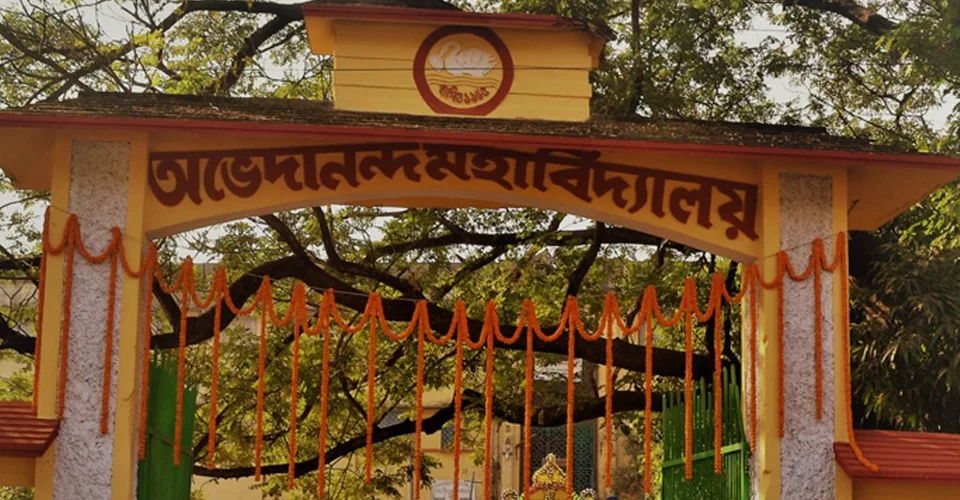
Abhedananda Mahavidyalaya is a college in Sainthia, in the Birbhum district of West Bengal, India. It was established in 1965 by Thakur Sri Satyananda Dev, a disciple of Swami Abhedananda, in connection with the latter’s birth centenary. Its founding was supported by local people and industrialists who contributed land to the Ramakrishna Ashram, which in turn provided land for the college. The institution’s history records voluntary labour by staff and students in constructing its buildings.
The founding principal was Dr K. D. Roy, also known as Swami Krishnananda, a professor of physics. The college developed from this community and spiritual foundation into a centre for undergraduate education affiliated to the University of Burdwan. It celebrated its Golden Jubilee in 2015. Its history places particular emphasis on access to higher education for families facing social and economic disadvantage in Sainthia and nearby rural areas.
Sources: College history ↗ · College letter hosted by University of Burdwan ↗
An inclusive educational purpose
The college’s vision connects education with inquiry, harmony, sustainability and freedom of thought. It aims to serve students across differences of caste, religion and gender, combining academic learning with values and a scientific outlook. Its mission identifies awareness of human rights, cultural heritage and the environment as part of education. Creativity and competence are also priorities, alongside the participation of staff, students and other stakeholders in the development of the institution and its surrounding community.
The published core values reinforce this approach through intellectual freedom, curiosity, careful analysis and dialogue. They also stress honesty, compassion, respect for women and respect for different communities. Social and environmental justice appear as responsibilities at both local and wider levels. These are the institution’s stated principles for academic work and community engagement, expressing how its founding tradition is intended to relate to modern education.
Sources: Vision and mission ↗ · Core values ↗
Study across arts, science and commerce
The college’s published course list from July 2022 documents undergraduate study across arts, science and commerce. Arts subjects include Bengali, English, Hindi, Sanskrit, history, philosophy, political science, economics and geography. The science list includes botany, chemistry, mathematics, physics and zoology, while commerce includes accountancy. The document distinguishes honours subjects from programme courses in arts, commerce, biological science and pure science. It provides a dated record of the academic range rather than a guarantee of present intake figures.
The departmental histories add detail to that development. Physics began in 1965, with an emphasis on scientific reasoning and practical aptitude. Electronics was introduced in 1987 through the UGC scheme for restructuring degree level courses and was initially hosted by Physics. The electronics account describes its purpose as broadening students’ opportunities for further education and professional development.
Sources: Courses offered, published July 2022 ↗ · Physics department ↗ · Electronics department ↗
Campus and practical learning spaces
The student facilities page describes a three storey main building used for teaching and administration. Science departments, Geography and Physical Education have laboratory facilities, while a central computer room supports students and teachers. The college also identifies an ICT enabled seminar room, providing a setting for presentations and academic gatherings. These spaces complement departmental teaching by providing facilities for practical work, computer use and discussion.
The wider campus includes a playground, a garden with a central fountain and a multi-station gymnasium. A girls’ common room provides a separate space for students to rest between activities, and the facilities page identifies hostel provision for boys. Backup generators support power supply during college hours. The combination of teaching spaces, recreational facilities and student amenities reflects the college’s role as a daily academic and community meeting place.
Sources: Student facilities ↗
Library collections and electronic resources
The college library dates from the institution’s establishment in 1965 and operates in the main building. Its collections include books and journals, rare material and a special collection devoted to Swami Abhedananda. The library serves both students and teachers, with a reading room and reference section identified in the facilities description. Some departments also maintain their own library resources.
All regular students are eligible to become library members. The library page identifies an online public access catalogue for searching resources and N-LIST access for electronic academic material. It describes KOHA automation as work in progress, so the published account should be understood as a continuing development rather than a claim that every library process has already been automated. Together, print holdings, reference provision and electronic access support reading and independent academic work.
Sources: About the library ↗ · Student facilities ↗
NSS, NCC and service beyond campus
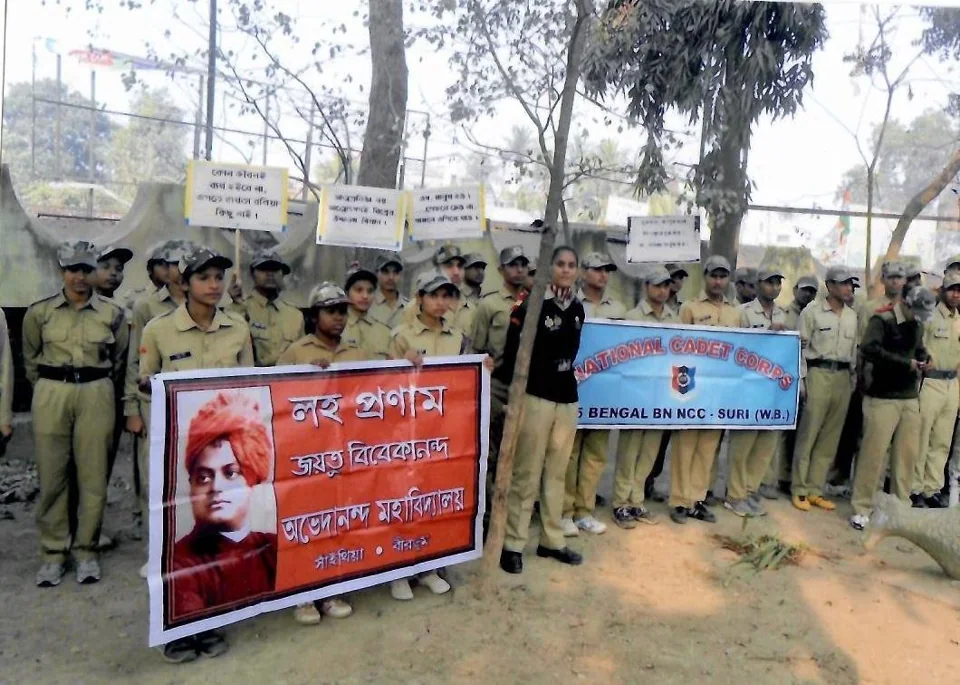
National Service Scheme and National Cadet Corps activities connect the college with the surrounding community. The NSS units document work in four adopted villages: Bhabghati, Akolpur, Akna and Pukurpara. Their account also identifies engagement in wards six and seven of Sainthia Municipality. Regular activities and special camps provide opportunities for students to participate in service beyond their academic courses.
The published record includes health surveys, tree planting, awareness rallies and community programmes. It also describes a thalassaemia detection camp organised with outside partners, local health check-ups and blood donation activities. NCC is presented as a setting for discipline, self-reliance and civic responsibility. A snake awareness exhibition during the 2015 Golden Jubilee is another documented example of public engagement, using an educational event to address misconceptions. These activities give practical expression to the college’s emphasis on inclusion and responsibility towards its locality.
Sources: NSS and NCC activities ↗