Visa
About Abeda Inamdar Senior College
An institution at Azam Campus
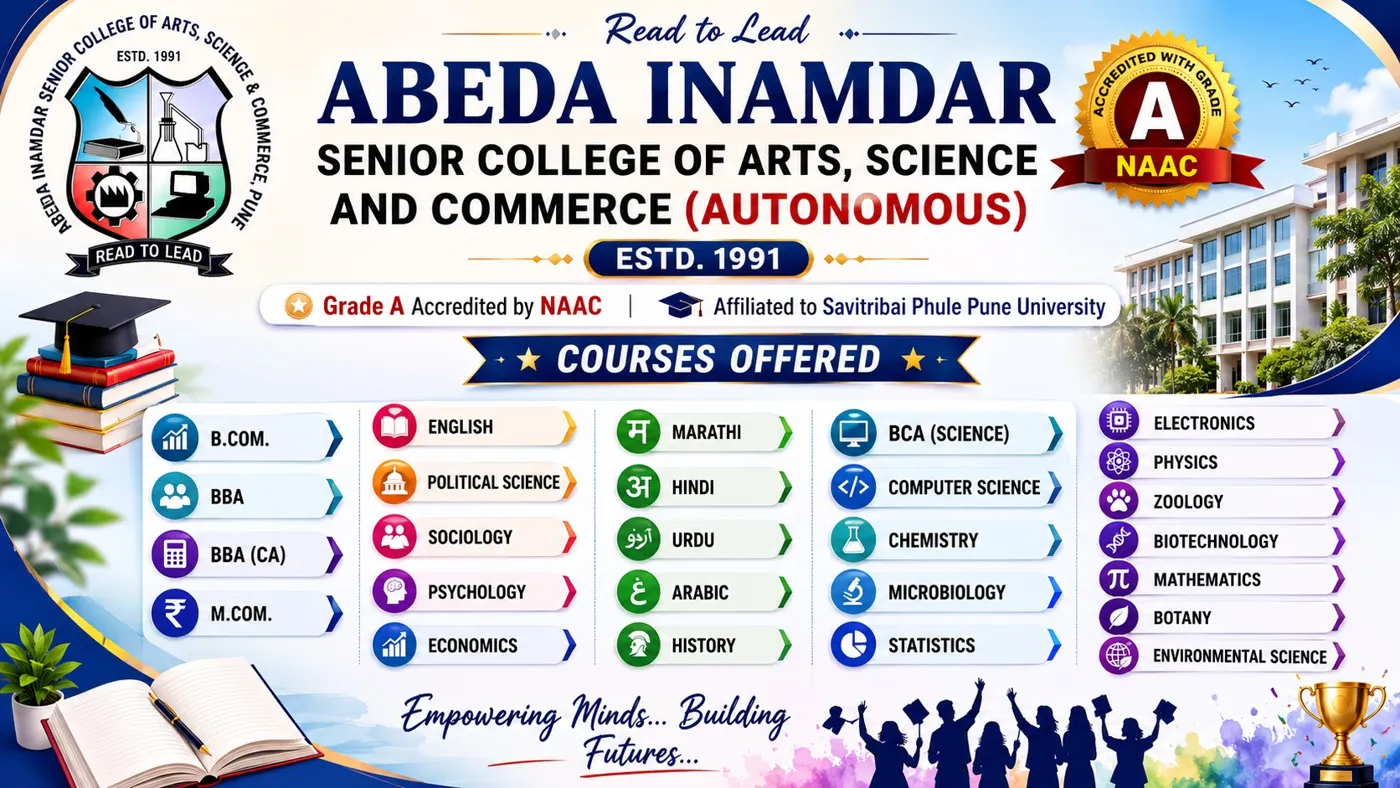
Abeda Inamdar Senior College of Arts, Science and Commerce is an autonomous college affiliated to Savitribai Phule Pune University. It is located at Azam Campus in the Camp area of Pune, Maharashtra, and is governed by the Maharashtra Cosmopolitan Education Society. The society was founded in 1948 to improve educational opportunities for economically, educationally and socially disadvantaged communities. The college carries that emphasis into higher education, with particular attention to minority students and weaker sections of society.
The college began in the academic year 1991 to 1992 with science and commerce divisions, supported by a donation from Abeda Inamdar. Arts teaching followed in 1992 to 1993, and computer science was introduced later in the decade. Its subsequent development brought postgraduate study and research alongside undergraduate education.
Sources: About the College ↗
Arts, commerce and scientific disciplines
The college's academic organisation spans three broad faculties. Its arts department directory includes English, political science, sociology, psychology, economics and history, together with Marathi, Hindi, Urdu and Arabic. This combination places the study of languages alongside subjects concerned with society, institutions and human behaviour.
The commerce faculty lists B.Com., BBA, BBA with computer applications and M.Com. Science departments include computer science, chemistry, microbiology, statistics, electronics, physics, zoology, biotechnology, mathematics, botany and environmental science. The directory also lists BCA in its science grouping. Taken together, these subjects give the institution an academic scope extending from literary and social studies to business, computing and laboratory sciences. Its undergraduate and postgraduate structure reflects the gradual expansion described in the college history rather than a single specialist institutional focus.
Sources: Faculty of Arts ↗ · Faculty of Commerce ↗ · Faculty of Science ↗
English and literary participation
The English department illustrates the relationship between classroom study and activities beyond the syllabus. Its published profile describes undergraduate teaching, postgraduate provision beginning in 2003 to 2004 and an affiliated research centre. Language learning is approached through both established teaching methods and newer approaches, with attention to students' ability to use English effectively.
The department also describes a specialist library for students and staff, postgraduate seminars and creative activities such as a book club, a talk club and Wordsmith's Nook. Its event archive records a literary festival held in January 2020, combining contests with vocabulary activities, and other sessions concerned with literature and cultural questions. These documented examples show how the department has used discussion, reading and participation to complement formal academic work.
Sources: Department of English ↗
Research and advanced study
Research is part of the college's remit as well as its taught programmes. The institution encourages staff and students at undergraduate and postgraduate levels to undertake projects that develop knowledge and new perspectives within their subjects. Departmental activity is complemented by research centres affiliated to Savitribai Phule Pune University.
The research page identifies centres in chemistry, English and commerce offering doctoral programmes. It describes their role as providing a setting for collaborative investigation and academic exchange. Conferences, seminars and interactions with industry experts and other academics are among the approaches used to introduce different viewpoints into research. This structure connects subject departments with advanced scholarship and with conversations beyond the college. It also places opportunities for research participation at several educational levels, rather than presenting inquiry solely as an activity reserved for doctoral candidates.
Buildings and learning facilities
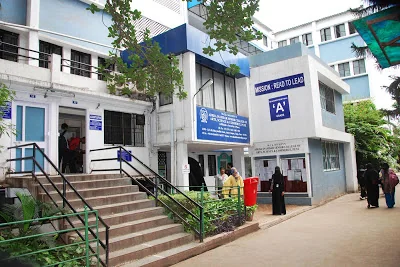
The college's infrastructure directory distinguishes its main teaching building from a postgraduate building and an electronic library building. Listed academic spaces include smart classrooms, classrooms equipped with projectors, laboratories and a chemistry laboratory with a fume hood. Seminar and assembly facilities provide additional settings for presentations, meetings and larger institutional activities.
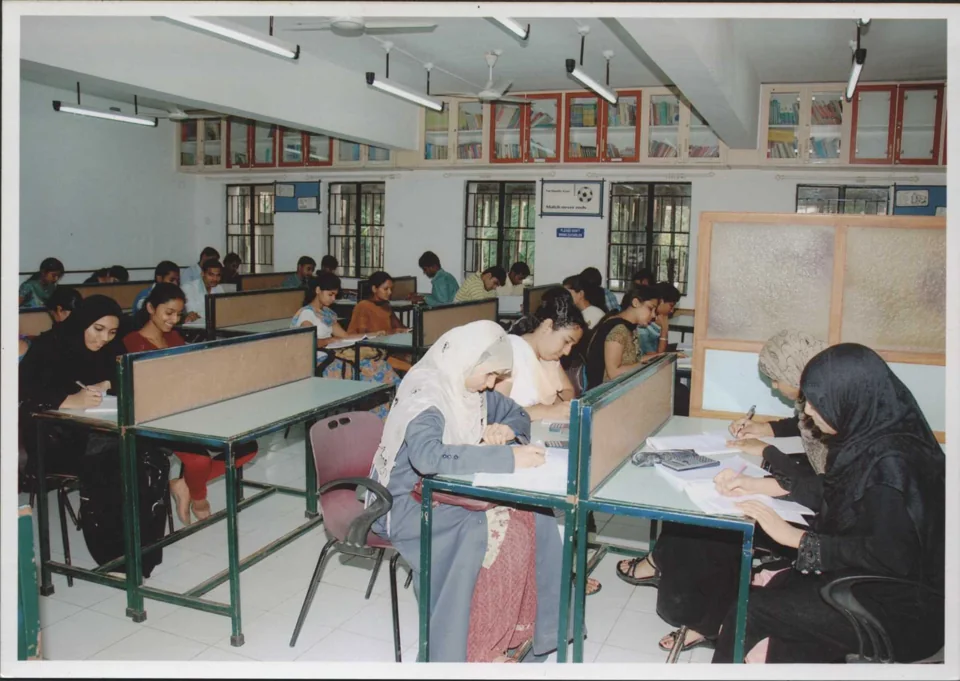
Library provision includes a digital library, a stack room and issue counter, and reading accommodation. The library page presents photographs of the issuing counter and reading rooms, and links to its own library website and institutional repository. The broader infrastructure listing also includes an electronic administration office, the A. R. Shaikh Assembly Hall and the V. M. Gani Sports Complex at Azam Campus. These facilities connect teaching and independent study with administrative, sporting and collective campus activities.
Sources: Infrastructure ↗ · Library ↗
Community service through NSS
The National Service Scheme gives students an organised route into community participation. The college describes its NSS work as a means of developing social responsibility, discipline and awareness through practical service. New volunteers receive an orientation, while activities continue across the academic year in relation to the university calendar.
A winter camp takes volunteers to an adopted village for a week of residential participation. The activities described include educational work, surveys, village cleaning, street plays and awareness rallies. The programme also incorporates workshops, talks, yoga and mental health awareness. Outside the camp, volunteers undertake blood donation, tree planting, cleanliness initiatives, visits to older people's homes and other awareness campaigns. These examples connect the college's educational objectives with responsibilities toward neighbouring communities and give students experience of collective work outside their usual classrooms.
Sources: National Service Scheme ↗
Educational values and student development
The college's stated goals extend beyond the completion of academic courses. They include developing communication and technological competence, encouraging creativity, supporting participation in sport and cultural activity, and helping students recognise civic responsibilities. Its public values emphasise respect, tolerance and a secular outlook within a community drawn from different backgrounds.
The institutional account describes science exhibitions and commerce activities as ways for students to express subject knowledge through projects and practical presentations. It also identifies computer, spoken English and communication training among its approaches to broader development. The college's emphasis on service, intellectual curiosity and research provides a common thread across these activities. Within that framework, academic study, extracurricular participation and social engagement are presented as connected parts of the educational experience.
Sources: About the College ↗