Visa

Finding your Columbus: the capital, the river and its neighbourhoods
Columbus is easier to plan as a collection of distinct areas than as one continuous sightseeing route. The Ohio Statehouse gives downtown its civic centre; the Scioto provides an outdoor counterpoint; and neighbourhoods such as the Short North and German Village reward time on their own streets. A visit can combine these with science, art and gardens, but the choice of base determines how much of your day goes into travelling between them.
This guide covers Columbus, Ohio, rather than the other US places carrying the same name. It also distinguishes the city from the wider Central Ohio destination. An attraction called Columbus may sit outside municipal boundaries, while a property using a Columbus postal address can belong to a different school or service jurisdiction. Use the exact location when planning an outing or a move.
For a first visit, choose two or three priorities and build around their operating days. Families may want a substantial COSI session; an art-focused visitor may prefer the museum and galleries; somebody evaluating relocation needs time for housing appointments and a trial commute. The VisaWand USA guide provides the national context, while the local choices below help make the stay workable.
A capital planned beside an older settlement
Columbus was founded in 1812 near the Scioto and Olentangy rivers and became Ohio’s permanent capital in 1816. The city’s community profile records that deliberate capital-city role. Across the Scioto, Franklinton has an earlier municipal story: the city’s account of Lucas Sullivant dates its layout to 1797 and its annexation to Columbus to 1870.
Those dates help explain the contrast between the government centre and the district across the river. They describe the establishment of these settlements, rather than the beginning of human history in the region. Let a visit connect the buildings with the river and surrounding communities instead of treating the Statehouse as an isolated monument.
Statehouse tours: a useful downtown starting point
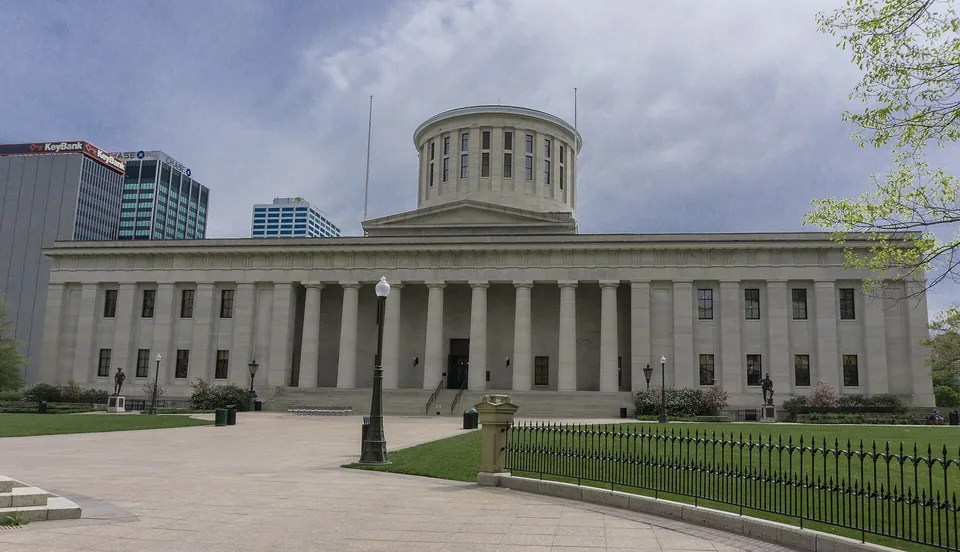
The Ohio Statehouse’s public tours are free and run on a different schedule on weekdays and weekends. Weekday departures start on the hour from 10am through 3pm; weekends have departures at noon, 1pm, 2pm and 3pm. State holidays are excluded. Allow time to reach the Map Room instead of arriving at the hour expecting the group to wait.
The Third Street entrance provides access to the tour starting area. Groups of ten or more must arrange a guide at least two weeks ahead; smaller groups can generally join a walk-in departure. Contact the tour office about specific accommodation needs, even for a small party.
On weekends the House and Senate chambers are locked and can be seen only through guided tours. That makes a tour more useful than assuming self-guided access gives the same experience. The complex remains a working seat of government, so plan around current access and security instructions. For a short trip, combine this visit with nearby downtown time rather than placing it between two distant attractions.
Museum admission that changes the family budget
At Columbus Museum of Art, the East Broad Street campus and CMA at The Pizzuti have different admission arrangements. Check the location when booking: a free offer at the main museum should not be assumed to cover the second site.
The main campus currently admits visitors aged twenty-five and under free. Its free-admission guidance also provides for one adult caregiver accompanying children aged sixteen or under per transaction. Visitors aged eighteen to twenty-five may be asked for identification. For an eligible family, this can change the cost of an afternoon substantially without requiring everybody to purchase a membership.
Sundays are free at the main museum, and Thursday admission is free from 5pm to 10pm. The museum closes on Mondays. Choose the visit around those details and the exhibitions you want to see, then check special closures. A free period is an opportunity to spend longer with the collections, rather than a reason to squeeze the museum between too many other stops.
COSI: reserve a substantial science visit
COSI, on West Broad Street, works best as a main activity rather than a quick stop squeezed into a museum circuit. Its science exhibits include areas such as Ocean, Gadgets and the Dinosaur Gallery. Decide which parts suit your group and check the date-specific hours and events calendar before making the rest of the day depend on an assumed opening time.
The current admission page distinguishes online and in-person prices. Standard adult admission, for ages thirteen and above, is listed at $30 online and $35 in person. A 5% Columbus Arts and Culture Fee is added, making those amounts $31.50 and $36.75 respectively before any optional extras. That difference is useful when budgeting, but confirm what the chosen ticket includes before purchasing.
For one adult, online standard admission plus a COTA day pass totals $36 at these published prices. Food, optional experiences and parking are additional.
The main entrance is on the west side, facing Dorrian Green. Parking is separate and rates vary with the location and other downtown events. Allow time for arrival and walking from the garage; do not treat the first available parking price as part of the museum’s admission. Use the museum’s access information if your group needs a quieter experience, a mobility arrangement or help navigating particular exhibits.
Franklin Park Conservatory during renovation
Franklin Park Conservatory and Botanical Gardens combines indoor and outdoor settings east of downtown. Its current general-admission hours are 10am to 5pm, with Thanksgiving, Christmas Eve and Christmas Day closures. After-hours special engagements have separate arrangements and should not be assumed to come with ordinary daytime tickets.
A major qualification matters for planning: the John F. Wolfe Palm House, Dorothy M. Davis Showhouse and Wolfe Terrace are closed for renovation, with reopening advertised for fall 2027. Choose the visit for the areas and exhibitions currently available. An archive picture of a greenhouse or a past butterfly exhibition cannot establish what you will see on your dates.
Current standard admission for ages thirteen to fifty-nine is $25.20 including the culture fee. Seniors aged sixty and over pay $21 including that fee. The first Sunday of each month has free daytime admission for eligible Franklin County and Columbus residents with valid identification, excluding special engagements. This is a local offer with conditions, not free admission for every visitor. Check the operator’s current rules and ticket options before finalising the plan.

North Market: food choice with the right address
North Market Downtown is a useful lunch stop when exploring the central city. Its merchant directory includes ready-to-eat food as well as specialist ingredients and treats, making it possible for a group to choose different meals without committing to one restaurant menu. Compare current prices and portions at the individual merchants rather than assuming market food is uniformly inexpensive.
Check that the listing says Downtown: the operator also has a Bridge Park location, and the directory can display merchants from both. The downtown market’s current ordinary hours are 10am to 5pm on Sundays and Mondays and 9am to 7pm Tuesday–Saturday. Individual merchants can vary those hours. A building being open does not guarantee that the stall you wanted is serving.
Use the stop to make a practical budget decision. A snack, full lunch and ingredient purchase serve different purposes; ask about preparation time if you need to reach a booked activity afterwards. Check ingredients directly where an allergy matters. For evening dining, use the current menu and reservation conditions of the establishment you choose, with tax and any disclosed service charge included in your comparison.
Seasons: plan for both summer outings and winter travel
National Weather Service normals for Columbus show how different the seasons can be. The 1991–2020 January averages are approximately 37°F for the daily high and 22°F for the low, around 3°C and minus 6°C. These are long-term averages, not a forecast or a limit on how cold a particular visit may become.
July’s corresponding averages are about 85°F and 66°F, roughly 30°C and 19°C. Summer is more comfortable for extended outdoor time than a typical winter day, but heat and rain still affect plans. Put a waterfront walk earlier in the day when the forecast is hot, and retain an indoor option for wet conditions.
Spring and autumn can suit a mix of museums and neighbourhood walking. Pack layers and use the forecast for your dates, rather than assuming a season guarantees suitable weather. In winter, allow extra time for road conditions and choose accommodation that limits repeated outdoor transfers. Someone considering relocation should also assess heating, cooling, insulation and the routine journey to work across seasons, not only during a pleasant viewing weekend.
Choosing neighbourhoods rather than collecting addresses
The Short North Arts District sits along High Street north of downtown and before the University District. Its lighted arches make the corridor recognisable, while galleries, shops and restaurants give it a different visiting rhythm from the government precinct. Set aside time to browse rather than treating every storefront as a booked attraction. Check the actual business calendar if a performance or gallery event is central to your trip.
German Village, south of downtown, offers brick homes, shops and streets, with the Brewery District to its west. It suits a slower walk and a stop around Schiller Park. The neighbourhood’s residential character is part of the experience: stay on public routes and treat homes as homes, even when their architecture is photogenic.
These are worthwhile places to spend time, but they do not represent every part of Columbus or answer where a newcomer should live. For a move, add the location of work, study and ordinary shopping to the map. A neighbourhood that works for a leisurely afternoon can still produce an awkward daily journey from a particular property.

Choosing accommodation around the purpose of the trip
Experience Columbus’s hotel directory distinguishes downtown, university-area and airport accommodation. A central hotel can simplify a museum-and-neighbourhood visit; a university-area base may be more practical for appointments on campus. For a late arrival or early flight, compare an airport hotel’s actual transfer arrangements with the cost of staying centrally. Confirm which airport the property serves.
Ask for the full payable amount rather than comparing headline room rates. Include taxes, parking, mandatory charges and any breakfast or shuttle you would otherwise buy. For a longer exploratory stay, establish the cooking and laundry facilities, cancellation terms and luggage-storage options. A photograph of a kitchen corner does not establish what equipment is provided.
Check your dates against the event that brought you to Columbus. University and sports visits, conventions and family occasions require different locations and booking priorities. If attending a particular event, use the organiser’s current venue and access information before reserving a non-refundable room. Accommodation convenience is worth assessing as part of the complete trip budget.
Airport arrival: use the airport code and the current route
John Glenn Columbus International Airport, CMH, and Rickenbacker, LCK, are distinct gateways. Confirm the airport code on the booking before choosing a transfer or nearby hotel. The airport authority’s ground-transport page gives separate information for the two locations; do not transfer directions from one terminal to the other.
For CMH ride-app pickup, the authority directs arriving passengers to level one, across the arrivals roadway to the ground-transport area, between the columns on the right. Taxis are available on the ground-transport level. Follow current signs and the operator’s pickup instructions if arrangements change, and allow time to reach the vehicle with luggage.
The airport links to COTA’s trip planner for public-transport journeys to and from the terminal. Use it for your specific arrival time and final address, including the walk after the bus. A service appearing on a map is not proof that it runs when your flight lands. Compare a workable bus journey with the complete cost of a taxi, ride app or rental car; parking and rental conditions matter after reaching the hotel too.
COTA fares and payment choices
COTA’s standard fixed-route fare is $2 with free transfers valid for two hours. A day pass is $4.50 and is valid until midnight. The published 31-day pass costs $62, while digital fare capping uses a calendar-month limit. Those periods are different: select the product against your actual stay rather than assuming all monthly arrangements last thirty-one days from purchase.
Tap to Pay, launched in January 2026, accepts eligible Visa or Mastercard cards and supported mobile wallets. Using the same payment method keeps the automatic transfer and capping calculation together. The stated caps are $4.50 per day and $62 per calendar month. Each payment type can serve only one rider at a time, so a family should arrange payment for each person instead of assuming one card can be tapped repeatedly for everybody.
The Transit app and COTA Smartcards remain alternatives. Cash users should ask the driver for a transfer pass. Check reduced-fare eligibility separately; a standard bank-card payment does not itself establish eligibility for a concession. For a late event, confirm the return service before leaving, rather than discovering the last usable connection after the programme ends.
The river and a three-day plan that leaves breathing room
Scioto Audubon Metro Park provides a green break south of downtown, with paved routes and space along the river. Its current seasonal closing time is 10pm April–September and 8pm October–March; opening is 6:30am. The operator’s map helps distinguish the park’s trail sections from the longer Scioto Greenway route. Choose a manageable walk instead of assuming every trail distance must be completed.
For day one, join a Statehouse tour and spend the remaining morning downtown. Choose the main art museum for the afternoon if its opening and admission arrangements suit, followed by one evening activity that interests your group. This is an editorial suggestion, not a claim that every programme fits the same timetable.
On day two, reserve a substantial COSI visit and leave time for the waterfront around it. Put lunch and a break into the plan rather than scheduling another major attraction immediately afterwards. Use day three for German Village and the Short North, or substitute the Conservatory if its current exhibitions are the priority. A relocation visit should replace part of this leisure schedule with a trial commute, shopping trip and prearranged housing appointments.
Moving: housing choices begin with the exact address
Before viewing homes, map where you will need to travel and at what time. A downtown job, campus appointment and shift elsewhere in the metropolitan area can lead to very different housing choices. Test the route in both directions. For a bus commute, include transfers, the walk to the stop and the final blocks; for driving, include parking and the return journey at the time you expect to travel.
Compare apartments and houses using the full recurring cost: rent, utility arrangements, parking, internet, pet charges and any required service package. Request the written terms of concessions, deposits and renewal notice. An initial promotion should not stand in for the amount the household needs to afford over time. This guide does not present a single rent figure as representative of every size, neighbourhood and lease.
The city’s Housing For All information explains several tenant-related initiatives and links to their legislation. Use the specific rule and an appropriate adviser for a lease or dispute; a policy summary is not a guarantee that every circumstance is covered. Housing assistance has eligibility and availability conditions, so it should not be treated as money assured to a newly arrived household.
Utilities, schools and setting up an ordinary week
Columbus’s utility-service guidance distinguishes owners and tenants. A tenant wishing to receive water and sewer bills needs an agreement signed with the property owner, who receives copies of the bills. Confirm how this works with the lease. Municipal electricity is available within a defined service area, not automatically at every Columbus address; establish the provider and account responsibilities for the property.
Inspect heating, cooling, windows and signs of leaks, and ask how urgent maintenance is handled. Arrange internet for the exact unit and check laundry access. Test a normal food-shopping journey, especially if living without a car. These details determine whether the chosen home works beyond its viewing-day appearance.
For children, verify the school district and address-based assignment before choosing housing around a campus. Columbus City Schools’ enrolment resources provide its school finder and contact routes; the district also handles records from outside Ohio and abroad. Programme or choice applications should be investigated separately from the ordinary assigned-school process.
Columbus Metropolitan Library cards are free for Ohio residents. Online applicants receive a digital number, but a physical card is needed to borrow physical materials; bring photo identification to a location for that step. For healthcare, establish insurance coverage, participating providers and arrangements for existing prescriptions before relying on a nearby practice. Keep these household tasks separate from the legal permission to live, work or study in the United States.
Immigration: match the route to the purpose
Columbus does not issue a city visa. US visitor rules distinguish a holiday from employment, degree study and permanent residence. A lease, university offer or employer’s interest does not itself give a visitor permission to start working or remain indefinitely.
Eligible travellers can consider the Visa Waiver Program for qualifying visits of up to ninety days, subject to ESTA and the programme’s other conditions. Verify eligibility against your circumstances, including relevant travel history; nationality alone does not settle it. Authorisation is not a guarantee of admission.
For employment, review the appropriate temporary worker category and petition requirements. For study, consult the student visa instructions alongside the institution’s process. Permanent immigration has separate pathways. Confirm current restrictions, fees and application instructions through official resources before making commitments dependent on approval. VisaWand’s consultant listings provide potential advisers to compare, with credentials, written scope and fees assessed individually.
When to look beyond the city
Dublin and Bridge Park offer another Central Ohio outing, including a separate North Market location. Experience Columbus’s Dublin information can help with planning, but Dublin is a separate municipality. A stay there should be assessed against the journeys you need to make into Columbus. VisaWand’s Dublin location page provides directory information and consultant links, rather than a completed destination guide.
For a wider destination search, use VisaWand’s USA location directory. It lists places to explore and does not imply that every entry already has a completed guide. Keep comparisons grounded in the actual location and household needs, rather than choosing a place simply because it appears in the same tourism region.
Official planning resources
Reviewed 13 October 2026. Use the official resources linked throughout this guide for admission, transport, housing and immigration decisions. Prices, services and rules can change; confirm the details relevant to your dates. Photography illustrates the locations and is not a live view.
View all official resources
- Ohio Statehouse free public tours and group conditions
- Columbus Museum of Art current admission and opening hours
- Columbus Museum of Art youth and caregiver free-admission conditions
- COSI online and in-person prices, culture fee and access
- COSI date-specific hours and events calendar
- Franklin Park Conservatory admission and renovation closures
- North Market Downtown merchant information and individual opening hours
- National Weather Service Columbus January 1991–2020 normals
- National Weather Service Columbus July 1991–2020 normals
- Experience Columbus Short North district information
- Experience Columbus German Village and Brewery District information
- Experience Columbus accommodation directory by area
- Columbus airport authority CMH and LCK ground-transport information
- COTA current fares and pass validity
- COTA bank-card and mobile-wallet payment rules
- Scioto Audubon Metro Park current hours, trails and map
- City of Columbus Housing For All initiatives and legislation
- City of Columbus owner and tenant utility service arrangements
- Columbus City Schools enrolment and school-finder resources
- Columbus Metropolitan Library membership requirements
- City of Columbus historical community profile
- City of Columbus Franklinton and Lucas Sullivant history
- Experience Columbus Dublin and Bridge Park visitor information
- Department of State visitor visa requirements
- Department of State Visa Waiver Program conditions
- Department of State temporary worker visa categories
- Department of State student visa instructions
- Department of State immigrant visa pathways
Plan the next part of your journey
Explore the United States guide, browse other cities or compare consultants for your travel and relocation questions.