Visa
Make time for the city as well as the lake
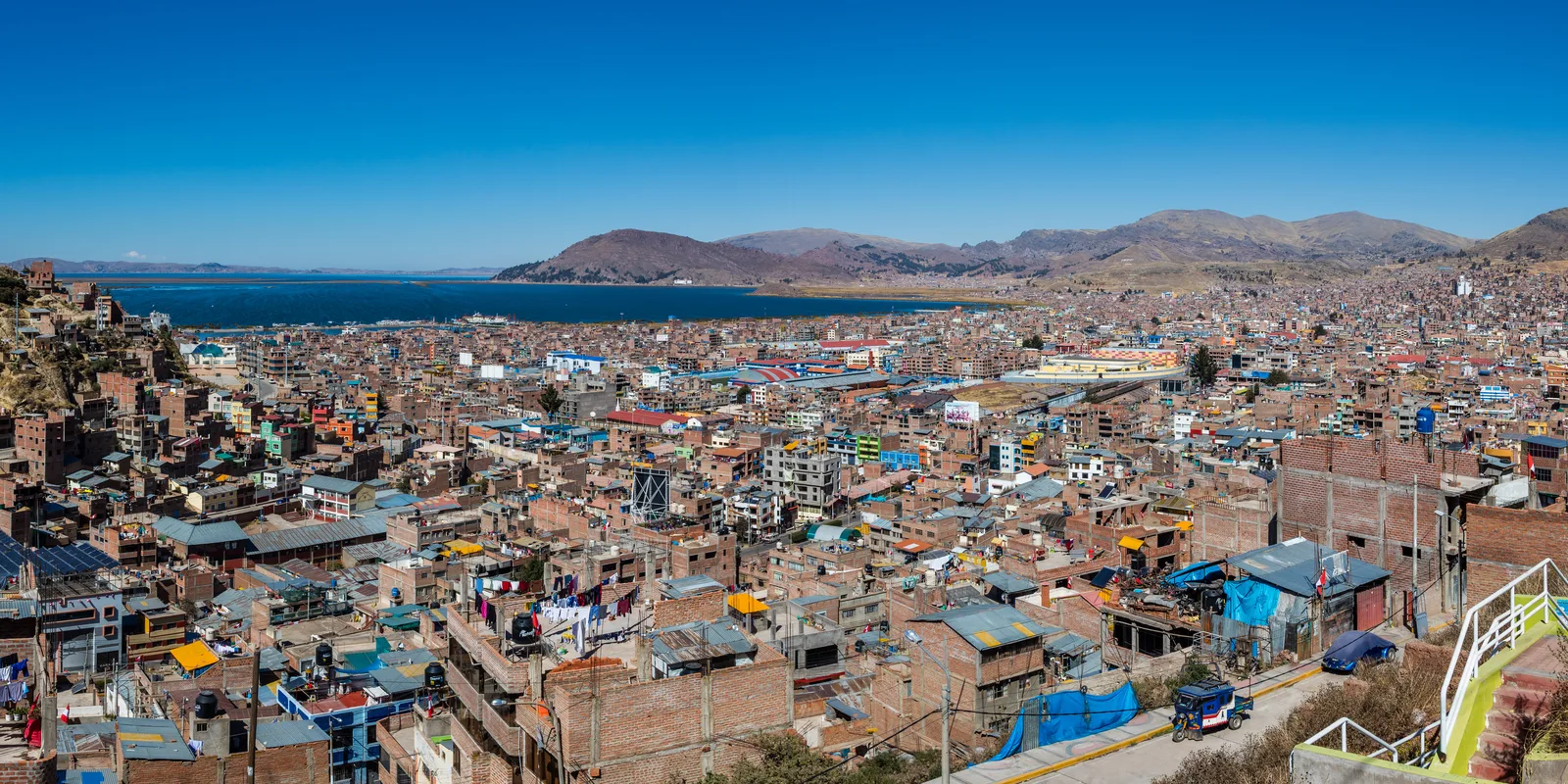
Puno rises from the western shore of Lake Titicaca, with buildings climbing the hills behind its bay. It is a working regional capital and a departure point for island visits, rather than a lakeside resort detached from ordinary life. Its appeal lies in combining the scale of the water with streets, food, religious traditions and communities whose lives extend well beyond tourism.
Choose Puno if you want to understand this part of the southern Andes and can allow time for its altitude. A hurried overnight between a bus and a boat gives the destination little chance. Begin with VisaWand’s Peru country guide, then plan the city, the islands and onward travel as connected but separate decisions. This guide concerns Puno beside Titicaca, in the Puno region, rather than another Peruvian settlement sharing its name.
Let altitude shape the itinerary
The official Lake Titicaca visitor information places the lake at approximately 3,810 metres above sea level; Puno’s streets rise above the shore. Reaching the city from Lima therefore involves a substantial change in elevation. A long bus ride is not, by itself, proof that your body has adjusted. Arrange your route and first nights with altitude in mind before filling the calendar with excursions.
The CDC’s altitude guidance recommends gradual ascent and only mild exercise during the first 48 hours at altitude, with alcohol avoided during that period. Headache with nausea, dizziness or unusual fatigue after ascent deserves attention. Do not climb higher while experiencing altitude-illness symptoms. Worsening symptoms, confusion, difficulty walking or breathlessness at rest require urgent medical help; descent may be necessary. Discuss your particular risks and any preventive medication with a qualified clinician before travel.
Read the history behind the streets
The municipality’s history of Puno describes an indigenous settlement predating the colonial reorganisation associated with 1668. That year marks an important change in the town’s administrative role and name, rather than the beginning of human life beside the bay. The surrounding lake basin connects the city with histories that cannot be reduced to one colonial foundation date.
This layered past becomes visible in the centre’s churches and public spaces. Allow a walk to raise questions about who built, used and maintained them, rather than treating the buildings as a decorative pause before a boat tour. Puno is also a place where people study, trade, worship and organise family life. An itinerary that leaves room for these everyday rhythms gives more context to the celebrated traditions of the wider region.
Walk between the cathedral and Parque Pino
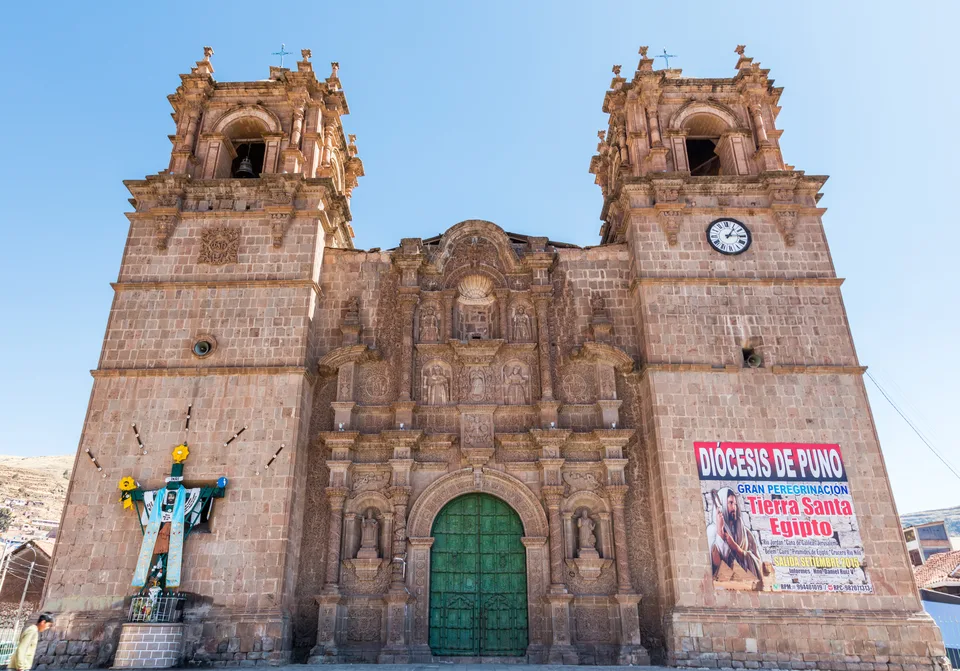
Start at Plaza Mayor and the Puno Cathedral entry in the national tourism inventory. Its stone frontage rewards close observation: the official description identifies carved Andean plant and animal motifs alongside Christian imagery. It dates the completion of the principal facade to the eighteenth century. Look slowly before heading indoors, and accommodate worship rather than assuming every open church is functioning as a museum.
Jirón Lima links this area with Parque Pino, roughly three blocks north of Plaza Mayor. The park’s western side faces the San Juan sanctuary associated with the Virgen de la Candelaria. Both the park and cathedral are listed as having free entry in the tourism inventory, although access to the church follows its religious use. This short axis makes a manageable introduction; there is no need to begin by climbing to a viewpoint.
Choose between central streets and a lake address
For a first visit, compare accommodation around the historic centre with properties along the lake. A central address makes it easier to return to the room between meals and walks. A lakeside property can offer a stronger sense of the landscape, but it may change how often you need transport. “Lake view” and “easy walk to dinner” are different advantages.
Tierra Viva Puno Plaza’s own information places it on Jirón Grau, one block from the cathedral; Casa Andina Premium Puno gives its address on Avenida Sesquicentenario beside the lake. These are examples of contrasting bases, not personal endorsements. Compare the actual room, heating arrangements, stairs, hot water and transfer costs. A comfortable first night matters more here than a long list of facilities you will barely use.
Understand what an Uros visit offers
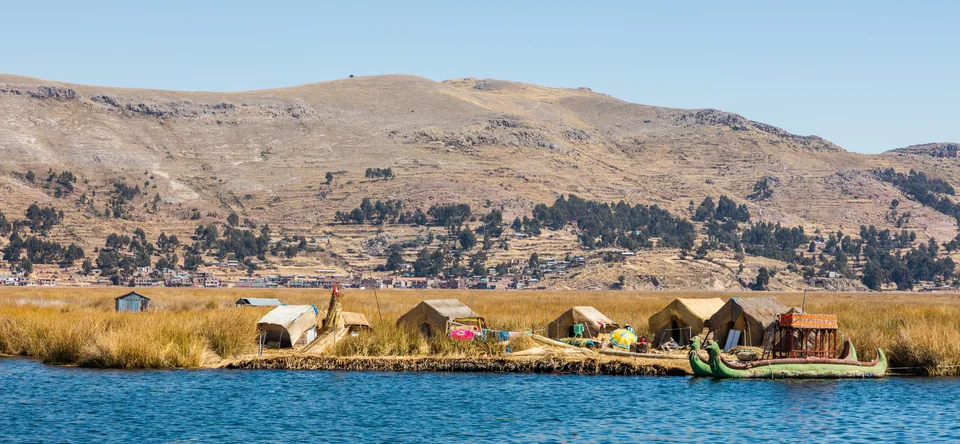
The official Uros Islands information explains the role of totora reeds in the artificial islands, boats and craftwork associated with Uro-Aymara families. An excursion can introduce the labour involved in constructing and maintaining this environment. It is also a visit to communities participating in a tourism economy, so arrive prepared to listen and ask respectful questions rather than expecting a place untouched by change.
Ask your operator which island or community will host you, how long the visit lasts and what is included. Clarify whether a reed-boat ride is optional and separately charged. Seek permission before photographing people and do not interpret an invitation to look at crafts as an obligation to buy. The nearest island outing and a full day crossing farther across the lake are substantially different commitments.
Ask what the boat day actually includes
Before booking, request a description of the whole day rather than just the island names. Useful questions include:
Where does the excursion start, and is hotel collection included? How much time is spent aboard compared with time ashore? Which meals, community payments and activities are included?
What flotation equipment and boarding assistance are provided? What happens if weather changes the route or prevents departure?
Keep your return plans realistic. An advertised finish is not the same as a protected connection to an onward bus or flight. Carry the clothing and supplies you need for time on the water in your day bag; luggage left at the accommodation will not help if the afternoon turns cold. For anyone who requires medication at a particular time, plan access throughout the journey. Choosing a shorter route can be a positive decision when it allows you to participate comfortably ashore.
Give Taquile time for its textiles
Taquile is a natural island, unlike the constructed reed islands of the Uros. Its particular distinction is textile practice: UNESCO’s account of Taquile and its textile art describes work made by men and women across generations and used in community life. Knitting and weaving carry knowledge through garments such as the chullo and patterned waistbands. The tradition was inscribed on UNESCO’s Representative List in 2008, following its earlier proclamation.
Plan for the island’s walking as well as its boat connection. Ask about the landing point, ascent, route and available alternatives if someone in your group cannot comfortably manage the terrain. When buying textiles, ask about the maker, material and technique. Their interest lies in the skill and meanings involved, not a claim that contemporary island life has stood still for centuries.
Consider an overnight on Amantaní
PROMPERÚ’s Amantaní information describes stays hosted in local homes and visits associated with farming life and the island’s ceremonial places. An overnight can provide more time than a tightly scheduled day trip, but it should be chosen for the exchange and setting rather than treated as a cheaper version of a city hotel. Household arrangements and facilities need discussing in advance.
Confirm meals, drinking water, bedding, washing facilities, charging and the next day’s departure. Tell the host or organiser about dietary or mobility needs before arrival. Pack what you need for the night in a manageable bag and establish how your larger luggage will be stored. If you become unwell at altitude, an island stay may complicate access to care; keep the option to revise plans instead of assuming every prepaid night must be used.
Visit Sillustani beside Lake Umayo
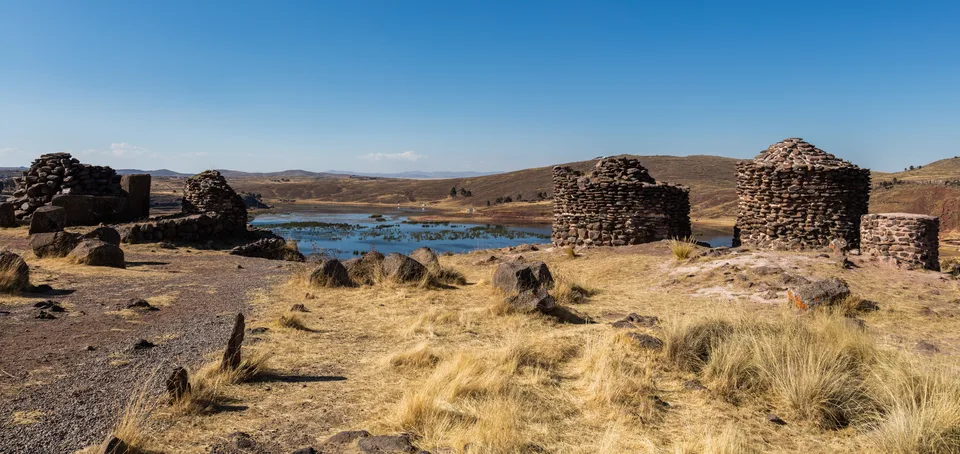
Sillustani’s official visitor information places its burial towers beside Lake Umayo, a different body of water from Titicaca. The stone chullpas give a regional excursion a clear historical focus. The setting also helps explain why the site deserves time beyond a hurried photograph: monuments, slopes and water form one landscape, rather than an isolated collection of structures.
Arrange the outing for a day when you feel comfortable walking at altitude. Ask about the route, guide, current admission and time at the site; published official pages do not provide a sufficiently consistent current tariff to quote here. If combining it with an airport journey, confirm luggage arrangements and the margin before check-in. A sightseeing stop should not turn an important flight into a race against road conditions.
Fly to Juliaca and complete the road connection
The usual airport to investigate for Puno is at Juliaca, followed by a road transfer to the city. Check the flight route and operating date directly with the airline. Puno is not the airport’s doorstep, and a quotation that ends in Juliaca is not necessarily transport to your hotel. Give the driver the full address and confirm where you will meet after baggage collection.
Aeropuertos Andinos del Perú’s passenger information explains that authorised airport taxis can be identified by the driver’s identification card and the operator’s logo. Obtain a complete quotation for your group and luggage, including any planned stop. If arriving late, confirm reception and access at the accommodation. Keep warm clothing in your hand luggage so that a delayed bag does not leave you without suitable layers for the road journey.
Compare a scenic train with a sightseeing bus
The PeruRail Titicaca service makes the Cusco–Puno journey part of the visit, with dining and an observation carriage. Its published schedules describe a journey of around ten and a half hours on selected days. It is therefore a planned long-distance experience, not a frequent local train. Check the direction, date, luggage conditions and fare before arranging accommodation around it.
For a road alternative, Inka Express’s Cusco–Puno route advertised fares from US$50 per person when checked on 21 October 2026. The sightseeing service includes a buffet lunch and guided stops; the operator lists S/53 per person in entrance fees payable separately. The price is a starting quotation, not a promise for every departure. Compare it with your own priorities: time, budget, walking at stops and whether you want an excursion rather than simply transport.
Keep local transport and disruption in the plan
Use walking for short central routes when you feel well, and arrange transport for journeys that would otherwise consume your energy. Before accepting a taxi, agree the destination and total fare. A city map does not reveal how a particular uphill approach will feel at this elevation. Ask a property to explain the last part of the journey, especially if you are carrying luggage or arriving after dark.
The FCDO’s Peru safety advice explains that protests can cause roadblocks, rail disruption and interruptions at land borders, with little notice; Puno is among the regions it discusses. This is a reason to check the current situation, not a claim that your route is closed. Keep a margin before essential connections and seek updates from the operator or free official iPeru information service.
Shop thoughtfully and budget for the whole outing
Textiles and other craftwork can be a meaningful part of a visit when you understand what you are buying. Allow time to ask about production rather than making a purchase under pressure at the end of a stop. Compare like with like: fibres, dimensions, technique and maker matter more than a broad label such as “traditional”. Keep receipts and leave room in your luggage for anything fragile or bulky.
Build your budget in Peruvian soles for local spending, while checking whether transport or accommodation is quoted in US dollars. Separate room costs, airport transfers, meals, boat excursions and admissions. A low excursion headline can exclude a community fee, lunch or the journey to the pier. Ask for the total and the payment method in advance. Leave a reserve for an extra night or changed connection rather than using every available amount on scheduled activities.
When comparing room quotations, establish whether breakfast, service charges and any applicable taxes are included. Keep the final written quotation alongside the cancellation terms so that two apparently similar bookings can be compared accurately.
Pick a season for the experience you want
The municipality’s climate account describes May–October as the period with bright days and cold nights, and November–April as the rainier part of the year. This is seasonal context, not a guarantee of dry weather on a boat trip. Pack warm layers, sun protection and rain protection together, rather than treating sunshine and cold as mutually exclusive possibilities.
February offers a different reason to visit. UNESCO’s description of the Virgen de la Candelaria festivities explains their religious, musical and dance traditions, drawing on Catholic and Andean elements and participation by Quechua and Aymara communities. Confirm the current year’s programme before booking; a previous festival’s dates do not establish the next edition. Decide whether you want to join that atmosphere or would prefer a quieter introduction to the city and lake.
For a festival visit, ask the accommodation how events affect access to its entrance and airport collections. Keep the booking address and arrival instructions available offline. If watching a procession or performance, leave clear space for participants and follow the organiser’s directions. The celebration is a community and religious occasion as well as an attraction for visitors.
Use three days as a flexible starting point
On day one, settle in and keep activity modest. If you feel well, make a short walk between Plaza Mayor, Jirón Lima and Parque Pino, returning to the room when needed. Confirm the following day’s arrangements without committing to strenuous walking. Travellers arriving directly from low altitude may need more time than this outline allows before attempting a full excursion.
On day two, choose a lake visit matched to your condition and interests: a shorter Uros outing or, when appropriate, a longer trip involving Taquile. Keep day three for Sillustani or additional time in the city. An Amantaní overnight requires reorganising the plan around two connected days and its transport. Do not try to add every island simply to make the itinerary look comprehensive; the experience depends on time ashore as much as names visited.
Test everyday life before making a move
Living in Puno demands a different assessment from enjoying its lake for a few days. Try ordinary routines before signing a long lease: shopping, laundry, reaching work or study and returning home in the evening. Compare central convenience with the access and gradients at a hillside address. A wide view can be attractive while leaving a household poorly placed for its daily needs.
Inspect warmth, ventilation, water, cooking facilities and the condition of doors and windows. Ask which bills are included, how hot water is provided and who handles repairs. Read the deposit, notice and payment terms rather than assuming they follow rules familiar from home. Indecopi’s rental precautions emphasise checking that the lessor owns the property or is authorised to let it and obtaining a clear contract. Avoid paying for a long commitment solely on the strength of photographs.
Visit at a time when you can judge the room’s temperature and noise, and ask to see the appliances working. Record the condition of the property and the inventory at handover. If your daily routine depends on an employer, university or particular clinic, compare the actual door-to-door journey from each candidate home. The most convenient holiday street may not be the best location for that routine.
Check household services and medical needs
For a longer stay, ask about water supply at the actual address and consult EMSAPUNO’s service information and notices. Establish storage and interruption arrangements without assuming an entire neighbourhood has identical service. Test internet performance where you intend to work or study, and consider how the household will manage an electricity or connection problem during an important appointment.
The regional hospital’s patient information is a starting point for investigating care, not proof that a particular specialist, medicine or insurance arrangement will be available when needed. Confirm ongoing treatment before relocating. Families should assess schooling and practical support directly, including the language and admission requirements relevant to their children. The decision should combine immigration permission, reliable income, suitable accommodation and workable services; a successful holiday demonstrates only part of that picture.
Distinguish tourism, work, study and residence
Check the Peruvian Foreign Ministry’s visa requirements for your nationality and the official tourist-visa procedure where applicable. Do not assume that a maximum mentioned online is the stay granted to every traveller. Check the permission recorded at entry, and resolve any uncertainty with Migraciones before it expires. If continuing across the lake region into Bolivia, check that country’s entry rules separately and complete the required border formalities.
Employment and long-term study need their own assessment. Use Migraciones’ procedures for resident worker status and resident study status as appropriate to your circumstances, distinguishing an application from abroad from a change of status within Peru. A rental contract does not itself authorise employment or permanent residence. Consult the relevant authority before relying on a proposed arrangement, particularly if the plan involves independent work, dependants or an extended stay.
Compare the next base before booking onward travel
The Juliaca destination page helps locate the airport city; it should not be treated as another name for Puno. Use the Cusco destination page and Arequipa destination page when comparing the wider southern Peru route. Account for the journey and changes in elevation, rather than choosing the order solely from a map. A lake excursion and a long intercity departure rarely benefit from being squeezed into the same day.
Explore the Peru destination directory for other locations and the Peru consultant listings for professional immigration support. Verify a consultant’s qualifications and written scope before paying. Puno rewards a measured plan: enough time to adjust, a considered accommodation base and a small number of well-chosen outings. Those decisions leave room for the city and its communities to become more than a transit stop beside an impressive lake.
Official planning resources
Reviewed 21 October 2026. Use the official resources linked throughout this guide for admission, transport, housing and immigration decisions. Prices, services and rules can change; confirm the details relevant to your dates. Photography illustrates the locations and is not a live view.
View all official resources
- PROMPERU: Lake Titicaca
- CDC Yellow Book2026: altitude travel and illness
- Puno municipality: local history
- MINCETUR inventory: Puno cathedral
- MINCETUR inventory: Parque Pino
- Tierra Viva Puno Plaza: location and facilities
- Casa Andina Premium Puno: lakeside accommodation
- PROMPERU: Uros reed islands
- UNESCO: Taquile and its textile art
- PROMPERU: Amantani
- PROMPERU: Sillustani burial towers
- Aeropuertos Andinos del Peru: passenger questions
- PeruRail: Titicaca train
- PeruRail: current timetables
- Inka Express: Cusco to Puno sightseeing bus
- FCDO: Peru safety and transport
- PROMPERU: free iPeru information and assistance
- Puno municipality: regional food
- PROMPERU: Puno
- Puno municipality: seasons and climate
- UNESCO: Virgen de la Candelaria in Puno
- Indecopi: precautions when renting accommodation
- EMSAPUNO: water services and notices
- Hospital Regional Manuel Nunez Butron: patient information
- Peru Foreign Ministry: visa requirements by nationality
- Peru Foreign Ministry: tourist visas
- Migraciones: resident worker status
- Migraciones: resident study status
Plan the next part of your journey
Explore the Peru guide, browse other cities or compare consultants for your travel and relocation questions.