Visa
Decide what kind of Budva trip you want
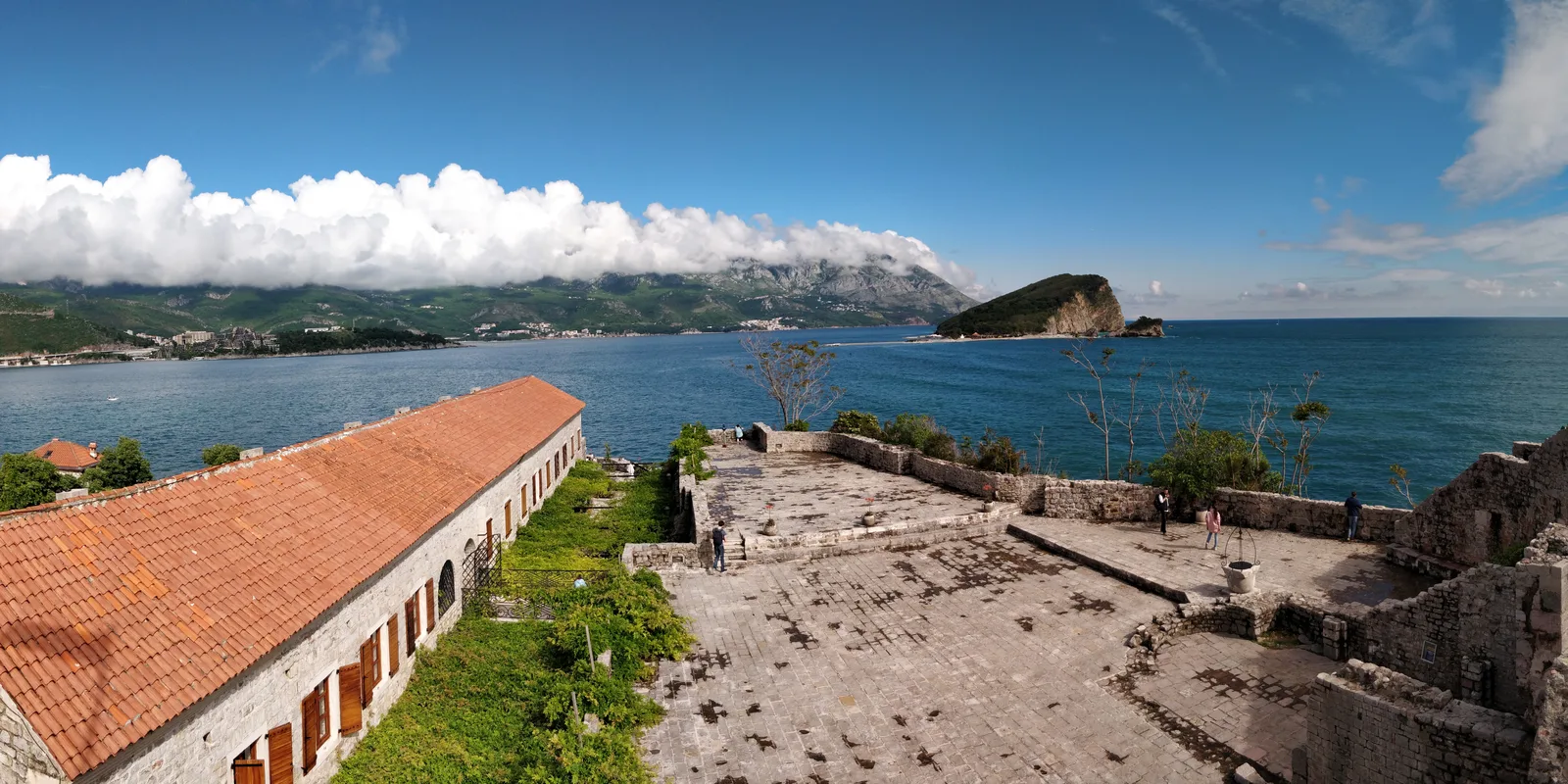
Budva brings a walled Adriatic old town, beaches and a substantial holiday resort into one compact coastal setting. You can spend a morning among stone lanes and church towers, then walk towards the waterfront for an afternoon by the sea. The important decision is which version of that experience you want: a lively summer base, a quieter cultural break, or somewhere to test everyday coastal living.
Choose dates and accommodation together. A room beside evening entertainment may suit friends travelling for nightlife, while a family with an early bedtime needs a more precise assessment of noise. A hillside apartment can have a memorable view but also a steep walk home. Neither the word “central” nor a photograph of the bay tells you enough.
Start with VisaWand’s Montenegro country guide for national planning, then use this guide to narrow the local choices. Budva rewards a stay with room for changing weather and unhurried coastal time; trying to fit the entire country around a single beach afternoon usually produces more driving than discovery.
Read the old town through its buildings
Budva’s old town is a small enclosed place of gates, lanes, churches and fortified edges. Its scale invites walking rather than a long checklist of major monuments. Look at how the stone buildings meet the walls and how quickly a shaded passage opens towards the sea. Comfortable shoes are more useful here than an ambitious schedule.
The Budva Tourism Organisation’s account of the old town records destructive earthquakes in 1667 and 1979, followed by restoration after the latter disaster. What visitors see therefore includes repair and reconstruction alongside older fabric. The founding story involving Cadmus and Harmonia belongs to legend; it should not be read as a documented account of the settlement’s beginnings.
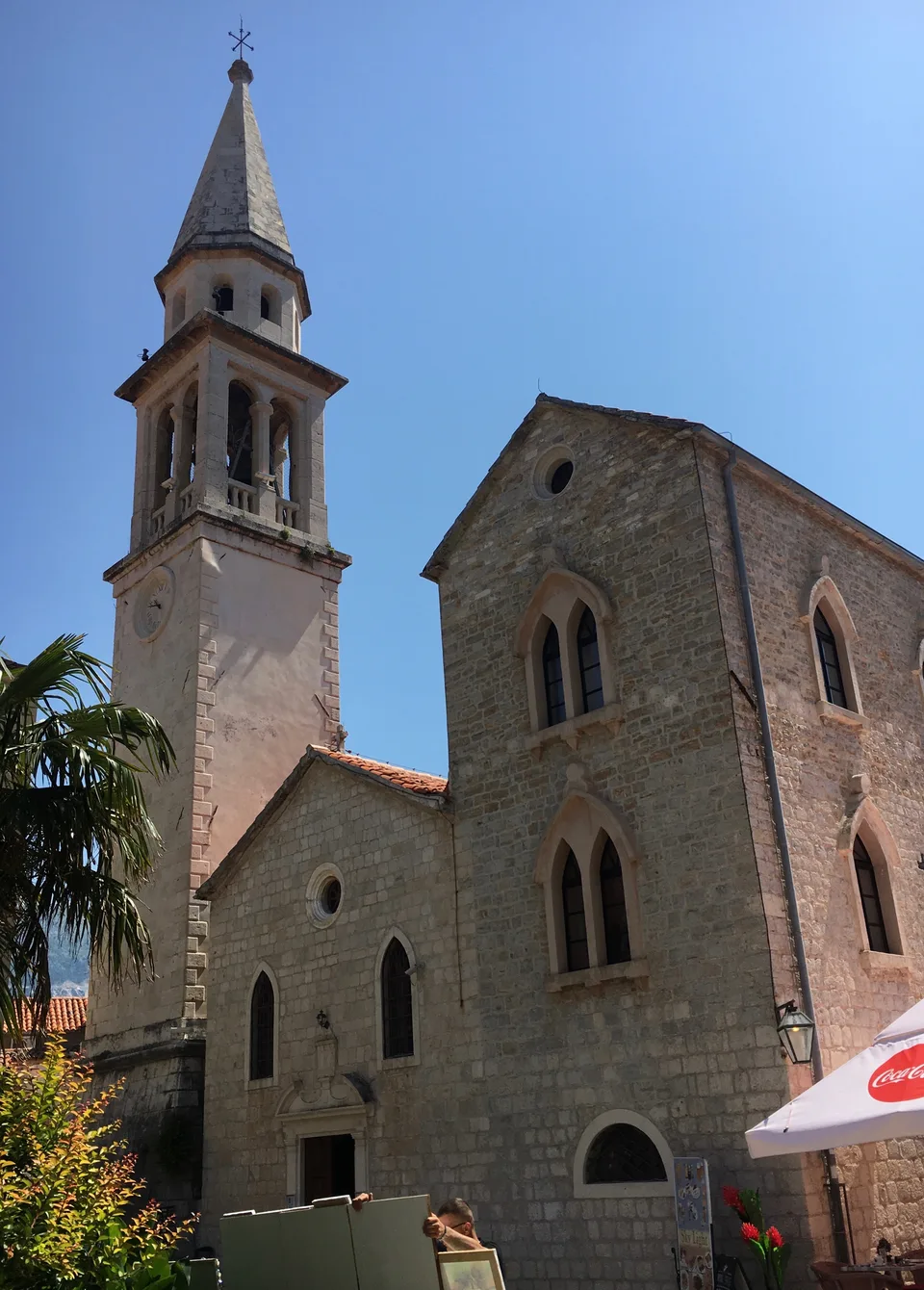
St Ivan Church and its bell tower provide a recognisable landmark, but access to individual religious interiors needs checking locally. Dress respectfully where worship takes place and do not assume that a tourist season means every door stays open. The summer Grad Teatar programme adds another reason to visit, provided your dates match an announced performance.
Use the museum to understand the coast
The City Museum’s archaeological and ethnographic collections give the old town a longer perspective. Archaeological material spans the fifth century BC to the Middle Ages, while the ethnographic collection concerns later regional life. This makes the museum a useful early stop: objects and domestic traditions add substance to the scenic waterfront.
At the time of review, the institution’s official visiting information lists adult City Museum admission at €5, with separate reduced and free categories. It lists the museum as closed on Monday, opening Tuesday to Friday from 08:00 to 22:00 and at weekends from 14:00 to 21:00. Confirm these hours for your travel dates rather than treating an undated web timetable as a seasonal guarantee.
The same institution lists free entry to the Modern Gallery and the Stefan Mitrov Ljubiša Memorial House, with different opening arrangements. They are useful alternatives when you want another indoor stop. Do not transfer the museum’s Monday closure or ticket price to every cultural venue in town.
Choose between the centre and the surrounding coast
Think of accommodation areas as different daily routines. Staying inside the old town puts historic lanes immediately outside your door, but requires checking pedestrian access, luggage handling and nearby evening activity. Just outside the walls, compare the actual walk to the entrance with the advertised distance to “Budva centre.” A short straight-line measurement can conceal steps or a road crossing.
The developed waterfront towards Slovenska Beach gives a different emphasis: promenade time and beach access rather than sleeping within the historic enclosure. Bečići and Rafailovići, farther along the coast, are alternatives when your main priority is a seaside holiday. Pržno, Sveti Stefan and Petrovac should be assessed as distinct bases, with their own transport and evening choices.
Use a map to mark your accommodation, a food shop, the intended beach and the stop you will actually use. Then ask the host about gradients and the last part of the route. This small exercise is especially valuable with a pushchair, limited mobility or a stay during hot weather.
Walk to Mogren only when conditions allow
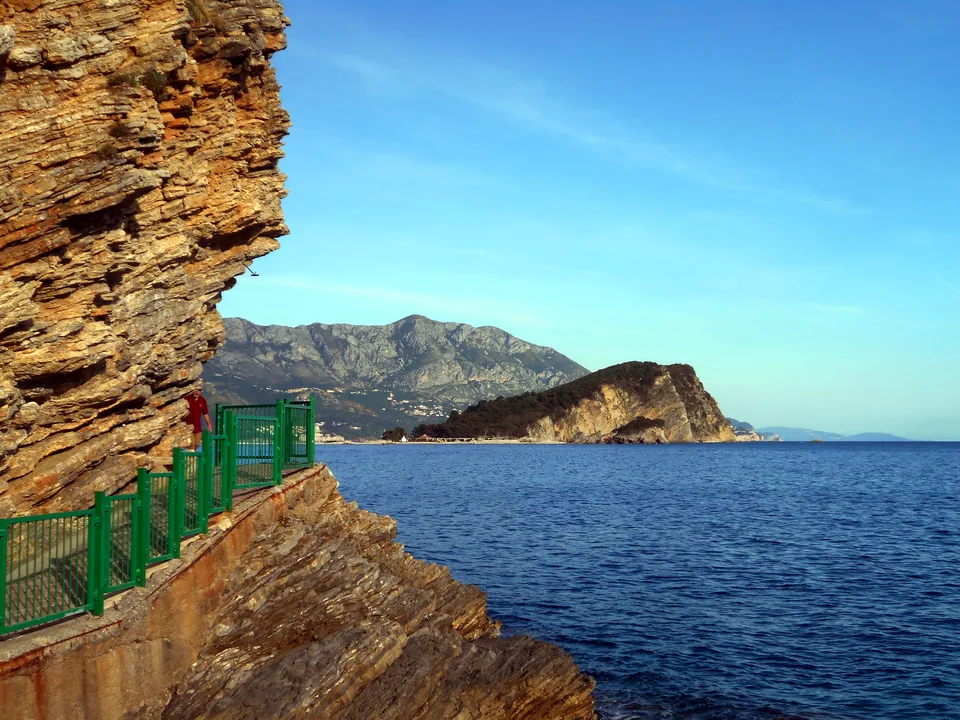
Mogren is one of the most practical excursions from the old-town end of Budva, but the approach deserves attention. The tourism organisation’s Mogren information describes two beaches connected by a tunnel and a roughly 350-metre concrete approach from the Avala area. That proximity makes it tempting to treat the walk as an automatic addition to any day.
The same source explicitly warns against the route in strong waves and southerly winds. Take that warning seriously. A narrow path beside the sea is a different proposition when water reaches the walking surface; a photograph taken on a calm day cannot establish present safety. Turn back when conditions are unsuitable and respect any closure.
For a beach visit, carry water and check the current arrangements for loungers, shade and any paid services before settling in. This guide does not promise a universal beach price or uninterrupted access to every section. If the path is unsuitable, keep the afternoon flexible rather than searching for a risky alternative around the rocks.
See Sveti Stefan without assuming island access
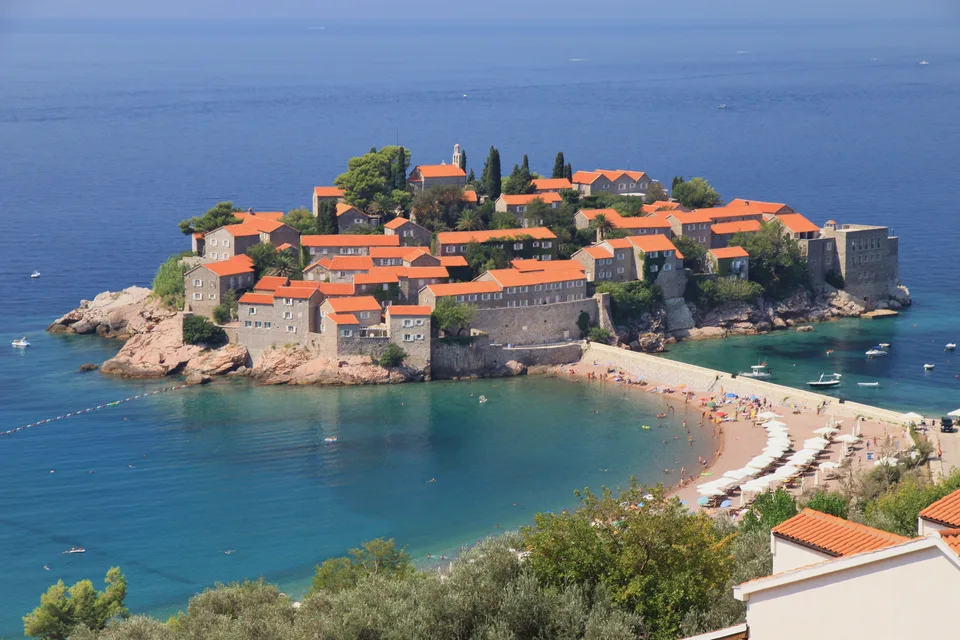
Sveti Stefan makes a worthwhile coastal outing because its tightly packed buildings and narrow connection to the mainland create a distinctive view. Budva’s tourism organisation describes a former fishing settlement adapted for hotel use in the mid-twentieth century, with the hotel opening in 1960. That history helps explain why the place functions differently from an ordinary village street.
Check Aman’s current Sveti Stefan information before arranging a visit. The operator describes the island as private accommodation with seasonal opening, while Villa Miločer operates throughout the year. This does not establish a right for casual visitors to enter the island, nor a general entitlement to use every neighbouring beach or resort facility.
Plan around an exterior view and whatever public access is confirmed on the day. Contact the operator directly for a reservation or specific access question. The local tourism background page is useful for context, but older destination descriptions and historical photographs cannot settle current admission arrangements.
Book a room that works beyond its photograph
Budva offers a choice between hotels and independently managed rooms or apartments. Compare service as carefully as space: reception availability, luggage storage, cleaning, breakfast, air conditioning and the ability to resolve a late arrival all matter. In an apartment, establish whether the kitchen is genuinely equipped for your intended meals.
Ask for the full price for your exact dates, including any visitor tax, cleaning charge, parking and deposit. A low nightly headline may be less useful than a slightly higher inclusive quote. Obtain written cancellation terms and check whether payment is taken by the property or a booking intermediary.
For a quieter stay, request a description of nearby bars, roads and current building activity, together with the room’s orientation. For accessibility, ask about the complete route from vehicle drop-off to the bed and bathroom. “Ground floor” alone does not establish step-free access. Outside the main season, confirm that the services you are paying for will operate during your stay.
If arriving after reception closes, get the key-collection instructions before travelling and save them offline. Make sure the property has your arrival estimate and a working contact method. Where parking is offered, ask whether it is reserved, whether a larger vehicle fits and whether the route to it involves a restricted street. These details can change which otherwise similar property is the better choice.
Arrive through the airport that fits your route
Tivat is the closest principal airport option for Budva. Airports of Montenegro’s access information places Budva about 21 kilometres from Tivat Airport. Treat this as orientation rather than a promised journey time: the transfer still depends on traffic, collection arrangements and the location of your accommodation.
Podgorica is another option; Budva’s official arrival information places it roughly 60 kilometres away. Compare the entire trip, including flight timing and the onward transfer, instead of assuming the nearer airport always gives the easiest arrival. Obtain a transfer quote that identifies passengers, luggage, destination and any waiting charge.
Dubrovnik Airport can also appear in flight searches, but it is in Croatia. That introduces a border crossing and separate entry or transit considerations. Check that your documents permit the whole route and allow a realistic buffer for the return flight. Budva has no railway station, so a journey using Montenegro’s rail network needs an onward road connection rather than a direct train into town.
Separate local buses from intercity journeys
Walking works well for exploring the old town and its immediate surroundings. For a trip farther along the coast, start with the Budva Tourism Organisation’s public-transport information. It identifies local services towards Sveti Stefan and Petrovac, including places such as Rafailovići and Pržno along the coastal corridor.
The local departure area described on Mediteranska Street should not be confused with the intercity bus station. Confirm the stop for your particular journey, the direction of travel and where you will board for the return. A route name alone does not establish a convenient evening service.
Published tourism timetables can remain online after operating patterns change. This guide therefore does not promise a fixed year-round frequency, last departure or fare. Ask for the current timetable and keep enough flexibility for a delayed return. If hiring a car, establish where it can legally remain overnight before booking; a vehicle is less convenient when accommodation has no usable parking arrangement.
Build a budget around your actual choices
Montenegro uses the euro, as confirmed by the national tourism organisation’s currency and payment guidance. Card payments are widely available, but carry a modest cash reserve for situations where your chosen payment method is unavailable. Read ATM charges and your own bank’s conversion terms before withdrawing money.
Separate the budget into accommodation, arrival and departure transfers, meals, local travel and optional activities. The verified €5 adult museum ticket gives one concrete cultural cost, but this guide does not invent a standard hotel rate, taxi fare or seafood bill. Those depend on your dates and the service purchased.
Keep a separate contingency for an altered departure or an unexpected transfer. For a short visit, spending slightly more on an easier arrival can be worthwhile if it preserves the afternoon you came to enjoy. Compare total costs rather than individual headline prices.
Budva’s visitor-tax and registration information describes an overnight accommodation charge and registration duties. Ask the provider to identify the applicable amount and confirm whether it is included; do not assume every advertised room price has already accounted for it. Keep the payment record. A written total for your whole party is more useful than a generic estimate assembled from unrelated seasons.
Match the season to your priorities
The national tourism organisation identifies July and August as the coast’s busiest period and suggests late spring or early autumn for a different balance of weather and visitor numbers. Use its seasonal planning information as broad guidance, rather than treating national temperature summaries as precise Budva weather forecasts.
For a summer stay, plan shaded breaks and avoid making every activity depend on walking in the hottest part of the day. A room’s cooling, shade and evening noise become practical considerations. For a cultural visit outside peak season, verify restaurant, attraction and excursion openings individually.
Sea conditions can interrupt a coastal plan even when an itinerary looks simple on a map. Keep the museum or another indoor visit available as an alternative, and check the forecast before using an exposed path. Swimming comfort and safe conditions are separate questions; neither a month on the calendar nor an appealing promotional photograph answers both.
Pack for the activities as well as the season: secure footwear for stone streets, sun protection for the waterfront and a layer for a change in conditions. Travelling with children or anyone who tires easily, identify places to stop before setting out. A shorter route with a comfortable break is often more enjoyable than completing a circuit solely because it appeared on the original plan.
Give three days a realistic shape
On day one, settle into the accommodation and explore the old town without an excursion deadline. Visit the City Museum if its opening day fits, then spend time around the church landmarks and waterfront. Choose dinner after comparing menus, leaving the evening free rather than adding a late transfer immediately after arrival.
On day two, make a coastal outing towards Sveti Stefan, with current transport and access checked first. Allow time for an exterior view and an unhurried meal. Keep any resort visit dependent on confirmed arrangements, and return before the last viable transport connection rather than building the day around an assumed late bus.
On day three, use calm conditions for Mogren or choose a slower beach and town day. If the exposed path is unsuitable, substitute the gallery and a longer meal. Travellers with only two nights should shorten this plan. Arrival and departure are substantial parts of a short stay, particularly when an airport transfer or border crossing is involved.
Test everyday housing before moving
A successful holiday apartment is not necessarily suitable for an entire year. Before committing to Budva, spend time in the area during the season in which you expect to live there. Inspect the route to food shopping, a pharmacy and any regular workplace, rather than evaluating only the view and summer beach access.
For a longer lease, clarify whether the property is available for the complete period or returns to holiday letting during summer. Record rent, deposit, notice, utilities, maintenance responsibilities and inventory in writing. Verify the owner’s authority to let it and seek independent local legal advice for an unfamiliar agreement or purchase.
Inspect cooling, winter heating, ventilation, damp, appliance condition and water arrangements. Ask to see recent utility bills and how accounts are measured and paid. No current representative rent series has been verified for this guide, so a quoted “average” would offer false precision. Compare actual properties with equivalent lease lengths, locations and included services instead.
Check commuting and essential services in person
Try a likely commute at the time you will actually make it. A short coastal distance does not establish a reliable arrival time, and a seasonal bus timetable may not suit an ongoing work or school routine. Check the return journey as carefully as the outward one, including the walk from the stop after dark.
For household planning, establish where you would obtain medical care, how prescriptions would be handled, and which insurance applies to your circumstances. The UK government’s Montenegro healthcare guidance explains a specific reciprocal arrangement for eligible British visitors involving a GHIC and an entitlement certificate. That is not a universal promise of free treatment for foreign residents or every visitor.
Check mobile and home-internet availability at the exact address, together with contract terms and any installation permission. The national tourism organisation’s practical information directory provides starting points for communications and other services. Families should contact prospective schools directly about admission, language and capacity before organising housing around an assumed place.
Keep tourism and residence permissions separate
Montenegro has its own immigration system. The government’s short-stay information describes qualifying visa and visa-exempt stays of up to 90 days within a 180-day period, but the allowance applicable to your passport and documents needs checking with the authorities. Do not assume that a Schengen visa, another residence card or an EU passport automatically settles every question.
Accommodation registration and permission to remain are separate duties. Confirm with your host who registers your stay and retain the relevant evidence. Paying a visitor charge does not extend an immigration allowance or authorise employment.
For work, consult the government’s foreign-employment information before starting an activity. Study and other longer stays need the appropriate temporary-residence category and supporting evidence. Permanent residence has separate eligibility rules; neither a holiday nor buying accommodation guarantees it. Requirements can change, so use current official instructions and, where needed, qualified advice. VisaWand’s Montenegro consultant listings can help identify advisers, whose credentials and scope you should assess independently.
Compare Budva with other bases
Budva suits travellers who want historic streets and an established beach-holiday setting together. If your priority is a different coastal environment, compare the Kotor destination page and Tivat destination page before choosing accommodation. These links help you explore alternatives; a location listing alone does not establish a complete travel itinerary.
For a wider route, use the Montenegro destination directory to identify other places and then check realistic connections. Avoid adding several towns simply because their map markers look close together. Transfer time, parking, luggage and the availability of the next service all reduce the time you actually spend exploring.
Before buying an excursion, ask for the precise stops, time spent at each, entrance charges and cancellation arrangements. A coastal panorama tour and an independent afternoon in another town are different products. If a boat trip is included, establish how weather cancellations are handled and whether the replacement arrangement is acceptable to you before paying.
Keep one clear purpose for each day: old-town history, time by the sea or an excursion. That approach leaves space for weather changes and discoveries without creating a rushed circuit. For a possible move, give ordinary errands the same attention you give the coast; those experiences will tell you more about daily suitability than another viewpoint alone.
Official planning resources
Reviewed 24 October 2026. Use the official resources linked throughout this guide for admission, transport, housing and immigration decisions. Prices, services and rules can change; confirm the details relevant to your dates. Photography illustrates the locations and is not a live view.
View all official resources
- Budva Tourism Organisation: Old Town
- Budva Tourism Organisation: City Museum collections
- Museums and Galleries of Budva: official visiting information
- Budva Tourism Organisation: Mogren Beach
- Aman Sveti Stefan: current resort information
- Budva Tourism Organisation: Sveti Stefan
- Airports of Montenegro: reaching Tivat Airport
- Budva Tourism Organisation: arrival connections
- Budva Tourism Organisation: local public transport
- Montenegro National Tourism Organisation: regional food
- Montenegro National Tourism Organisation: currency and payment
- Budva Tourism Organisation: visitor tax and registration
- Montenegro National Tourism Organisation: choosing a season
- UK foreign travel advice: healthcare in Montenegro
- Montenegro National Tourism Organisation: practical visitor information
- Government of Montenegro: short stays
- Government of Montenegro: foreign employment
- Government of Montenegro: temporary residence
- Government of Montenegro: permanent residence
Plan the next part of your journey
Explore the Montenegro guide, browse other cities or compare consultants for your travel and relocation questions.