Visa
Stay for the city as well as the warriors
Xi’an deserves more than an overnight stop on the way to the Terracotta Army. Its wall still gives the centre a legible shape, the Bell Tower anchors a busy urban crossroads, and museums connect objects with the dynasties that made the region important. Between major sights, food streets and ordinary neighbourhood life give the visit its texture. Three full days is a useful starting allocation; four makes room for a less hurried museum programme.
The location is Shaanxi’s provincial capital, on the Guanzhong Plain. Shaanxi and neighbouring Shanxi are different provinces, a distinction worth checking when booking transport or reading immigration information. Xi’an’s administrative territory also reaches far beyond the walled centre. A hotel advertised under the city name may be convenient for an airport, business district or outlying attraction while requiring substantial travel for everything else. Compare actual addresses before deciding how many nights you need.
Read the layers of the former capital
The municipal city profile identifies ancient Chang’an with present-day Xi’an and describes its long history as a capital. That inheritance spans different periods and locations. The Qin emperor’s burial complex, the Tang associations of the Giant Wild Goose Pagoda and the Ming form of the city wall should be understood as separate chapters, rather than one surviving ancient city built at a single moment.
This makes a museum-led approach especially rewarding. Objects, buildings and excavated landscapes explain different aspects of power, belief, trade and daily life. Leave room for interpretation instead of judging each visit by the scale of its photograph. Modern Xi’an surrounds and inhabits that inheritance: traffic moves around monuments, people commute across the city, and commercial streets serve residents as well as visitors. The historical setting is compelling without imagining that contemporary life has been suspended around it.
Choose between the centre, the south and an outlying base
The Bell Tower and the streets within the wall offer a clear starting point for central sightseeing. A stay here can suit visitors planning food walks, tower visits and repeated returns to the historic centre. Check the immediate street and the walking route to a station: a central location does not guarantee a quiet room or an easy crossing with luggage.
The southern city around Xiaozhai and the Giant Wild Goose Pagoda offers a different emphasis, useful when Shaanxi History Museum and the pagoda area are priorities. The museum’s visitor guide identifies nearby Xiaozhai and Dayanta metro stations, with a walk still required. A northern railway-area hotel may suit an early train, while an airport hotel serves a flight-led stay. Lintong makes sense when the mausoleum complex is the principal purpose. For a short general visit, compare those transfer costs with remaining near your other activities.
Give the Terracotta Army a proper day
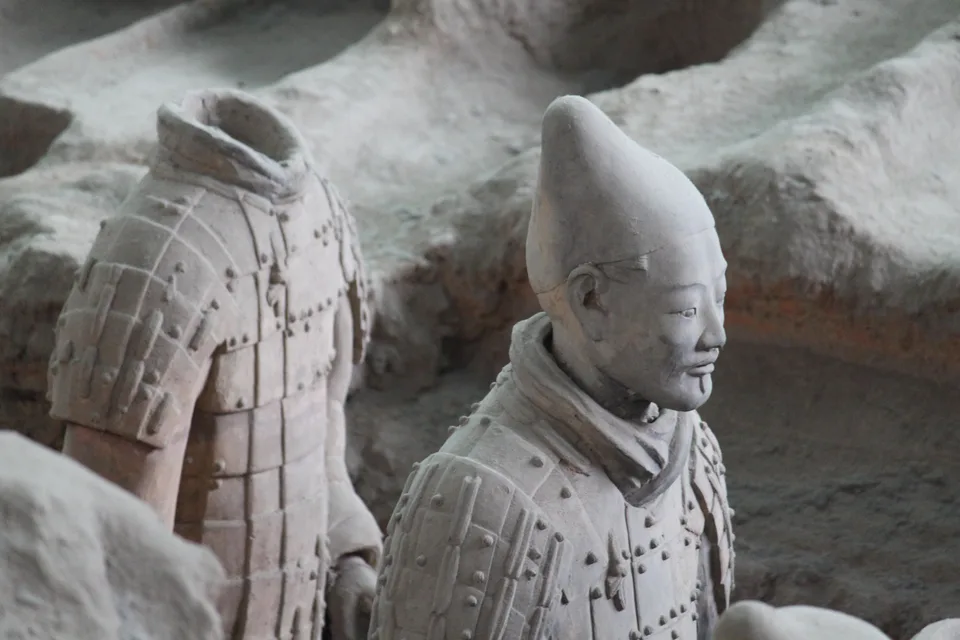
The UNESCO account of the First Qin Emperor’s mausoleum places the complex northeast of central Xi’an, at the foot of Lishan. The terracotta discoveries of 1974 revealed part of a much wider funerary landscape associated with the emperor who unified China in the third century BCE. The warriors are important as evidence of organisation, craftsmanship and imperial power, as well as an arresting visual experience.
Treat the outing as more than a quick look into one hall. Allow time to compare figures, read explanations and understand the difference between an excavated pit and a reconstructed display. A guide may help, but establish language, duration, price and the places included before paying. Families should plan a realistic walking and attention span, with breaks. Travellers needing assistance can ask the museum about its listed wheelchair service and the actual route they hope to follow; equipment availability alone does not establish complete step-free access.
Book the correct mausoleum admission
The museum’s ticket instructions list ordinary adult admission at CNY120 throughout the year. Reservations use real names and timed entry, including for overseas visitors, and the original passport must match the booking. Confirm a successful order before travelling to Lintong. Concession wording includes nationality conditions, so do not assume a general claim about free child or senior entry applies to every foreign passport holder.
The same admission covers the warriors area and Lishan Garden, with a free connecting shuttle. The bronze chariots belong to the latter part of the current visitor route. Keep enough time for both if that is your intention. The main visitor guide distinguishes last admission from closing: ordinary last-entry times change seasonally, and major holidays can have special arrangements. Use the reservation confirmation and latest notice for your date. Joining a commercial excursion should not leave the admission, transport or guide component of its price unclear.
Reserve Shaanxi History Museum before arranging the day
Shaanxi History Museum is a strong choice for putting individual monuments into a wider regional story. Its main site is at 91 Xiaozhai East Road in Yanta. The current official guide releases main-site reservations five days ahead at 5pm. Entering information in advance is not a confirmed reservation: check the successful-order record, and bring the original passport for the booked time slot.
Basic admission is free, while the Tang murals and some special exhibitions have separate tickets. The museum says it has not authorised third parties to sell or bundle its tickets. For 6 May to 14 November 2026, its main-site schedule is 8.30am to 7pm, with last checks at 6pm, subject to holiday notices. Verify the next seasonal schedule before a later visit. Cancel promptly if plans change; missed reservations can restrict future bookings. Choose a manageable selection of galleries rather than treating every display as compulsory.
Explore the wall by a chosen section
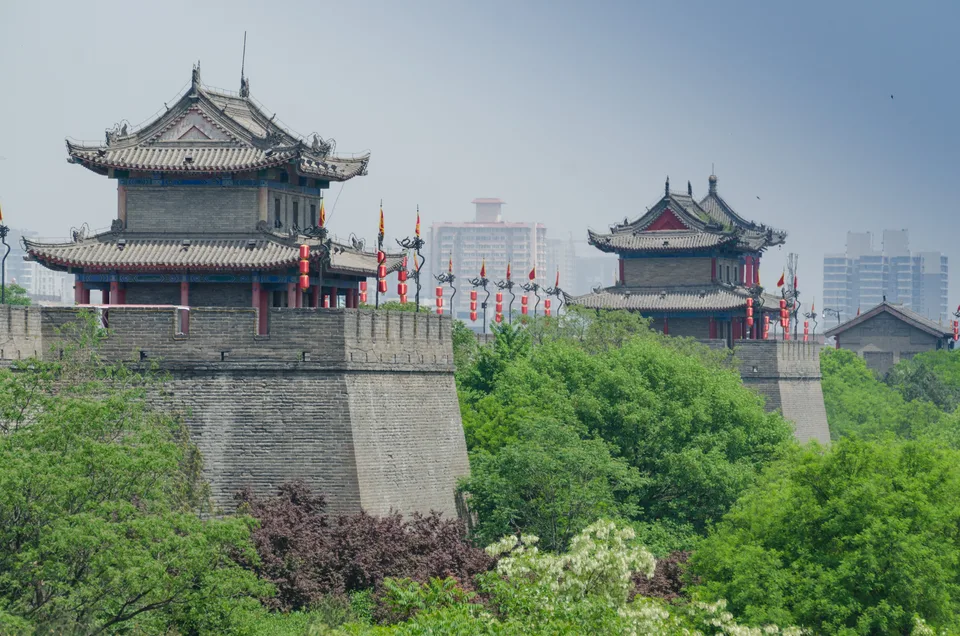
Xi’an’s present wall has its roots in the Ming period. From above, towers, brickwork, the moat and the changing city beyond give a useful sense of scale. Walking a section is enough to appreciate it; a complete circuit should be a deliberate choice based on time, weather and fitness. Cycling, where available and permitted, adds its own rental conditions and responsibilities.
The Qujiang authority’s access information identifies multiple ascent and descent points, including Yongning Gate, the South Gate, and gates on the other sides. Check which entrance and exit operate for your visit, rather than assuming every gate shares one timetable. Admission and bicycle rental are separate questions, and a residents’ annual card is not a standard tourist ticket. Ask about current prices and weather restrictions before paying. Travellers with limited mobility should confirm the precise access route instead of inferring accessibility from the broad, level-looking wall top.
Connect the pagoda with its Buddhist purpose
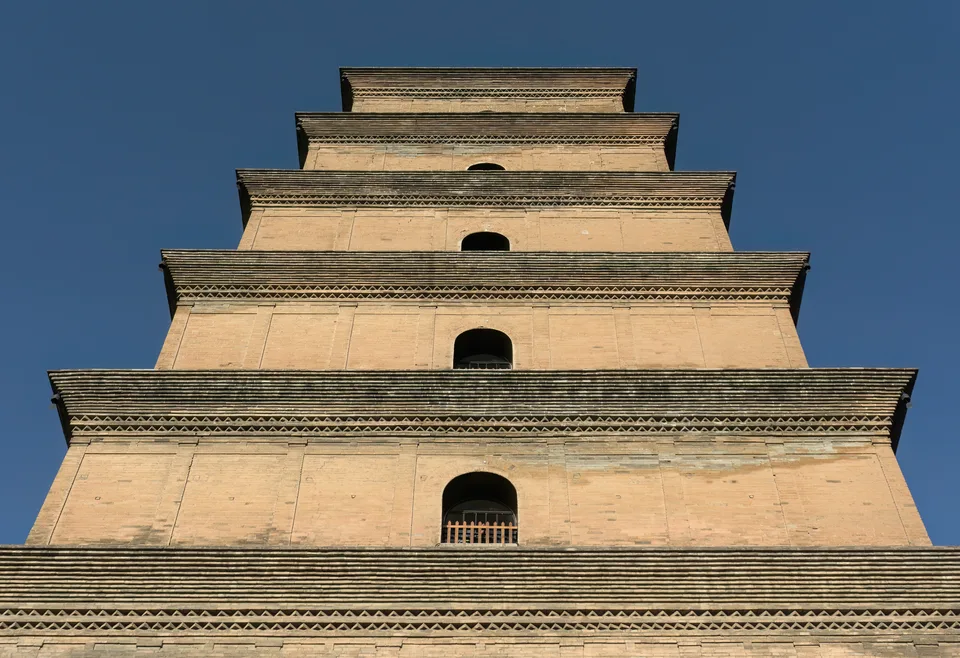
The Giant Wild Goose Pagoda stands within Da Ci’en Temple. The municipal landmarks guide connects it with the Tang period and the Buddhist scriptures brought from India by Xuanzang. That religious and scholarly function gives the building more meaning than its familiar outline alone. Distinguish public-space access from temple or pagoda entry.
Allow an unhurried visit, with appropriate behaviour around worshippers. Photography should follow signs and staff instructions; entering a religious place does not make every room or person a photographic subject. The surrounding southern-city area can be explored as a separate part of the day, with a meal nearby. Check the current programme before travelling specifically for fountains, lighting or performances. A photograph of a busy evening does not prove that the same event runs at the same hour throughout the year.
Approach the Bell Tower as a city landmark
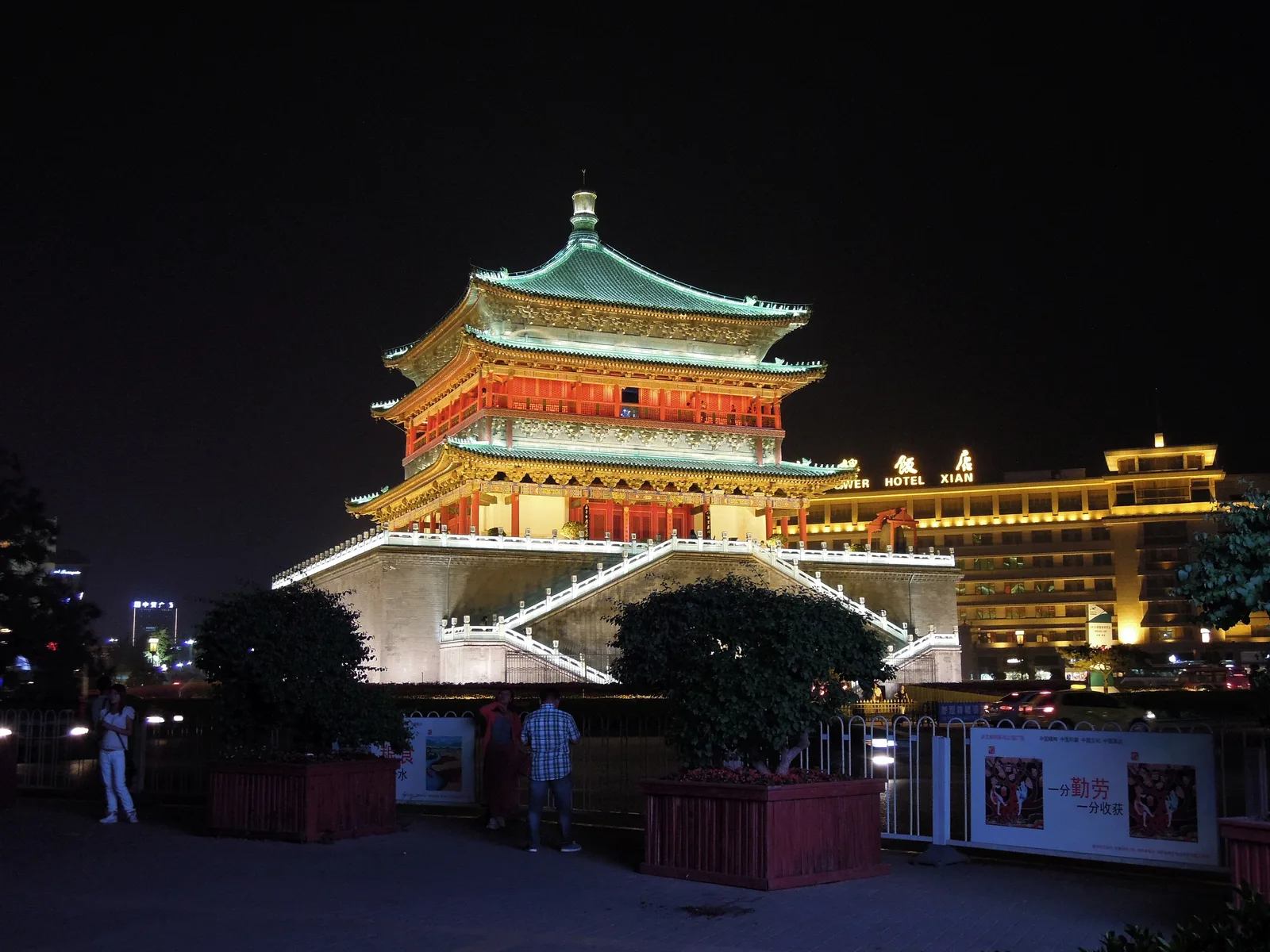
The Bell Tower is a useful point from which to understand the central city. Its illuminated exterior can make an evening walk worthwhile, while the Drum Tower and neighbouring streets offer another focus nearby. Decide whether viewing the exterior or entering the monument better fits your time and interests. Check current access and ticket arrangements before making an interior visit the fixed point of a short day.
Plan pedestrian access carefully around the busy roads. Follow the intended crossings and passageways, keeping the destination address available if you need help finding the entrance. Leave space for other pedestrians when stopping for photographs, especially in the evening. A central hotel can make it easier to return at a different time rather than waiting indefinitely for a particular light or view. Keep the return journey simple if dinner, shopping and sightseeing extend later than expected.
Eat with attention to ingredients and tradition
The Muslim Quarter is a place of Hui community life as well as a visitor destination. The city’s food account identifies paomo, bread in mutton or beef soup, beef-filled roujiamo and sweet snacks including persimmon cakes. These provide a practical introduction to a food culture that deserves more attention than a succession of novelty purchases. Choose a few things you want to understand and enjoy them without rushing between stalls.
Ask what meat, broth, sauces and garnishes a dish contains. A familiar name can cover different preparations, and a neighbourhood’s identity does not independently certify every outlet for a dietary requirement. Confirm halal arrangements, allergens or vegetarian preparation directly where these matter. Check whether prices are per portion or weight before ordering. For paomo, ask how the bread and soup are served rather than assuming every shop follows an identical process. A written dietary note can make the conversation easier.
Choose accommodation through the details that affect a stay
Compare accommodation by the journeys it supports, the actual room and the complete charge. Breakfast, cancellation, bedding, taxes and late check-in arrangements matter more than a room category’s impressive name. Check whether facilities shown in photographs are included in your booking.
Use the city’s accommodation information alongside property details when researching a stay. Ask a prospective property how foreign-guest registration will be handled and keep its exact Chinese address offline. For longer stays, establish laundry, cooking equipment, desk space and cleaning frequency. Families should confirm occupancy and beds directly. Travellers needing an accessible room should ask about the route from the street, lift dimensions and bathroom arrangement, rather than relying on a single facilities icon.
Arrive with the airport terminal confirmed
Xi’an Xianyang International Airport serves the city, with terminal arrangements that have changed since the opening of T5. Verify the terminal with the airline for each flight, including the return. Save pickup instructions and allow for the final journey inside the airport. An old hotel-transfer description may refer to a different terminal from the one on your booking.
Shaanxi Daily’s original station reporting confirms Airport T5 on Metro Line 14. Plan the full onward route, including any interchange and walk to the accommodation, and check current operating hours for your arrival. A late flight should have a workable alternative if rail has finished. Check the boarding terminal on any onward coach ticket too. For a prearranged car, agree the destination, total charge, waiting allowance and delayed-flight contact procedure. Avoid turning an average driving time into a promise about a particular day’s traffic.
Keep railway stations and local journeys distinct
Read the exact railway station on each ticket. Xi’an, Xi’an North and any other named departure point should not be treated as interchangeable. Include travel to the station, security and finding the platform when deciding whether an intercity connection is comfortable. Keep the original identity document used for the reservation available.
The 2026 government services guide explains passport-based railway booking and identity checks through China Railway’s 12306 service. For local trips, compare the metro route with the final walk rather than simply counting stops. Ask station staff about accepted payment methods; overseas-card tap access advertised in another Chinese city does not prove the same facility exists at every Xi’an gate. Save the destination in Chinese and a return route offline. If testing a future commute, repeat it at the working hour you would actually use, including any evening shift or school collection.
Put the budget around your actual bookings
Use Chinese yuan throughout a comparison. The mausoleum’s published CNY120 adult ticket and the history museum’s free basic admission give two concrete planning points, but they do not establish the cost of a whole visit. Add the room, meals, airport and railway transfers, local transport and any separate exhibitions, rentals or guides.
Set up a usable payment method before relying on it for a timed reservation. Government guidance describes linking overseas cards to payment apps, with issuer verification, fees and limits that depend on the service. Keep an alternative, including accessible cash for smaller transactions. Compare a cheaper outlying room with the total cost of reaching your activities, particularly when several people travel together. For a paid tour, identify inclusions and cancellation conditions in writing. A daily budget built from your dated bookings is more useful than an unsupported citywide average that conceals room category and group size.
Shop for provenance rather than an imitation bargain
Museum shops offer one way to look for objects connected to the history you have explored; central commercial streets provide a different shopping experience. Ask where a craft item was made and what materials it uses. A terracotta-style souvenir is a modern purchase, and its value should be assessed as such. Establish the full price and packaging before buying anything fragile or bulky.
For food gifts, check the destination’s import restrictions and the package’s ingredients and expiry date. Keep receipts for substantial purchases and clarify returns while still in the shop. Someone considering a move can use shopping time more practically: compare the groceries, household supplies and laundry services near a possible home. A famous retail area may be enjoyable for an afternoon without being the best place to furnish an apartment or buy everyday essentials. Test the neighbourhood with an ordinary shopping list and the transport you expect to use.
Choose the season with heat, cold and rain in mind
The WMO climate table for Xi’an uses 1961–1990 averages, so it is a historical reference rather than a description of every recent year. It records January average daily minima and maxima of −4.2°C and 4.8°C, and July figures of 21.6°C and 32°C. September’s mean precipitation is 108mm. Autumn should therefore not be presented as a guarantee of dry weather.
Spring and autumn can offer more comfortable conditions for extended outdoor visits than midsummer heat or winter cold. Check the current forecast, carry suitable layers and keep an indoor alternative for heavy rain. The exposed wall and open parts of the mausoleum outing deserve different preparation from a museum gallery. Around major holidays, secure reservations early and confirm special operating notices. If adding mountain destinations, check their separate forecast and physical demands rather than extending the city’s conditions to higher terrain.
A three-day plan with reservations in the right order
On day one, begin with the central landmarks around the Bell and Drum Towers, allowing time for a food walk and lunch. Choose a manageable section of the wall for later in the day if conditions suit. An evening view of the Bell Tower can fit naturally without a second journey across the city.
Give day two to the Terracotta Army and, if desired, Lishan Garden. Start from a confirmed timed booking, allow for transport and do not promise another distant attraction immediately afterwards. Use day three for Shaanxi History Museum and the Giant Wild Goose Pagoda area, with the sequence determined by your museum reservation. If that booking is unavailable, adjust the day before paying for other commitments. A fourth day provides welcome room for slower galleries or another district. Count arrival and departure realistically: a late landing and early train do not create two full sightseeing days.
Test a possible move through housing and commuting
Start with temporary accommodation and inspect homes around the actual workplace or school. Test mobile reception, broadband, room temperatures and noise at the hours you will use the property. Ask how heating and cooling work, who pays utilities and whether building charges are additional. Inspect the kitchen, laundry arrangements, water pressure and repair process rather than judging only the living-room photograph.
Read the lease with appropriate translation or independent advice before paying a deposit. Identify the authorised landlord or agent, rent schedule, inventory, notice, repair responsibilities and deposit-return conditions. Add the commute and household services to the cost comparison. An attractive advertised rent may require daily journeys that undermine its advantage. Confirm how address registration will be completed. Renting a home is one practical part of relocation; it does not establish the right to work, study or remain indefinitely in China.
Arrange registration and household services separately
The municipal accommodation-registration guidance explains that hotels register foreign guests, while people staying elsewhere must arrange registration with the local public security authorities within 24 hours. Ask the host for help and confirm the current local procedure through 12367. The national online pilot described in that notice covered specified regions; its republication on Xi’an’s website should not be read as proof that Shaanxi was included.
For a local SIM, government guidance directs foreign visitors to telecom service outlets with a passport. Compare the contract and data allowance, and test the service before leaving. Families should establish school admission, curriculum and transport before signing a long lease. Identify routine healthcare and insurance arrangements, including payment and continuing prescriptions. The official China health advice identifies 120 for an ambulance and discusses treatment and evacuation cover. Check medicine availability and import requirements before moving an ongoing course of care.
Match immigration permission to the intended activity
Tourism, paid employment, study and permanent relocation require separate consideration. Visa-free entry depends on nationality and current conditions. The UK government’s entry guidance, for example, describes a 30-day arrangement for British-citizen passport holders through 31 December 2026; it is not a universal rule. Use the Chinese embassy or consulate responsible for your application to establish the route that fits your documents and purpose.
The NIA’s August 2026 transit policy separately permits qualifying onward travellers up to 240 hours. Xi’an Xianyang Airport is an eligible port and its linked table permits travel in Shaanxi, but the route must satisfy the third-country-or-region and confirmed-ticket requirements. Employment requires the appropriate work permission; study and permanent residence have their own approval processes. Where a visa requires a residence-permit application after arrival, meet its deadline. Use VisaWand’s China guide and consultant listings to prepare questions, with official decisions controlling the outcome.
Compare further destinations with the nights available
The Qin-Han branch of Shaanxi History Museum offers a different emphasis from its main Yanta site and occupies a separate address in Xixian New Area. Its visitor arrangements differ too: the current guide allows entry with original valid identification without the main-site reservation process. Check the exact destination before travelling, and allocate it its own time rather than treating the two buildings as adjoining galleries.
For a longer trip, compare VisaWand’s Chengdu city guide and Beijing city guide with the experience you want and the connections available. The China location directory helps identify other bases, and the China destination page supports consultation searches. Plan additional nights around real travel days and verified departures. Xi’an works well as a substantial urban stay in its own right; adding another place should leave enough time to understand both, rather than turn the journey into a series of transfers.
Official planning resources
Reviewed 15 October 2026. Use the official resources linked throughout this guide for admission, transport, housing and immigration decisions. Prices, services and rules can change; confirm the details relevant to your dates. Photography illustrates the locations and is not a live view.
View all official resources
- Xi’an municipal government: city profile
- Emperor Qinshihuang’s Mausoleum Site Museum: official visitor guide
- UNESCO: Mausoleum of the First Qin Emperor
- Shaanxi History Museum: current visitor guide and booking rules
- Qujiang district: expanded Xi’an City Wall access
- Xi’an government: historical landmarks and local food
- Xi’an government: Muslim Quarter dishes and Bell Tower
- Xi’an municipal government: airport Terminal 5 opening
- Xi’an Metro: 2024 Spring Festival operating changes
- Qinshihuang Museum: admission and passport rules
- WMO: Xi’an climate averages
- Shaanxi Daily: original reporting on Airport T5 metro station
- Xi’an government: foreign visitor accommodation registration
- Chinese ministries: working and living services,2026 edition
- Xi’an municipal government: accommodation information
- NIA: visa-free transit policy,20August2026
- UK government: China health advice
- UK government: China entry requirements
Plan the next part of your journey
Explore the China guide, browse other cities or compare consultants for your travel and relocation questions.