Visa
About Arturo Prat University
A regional state university
Arturo Prat University, usually abbreviated to UNAP, is a Chilean state university based in Iquique, in the Tarapacá region. Its institutional mission encompasses technical, professional and postgraduate education. The university connects this educational role with the generation of knowledge relevant to sustainable territorial development. Its stated commitments include social mobility, cross-border integration, intercultural understanding and democratic values. Respect for human rights and engagement with Indigenous peoples also feature in this framework. The university’s vision describes the regional contribution it seeks to make, placing service to the territory at the centre of its aspirations.
Sources: Institutional mission and vision ↗
Institutional history and regional presence
UNAP marked forty years of existence in November 2024. Its anniversary reflection dates the celebration to 30 November and distinguishes the university’s own history from the earlier University of Chile presence in Iquique, established fifty-eight years before that anniversary. This gives the institution a lineage extending beyond the creation of the current university in 1984. The reflection presents education, research, innovation and engagement with surrounding communities as interconnected responsibilities of a state institution. It also discusses the university’s presence across five Chilean regions and its role in the formation of socially engaged graduates. The account describes proposed new infrastructure at Alto Hospicio and Pozo Almonte as plans, illustrating the regional expansion being considered at the time of the anniversary.
Sources: Fortieth anniversary reflection, 21 November 2024 ↗
A distributed library and archive
The Library and Archive System manages, preserves and disseminates the university’s bibliographic resources. Its remit includes information services and knowledge management for academic work and research, together with the safeguarding of institutional documents. The system connects collections in several university locations: the central Iquique campus, Huayquique and Baquedano, the Victoria campus, and the teaching and community engagement centres in Arica, Antofagasta and Santiago. This distributed organisation supports an institution whose activity extends beyond its headquarters. Library provision consequently links the preservation of resources with access across different centres, rather than being confined to a single building in Iquique.
Sources: Library and Archive System: About ↗
Access to books and shared collections
The library services distinguish between material borrowed for use outside the library and items consulted within its premises. Loan periods depend on the collection and resource format. An inter-campus service allows users to request books belonging to another library within the university’s system, connecting its geographically dispersed holdings. A separate interlibrary loan arrangement involves libraries at universities participating in agreements through Chile’s Council of Rectors. These requests depend on the availability of material and the regulations of the lending institution. Together, the services make local collections part of a wider network of academic resources. The published information explains how different forms of borrowing serve study and research across the university’s locations.
Sources: Library services ↗
Education research in local schools
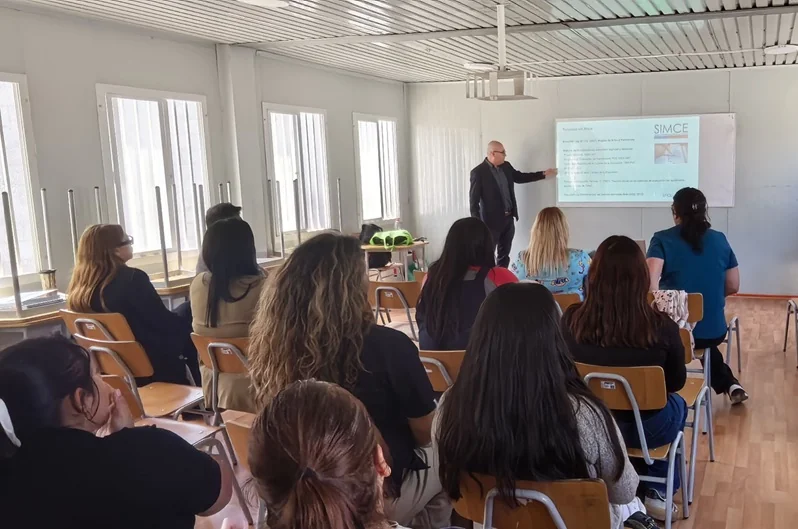
A report published on 3 November 2026 describes collaboration between UNAP and Colegio Simón Bolívar in Alto Hospicio. Patricio Rivera Olguín, a university researcher in pedagogical approaches and a member of the Spanish language and communication teacher education programme, worked with school leaders and teachers. The workshops examined regional educational evidence alongside participants’ experiences of classroom practice. Topics included absenteeism, school coexistence, learning gaps and teaching processes. Group discussion allowed teachers to compare difficulties and consider alternative approaches. The report links the activity with a workshop on teachers’ beliefs held at the same school the previous year. This continuing relationship places university research in dialogue with the professional knowledge of local educators, while bringing school perspectives into discussion of Tarapacá’s educational challenges.
Sources: Education research and Alto Hospicio schools, 3 November 2026 ↗
Research and public communication
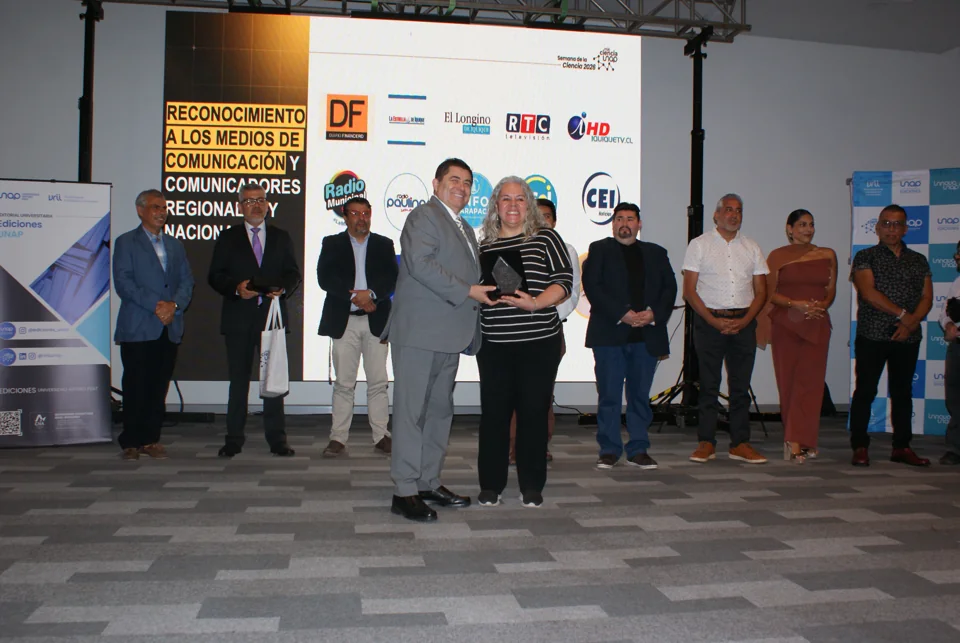
The university’s report of 2 November 2026 records the opening of its Science Week, organised through the Vice-Rectorate for Research and Innovation. The ceremony recognised researchers, students beginning scientific projects and regional media professionals involved in communicating knowledge. A public account reviewed research activity between October 2025 and October 2026. Guest speaker Carolina Gainza Cortés, a sociologist and researcher, invited reflection on the social responsibility of universities and the people for whom research is undertaken. The event also included discussion of the social purpose of investigation and the importance of explaining its contribution to wider audiences. Recognition extended to scientific communication and research in vulnerable social contexts, alongside work in other disciplines. Postgraduate students and participants in internal early research initiatives formed part of the programme. This combination presented research as an activity involving established academics, developing student investigators and relationships with the surrounding community.
Sources: Science Week report, 2 November 2026 ↗
Cooperation across South America
International engagement includes participation in CRISCOS, the Council of Rectors for the Integration of the Central-West Subregion of South America. A university report dated 3 November 2026 describes its annual assembly at the Universidad Nacional del Este in Paraguay. Representatives of institutions from Chile, Argentina, Bolivia, Paraguay, Ecuador and Peru reviewed exchange activity and discussed future cooperation. UNAP participated in the network’s administration and in coordination of collaborative research initiatives. The report identifies specialised workshops and proposed research competitions among activities being developed. Agreements signed with Universidad Iberoamericana and Universidad Autónoma de Asunción were intended to broaden academic collaboration, research and mobility. These arrangements show how the university’s regional outlook includes connections with institutions elsewhere in South America, while distinguishing planned opportunities from completed exchanges.