Visa
About Armstrong Atlantic State University
From a Savannah college to a university
Armstrong Atlantic State University is a historical name of the Savannah institution that later became Armstrong State University and consolidated with Georgia Southern University. Its origins lie in Armstrong Junior College, founded in 1935 by Savannah Mayor Thomas Gamble to widen local access to higher education. The college initially occupied the former Armstrong House near Forsyth Park, providing an option for young people unable to study away from home.
The institution moved to its southside Savannah site in 1966 after gaining four-year status and receiving land donated by the Mills B. Lane Foundation and Donald Livingston. Over the following decades it added graduate study in business and education and developed a role in health-professions education. University status in 1996 brought the Armstrong Atlantic State University name. Its later collaboration in the Liberty Center at Hinesville extended educational opportunities to military personnel, veterans and their families.
Sources: Armstrong institutional history ↗
Consolidation and present identity
Armstrong no longer operates as an independent university. The University System of Georgia's Board of Regents gave final approval to the consolidation of Armstrong State University and Georgia Southern University on 12 December 2017. Its resolution made the change effective on 1 January 2018, with the combined institution using the Georgia Southern University name.
The board described consolidation as a way to align academic offerings with regional needs, broaden programmes and direct savings toward academic work. Those statements explain the initiative's intended purpose, rather than establish measured results. The decision followed approval of the consolidation plans by the regional accrediting commission. For the Armstrong institution, the change placed its Savannah educational community within a larger university structure while retaining an identifiable campus and local history. The former university's name therefore refers to a predecessor, not an additional currently independent university.
Sources: Board of Regents final consolidation decision, 12 December 2017 ↗
The Armstrong Campus today
The successor location is Georgia Southern University's Armstrong Campus at 11935 Abercorn Street in Savannah. Its official campus description emphasises hands-on health-professions education and access to coastal research opportunities. The landscaped campus also functions as an arboretum, incorporating native and introduced plants into the setting in which students study and meet.
Campus life includes residential accommodation, dining, student organisations and recreation. Residence options include apartment-style and suite-style settings, with Windward Commons designed for first-year students. The Galley dining hall and other food outlets serve the campus. Student groups offer academic, leadership and recreational interests, while Savannah Browse brings campus departments, nonprofit agencies and local businesses together before fall classes. These are features of today's Georgia Southern campus: they describe the continuation of the Armstrong setting after consolidation, rather than the services of a separate Armstrong Atlantic administration.
Sources: Armstrong Campus in Savannah ↗
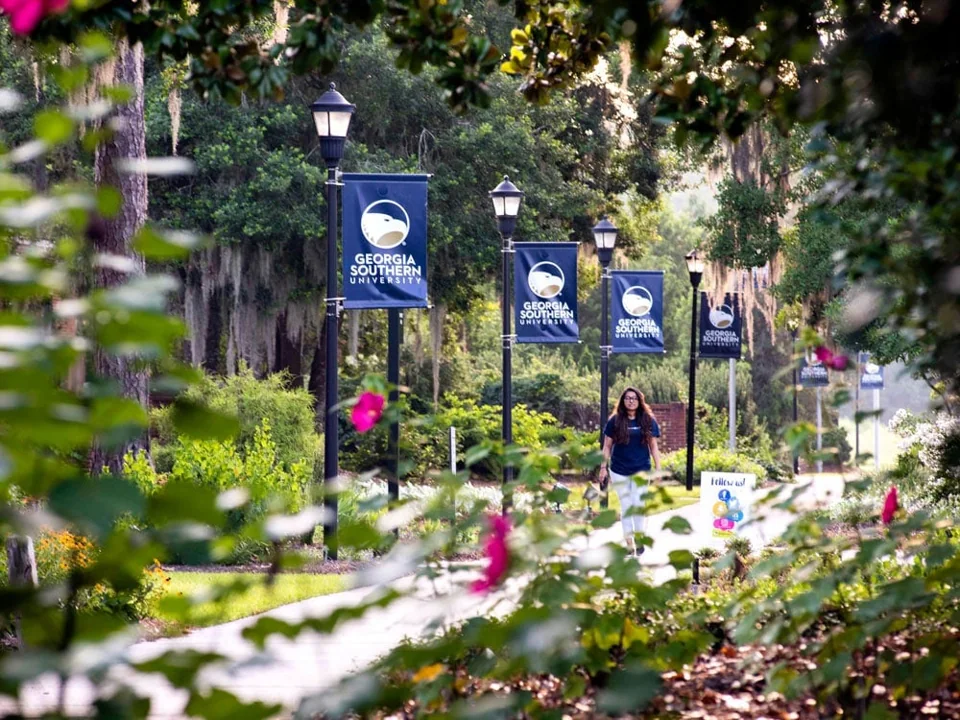
Lane Library and the Learning Commons
Lane Library remains a central academic resource on the Armstrong Campus. Georgia Southern's library description identifies print and digital collections, study areas and research assistance as parts of its work. Its special collections preserve Armstrong's history as well as material relating to Savannah's wider cultural life. The university archives and the Florence Powell Minis Room connect the library with the documentation of local people, places and institutions.
The campus also has a Learning Commons. This is described as a multidisciplinary environment for collaborative learning, with technologies available for use in the building and at home. Its student-centred services and programmes support learning and engagement. Together, the library and Learning Commons provide different settings for individual research and shared academic work. They form part of Georgia Southern's current library system while maintaining a distinctive place in Armstrong's educational community.
Sources: Georgia Southern Libraries: Lane Library and Learning Commons ↗
Remembering Armstrong’s history
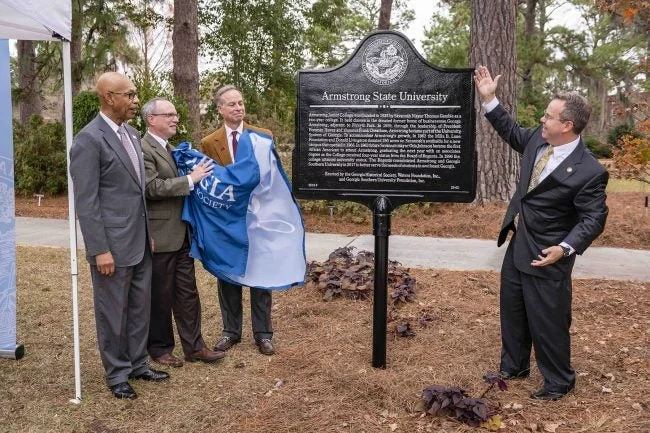
On 17 December 2019, Georgia Southern and the Georgia Historical Society dedicated a historical marker on the Savannah campus, in the quad behind Burnett Hall. The marker records Armstrong's development from a two-year college through its incorporation into Georgia Southern. It also notes the institution's entry into the University System of Georgia in 1959 and the opening of the new southside campus in 1966.
Another important part of the marker is the account of Otis Johnson, who became the first African American student to attend Armstrong in 1963 and graduated the following year. Johnson, later a mayor of Savannah, participated in the dedication. The event linked institutional history with the city's experience of desegregation and educational opportunity. The marker provides a visible reminder of the predecessor institution within the campus that carries its name.
Sources: Historical-marker dedication, 17 December 2019 ↗
Recreation and a continuing campus legacy
The Armstrong Recreation Center offers another example of how the campus has evolved since consolidation. Recreation originally operated in the Student Recreation Center, which opened in August 2007. In August 2020, the Armstrong Alumni Arena was renovated and transformed into the current recreation centre, bringing together the campus's recreation and intramural-sport activities.
Its facilities accommodate weights and exercise equipment, court sports and a game room. Programmes include fitness classes, intramural competition, club sports and Southern Adventures outings. Nearby recreation fields, tennis facilities and disc-golf space extend the available activities beyond the building. The centre also contains the Armstrong Hall of Champions exhibit, preserving a connection with earlier collegiate athletes. This combination of a historical exhibit and present-day student activity illustrates the campus's continuing identity: an Armstrong legacy within the current Georgia Southern University community.
Sources: Armstrong Recreation Center ↗