Visa


About Argentine Atlantis University
A regional university with a community mission
Universidad Atlántida Argentina presents its educational purpose in relation to the development of the surrounding region. Its mission links university study with community service, professional preparation and an environment open to different ideas. It places human dignity alongside the pursuit of knowledge, treating education as preparation for action and participation in community life.
The university’s academic organisation includes faculties of Humanities, Psychology, Engineering, Law, Economics and Architecture. This range brings social, technical and professional fields within one institution. Its mission is therefore broader than preparation for a single occupation: the university describes the formation of professionals who can contribute to the community while continuing to develop academic knowledge and thoughtful judgement.
Sources: Mission and faculties ↗
Origins and locations
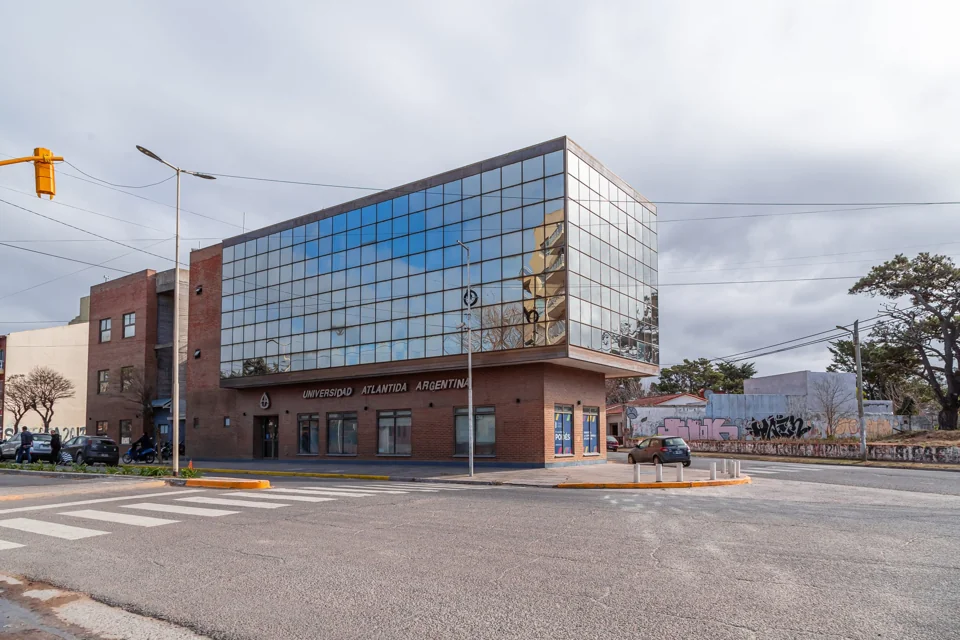
Atlántida originated as a project of the community of Partido de La Costa, brought into being through Fundación de la Atlántida Argentina. It was inaugurated in Mar de Ajó in 1995. That locality remains the university’s central location, with its principal address on Diagonal Rivadavia and an annex at Rico and Montevideo.
The university also lists premises in Mar del Plata, Dolores and the City of Buenos Aires. Mar del Plata is located on Arenales Street; Dolores has a university campus at Ingeniero Quadri and Junín; and the Buenos Aires space is on San José Street. These locations give the institution a presence across several communities rather than a single undifferentiated campus. Its location directory associates different faculty provision with particular sites, reflecting the distribution of academic activity.
Sources: Origins and locations ↗
Organising distance education
The Institute of Distance Education, known as IEAD, manages the university’s institutional distance-education system. It reports to the Rectorate and coordinates with other university areas. Its responsibilities cover the design, planning, implementation, management and evaluation of educational provision mediated through technology.
The institute separates this work into several areas. Teaching support helps faculty plan virtual classrooms, develop materials and strengthen technology-mediated teaching practices. A student area provides guidance, monitors participation and coordinates personalised academic support. Technology, innovation and support staff manage the institutional virtual campus and work with the university’s systems area on digital platforms. An extension area assists with online university-extension courses and diploma activities. These functions make distance education an institutional undertaking involving pedagogy, technical systems, student support and coordination across academic units.
Sources: Institute of Distance Education ↗
Research and the circulation of knowledge
The university’s research policy connects science, technology and innovation with regional cultural, educational, social and economic development. It includes basic, applied and experimental research, alongside the training of researchers and the transfer of knowledge beyond individual projects. Cooperation with other scientific and technological organisations is part of this framework.
The Research Secretariat promotes projects and teams involving teachers and students. It also supports scientific publications and training for faculty members undertaking research. Its postgraduate department works with academic and extension areas on the planning and management of advanced educational proposals. Other departmental responsibilities include evaluation and training, publication, and research and development. A published 2026 call for student research assistants provides an example of an organised route for student participation in this work.
Sources: Research policy and organisation ↗
Human rights as an academic field
The Institute of Human Rights was created in 2012 through a resolution of the university’s Superior Council. Its remit concerns the rights expressed in Argentina’s national constitution and international treaties. The institute approaches this field through academic work, university extension and research.
Its stated purpose includes developing activities that make human rights a foundation for cultural understanding and change. Within the university’s wider organisation, it provides a defined institutional setting for examining the principles and values associated with these rights and connecting them with educational and community-oriented activity.
Sources: Institute of Human Rights ↗
Circular economy and regional engagement
The Institute of Circular Economy examines production and consumption in relation to resource extraction, waste and energy use. Its objectives include research, discussion and training around reuse, recycling and recovery, with particular attention to turning waste into inputs for further activity. The institute also seeks to bring relevant competencies into undergraduate and postgraduate education.
Work beyond formal courses includes training for community organisations, businesses and public-sector participants. The institute’s regional emphasis is southeastern Buenos Aires Province, where it proposes adapting broader experiences to local conditions. Cooperation with public and private organisations, advice on regional problems and the transfer of knowledge are part of its stated approach. Its account relates this work to sustainability and the United Nations’ 2030 development goals.
Sources: Institute of Circular Economy ↗
Intelligent systems and applied inquiry
The Institute of Intelligent Systems focuses on research, development and innovation using computational-intelligence techniques. It began activities on 1 April 2022. Its stated purpose is to address real problems of social or institutional interest and to develop skills in applied computational intelligence.
The institute’s published account records early collaboration with engineering students’ final-project work, including discussion of possible artificial-intelligence topics. It also describes conversations across engineering and law about ethics and artificial-intelligence applications. Research recorded on the page includes the use of computational intelligence in analytical assessment rubrics for engineering subjects. These examples illustrate a combination of technical inquiry, educational applications and interdisciplinary discussion, while the institute’s wider remit includes consultation and knowledge transfer in response to regional organisations’ needs.
Sources: Institute of Intelligent Systems ↗
The distance-learning model
Atlántida’s institutional distance-education system, or SIED, is built around interaction rather than simply the distribution of reading materials. Its pedagogical model combines live technology-mediated meetings with asynchronous activities, virtual classrooms and continuing support for students and teachers. The university calls this approach expanded presence, describing different ways of maintaining educational relationships across time and distance.
Specialist teams bring together pedagogy, communication and technology. The system also includes training for teachers, researchers and extension staff, and the development and sharing of knowledge about distance education itself. It is designed to operate in dialogue with academic and management units across the university. This gives online teaching a connection with institutional planning, course design and the support structures used by the wider university.