Visa
About Archmere Academy
A college-preparatory school in Delaware
Archmere Academy is a private, Catholic, coeducational school for grades nine through twelve in Claymont, Delaware. Its campus is on Philadelphia Pike, and its work centres on preparing students for college through academic study and personal development. The school opened in 1932 and continues to identify with the Norbertine tradition.
Archmere’s introduction describes education in terms of the whole person, bringing intellectual development together with faith, social growth and service. Its account of classroom learning emphasises critical thinking, analytical reasoning and creativity across academic disciplines. Faculty attention and relationships between teachers and students form part of this approach. Although its name includes “Academy,” Archmere is a secondary school: its college-preparatory role concerns students’ preparation for subsequent higher education.
Sources: About Archmere ↗
From estate to day school
Archmere began on the former country estate of John J. Raskob and Helena Springer Green Raskob. The Norbertine Fathers purchased the property in 1932, and the school opened that September as a boarding and day school for boys. Its formal dedication followed on 12 October. The Patio and Manor buildings were adapted to educational uses as the new institution developed.
Later changes shaped both the campus and the student body. St. Norbert Hall was dedicated in 1959, and a field house opened in 1967. In 1975, boarding provision ended and Archmere became exclusively a day school. The same year brought coeducation, with young women joining the student body. A subsequent building project, completed in 1983, reorganised library, performance and other teaching spaces to support expanding programmes.
Sources: Academy history ↗
Norbertine heritage and educational values
The school maintains a relationship with the Norbertine community at Daylesford Abbey in Paoli, Pennsylvania. Its mission and heritage page presents the order’s emphasis on shared life, prayer and ministry as an influence on the school’s community. Peace, reconciliation and service are part of this account of its religious tradition.
Five named values organise Archmere’s educational outlook: community, respect, zeal, reverence and wisdom. The school relates them to responsibility towards others, recognition of individual differences, thoughtful use of talents, spiritual reflection and ethical judgement. Its intended graduate profile also emphasises independent learning, curiosity, communication and collaboration. These are stated educational aims, connecting academic work with the way students participate in local and wider communities and consider the consequences of their decisions.
Sources: Mission and heritage ↗
Academic study and teaching
Archmere’s programme combines a liberal arts approach with courses at College Preparatory, Honors and Advanced Placement levels. Its academic philosophy recognises that students may have different strengths across subjects. Progression between levels can therefore be part of an individual student’s academic development, rather than every subject being treated as an identical learning experience.
The curriculum includes English, history, mathematics, physical and life sciences, theology, world languages and cultures, computer science, music, and art and design. Teachers are described as building subject knowledge while encouraging critical thinking, curiosity and academic discipline. Their involvement also extends beyond lessons through advising, mentoring, clubs and coaching. The curriculum page places these relationships alongside formal coursework as part of a school environment concerned with students’ development as increasingly independent learners.
Sources: Curriculum ↗
Learning support and the transition to high school
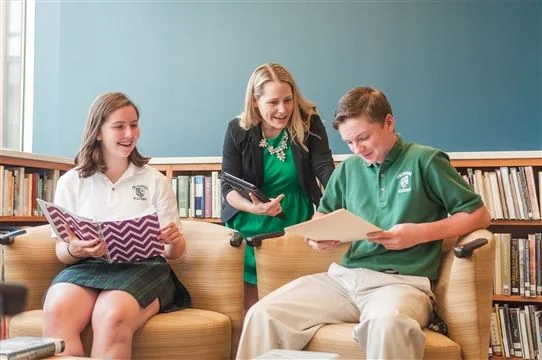
The Student Learning and Resource Center provides help with organisation, study skills and tutoring through a learning specialist. Students can use this support whether or not they have documented learning differences. The specialist also works with parents, teachers and the School Counseling Office, connecting classroom needs with support across the school.
For students with relevant documentation, Formal Education Plans set out individual academic accommodations and support arrangements. Other activities include coordination of peer tutoring with National Honor Society members, study sessions and supplemental instruction. The centre also supports teachers through resources and professional development. Summer Enrichment offers incoming ninth-grade students a two-week introduction involving English, mathematics, science and organisational skills, allowing them to become familiar with the campus, school systems and fellow students before the academic year.
Global studies through language and experience
Archmere’s Global Studies Program combines language study, coursework, participation, travel and reflection. Its five organising requirements are identified as Speak, Study, Act, Travel and Share. Students who fulfil the full set can earn a Global Studies Diploma; those meeting the other minimum requirements without international travel can earn a certificate.
Language preparation can involve Chinese, French or Spanish, while relevant coursework spans cultural, historical, religious and contemporary global topics. Participation options include hosting an international student, service activities, presentations, clubs and other approved projects. The final sharing component takes the form of a supervised capstone project or a recorded interview reflecting on what the student learned. The programme therefore connects experiences outside school with academic preparation and a structured account of personal learning.
Sources: Global Studies Program ↗
Historic buildings with continuing educational uses
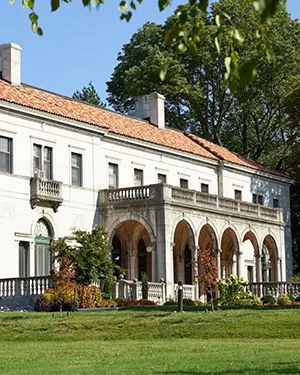
The Patio was constructed between 1916 and 1918 as the Raskob family home. When Archmere opened, the mansion became the main schoolhouse and accommodated boarding students. Its present uses include concerts, educational programmes and events, giving the historic building a role within the school’s continuing cultural life.
The neighbouring Manor originally contained the estate’s heating and electrical equipment, maintenance areas and staff rooms. It later became classroom space and subsequently a home for visual arts education. The estate’s architecture includes an arched colonnade and a covered entrance, alongside the carefully designed interiors associated with its earlier residential purpose. These buildings connect the academy’s educational history with the physical setting it inherited, while their changing uses illustrate how the campus has been adapted over time.
Sources: History of The Patio ↗